
Blog & Latest Updates
Fly Fishing Articles
Insects by Common Name


Insect Order Ephemeroptera (Mayflies)


Taxonomic Navigation -?-
Kingdom
Animalia (Animals)
» Phylum
Arthropoda (Arthropods)
» Class
Insecta (Insects)
» Order Ephemeroptera (Mayflies)


8 families aren't included.
Common Name
| Match | Common Name |
 | Mayflies |
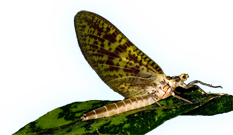
Mayflies live more than 99% of their lives as nymphs on the river or lake bottom, filling many crucial roles in freshwater ecosystems as they feed and grow. They eventually emerge from the water as winged sub-adults called "subimagos" by scientists and "duns" by anglers. Duns evolved to be good at escaping the water, with a hydrophobic surface and hardy build, but they are clumsy fliers. Within a day or two they molt one last time into "imagos" or "spinners," the mature adults, a transformation captured in this photo series of a dun molting into a spinner. They have longer legs and tails, and sleeker, more lightweight bodies, giving them the airborne speed, agility, and long grasp they need for their midair mating rituals. They are usually darker than the duns and have shinier, more transparent wings. They die within minutes or hours after mating.
Hatching Behavior
The importance of mayflies comes largely from their emergence and mating behavior. While many organisms assure the survival of their species using individualistic tools like stealth, speed, venom, or parental care, mayflies are famous instead for their "strength in numbers" approach. They coordinate their emergence and mating times (both time of year and time of day) so that they leave their safe habitats and emerge together in large numbers in a very short period of time. This can trigger feeding frenzies in every nearby insect-eater, from trout to birds to dragonflies, but there are simply so many mayflies at once that many luck out and survive to reproduce. These trout feeding frenzies are the stuff of legend among fly anglers, and they also pose one of our greatest challenges, because trout feeding feverishly on a thick hatch are often unwilling to strike any fly that doesn't properly imitate the mayfly of the hour.
The duns of each species typically emerge during an hour or two each day for a couple of weeks in the spring or summer, though there are some important fall hatching species. Some species follow more sporadic emergence strategies, and many of these combine to create a sort of "background noise" of miscellaneous mayfly activity on many trout streams throughout much of the summer. This mixed bag of mayflies provides good opportunities for anglers to catch rising trout that aren't too picky.
Mayfly nymphs emerge into duns in several different ways. Most often, the nymph swims to the water's surface and splits open its exoskeleton above the thorax (Thorax: The thorax is the middle part of an insect's body, in between the abdomen and the head, and to which the legs and wings are attached.). The dun wriggles out onto the surface, where its wings fill with fluid hydraulically and allow it to take flight. (In contrast to the common myth of mayflies needing time to "dry their wings," this process is more like inflating a raft.) Different species may be quick or slow at each stage of this process. Some take a long time to escape their nymphal shuck (
 View Full Size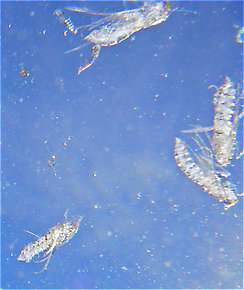
Here's an underwater view of the pupal shucks of several already-emerged Brachycentrus numerosus caddisflies.
Many important species follow completely different emergence patterns. In some, full winged duns emerge on the bottom of the stream and float to the surface. Others swim to shore and crawl out on land before emerging. Learning to identify mayflies and associate them with the right behaviors gives an angler an advantage: the ability to make a good guess about which style and stage of emergence to imitate, simply from seeing and recognizing some duns or mature nymphs.
Spinner Behavior
Once mayflies have molted into spinners (imagos), they usually gather in swarms to mate, usually over riffles. When they're done they fall dead, or spent (Spent: The wing position of many aquatic insects when they fall on the water after mating. The wings of both sides lay flat on the water. The word may be used to describe insects with their wings in that position, as well as the position itself.), on the water in an event anglers call a spinner fall. Spinner falls are usually better coordinated than emergences, because spinners gather in swarms for mating. This means some species with sporadic, unnoticed dun emergences become far more concentrated and important to anglers as spinners.
Spinner falls are also usually more predictable than emergences, because so many of them (although not all) take place at dusk, and they are preceded by visible aerial spinner swarms, which may start hours earlier at treetop level and descend gradually toward the water as night falls. Dusk spinner falls often mark the angler's best chance to see a good rise of trout each day. However, like most things in nature, mayfly spinners aren't as predictable as we'd like. Sometimes clouds of thousands of spinners will gather over a riffle in the evening and fly back into the woods as quickly as they came, never falling spent (Spent: The wing position of many aquatic insects when they fall on the water after mating. The wings of both sides lay flat on the water. The word may be used to describe insects with their wings in that position, as well as the position itself.). When that happens, anglers must swallow their disappointment and look for them to finish the job in the morning.
Mayfly females face the extra duty of laying their eggs after mating. Many species release their eggs as they fall spent (Spent: The wing position of many aquatic insects when they fall on the water after mating. The wings of both sides lay flat on the water. The word may be used to describe insects with their wings in that position, as well as the position itself.) on the water near the males after mating. Some land on the water, release a few eggs and take off again. Others fly low over the water and dip the tips of their abdomens below the surface for just a moment to release eggs. Still others drop their eggs from high in the air. In one very common genus, Baetis, the females land near shore and crawl underwater to lay their eggs in neat little rows on rocks and logs.
Nymph Biology
Mayfly nymphs or "naiads (Naiad: Naiad is the technical term for nymph used by modern entomologists.)" grow underwater for a period ranging from 3 months to 2 years, depending on the species. Like the stoneflies of Plecoptera, their development follows "incomplete" metamorphosis, meaning they do not undergo a dramatic transformation to adulthood via a pupal stage like butterflies and caddisflies (Trichoptera) do. Their changes are more gradual, at least internally. As the nymphs grow they proceed through numerous slightly different developmental stages called instars (Instar: Many invertebrates molt through dozens of progressively larger and better-developed stages as they grow. Each of these stages is known as an instar. Hard-bodied nymphs typically molt through more instars than soft-bodied larvae.), between which they molt out of their old exoskeletons and expose new ones.
- Some streamlined swimmers move like little bullets, faster then fish of the same size, and they swim upstream against strong current without a problem. Others inhabit slow water and use their speed to dart between leaves in the weed beds.
- Clingers of the family Heptageniidae are typically flat nymphs with strong legs and claws for holding on to rocks. Some have evolved further adaptations for clinging in fast water; for example, the genus Rhithrogena has gills resembling suction cups. There is great variation among the clingers and some species have adapted to slow water.
- Crawlers come in the most varied forms; they are a catch-all group for "average" families that usually excel at neither swimming nor clinging. The Hendricksons and Sulphurs of the Ephemerella genus are typical crawlers. There are tiny crawlers like Tricorythodes, and there are oddballs like Baetisca. The crawlers in Leptophlebiidae are quite good at swimming, and those in Drunella (especially Drunella doddsii) are quite good at clinging.
- The distinctive burrowers of Ephemeridae (and the less important Polymitarcyidae) are pale nocturnal creatures which use tusks to carve U-shaped burrows into the river bottom, where they live most of the time. Their long yellow bodies and feathery gray gills make them unmistakable. Their hatches are some of the angler's favorites, especially the giant Hexagenia limbata flies of the Midwest and West or the Eastern Green Drakes, Ephemera guttulata.
Entomologists have a similar system, but even their line between categories is a blurry one. Some burrowers swim well, some crawlers cling well, and some families like Leptophlebiidae and Potamanthidae straddle the boundary between categories.
If you fish a fertile stream, watch the bottom ahead of you as you walk. Sometimes, especially in April and May, you'll see lots of mayfly nymphs in front of you swimming out of your way or scurrying to the undersides of rocks. You don't need to be down on all fours with a magnifying glass to see mayfly life underwater.
Pictures of 828 Mayfly Specimens:
Baetisca obesa (Armored Mayfly) Mayfly Nymph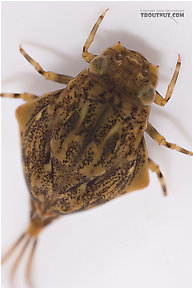 View 12 Pictures
View 12 PicturesCollected May 6, 2007 from the Neversink River (above reservoir) in New York
Added to Troutnut.com by Troutnut on May 10, 2007
Added to Troutnut.com by Troutnut on May 10, 2007
Female Ephemera guttulata (Green Drake) Mayfly Dun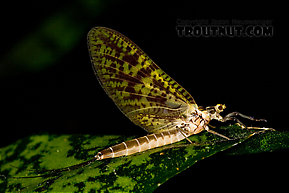 View 16 PicturesIt's about time I got a green drake on this site!
View 16 PicturesIt's about time I got a green drake on this site!Collected June 1, 2007 from the West Branch of the Delaware River in New York
Added to Troutnut.com by Troutnut on June 4, 2007
Added to Troutnut.com by Troutnut on June 4, 2007
Male Neoleptophlebia adoptiva (Blue Quill) Mayfly Dun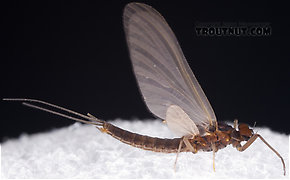 View 14 Pictures
View 14 PicturesCollected April 30, 2007 from Dresserville Creek in New York
Added to Troutnut.com by Troutnut on May 3, 2007
Added to Troutnut.com by Troutnut on May 3, 2007
67 Underwater Pictures of Mayflies:


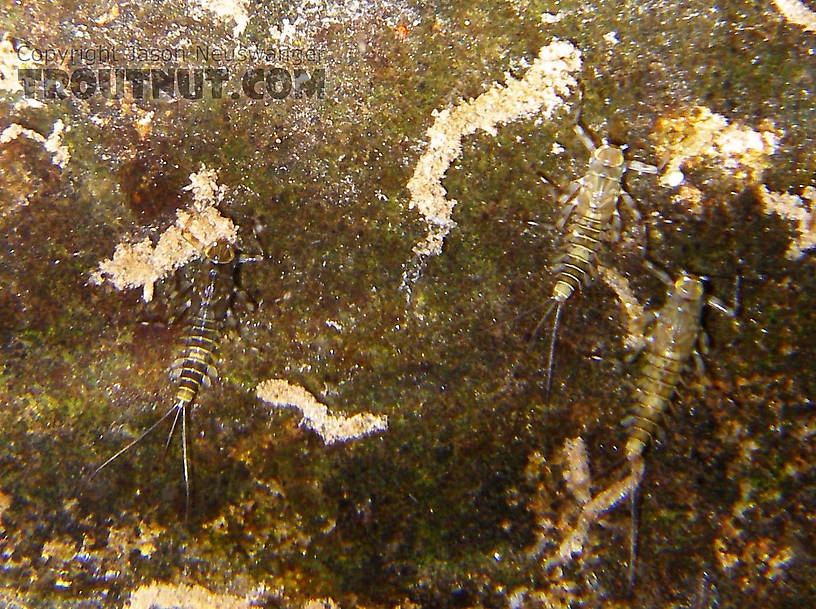
Several Baetidae nymphs line up on a rock.
In this picture: Mayfly Family Baetidae (Blue-Winged Olives).
In this picture: Mayfly Family Baetidae (Blue-Winged Olives).
StateNew York
LocationMongaup Creek
Date TakenApr 19, 2006
Date AddedApr 22, 2006
AuthorTroutnut
CameraPENTAX Optio WPi
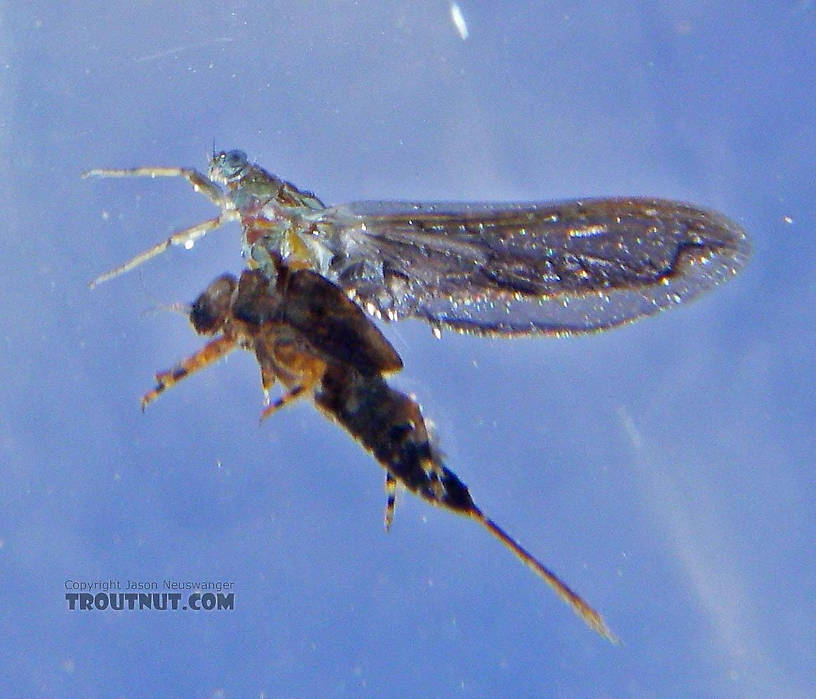
This is a close-up underwater view of a stillborn (Stillborn: In fly fishing, a stillborn insect is one which got stuck in its nymphal or pupal shuck during emergence and floats helplessly on the surface instead of flying away. It is a specific class of cripple, although it is sometimes used interchangeably with that term.) Ephemerella subvaria (Henrickson) female dun.
In this picture: Mayfly Species Ephemerella subvaria (Hendrickson).
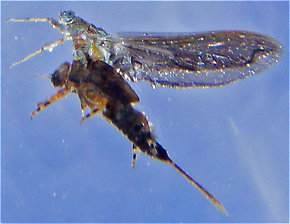
In this picture: Mayfly Species Ephemerella subvaria (Hendrickson).
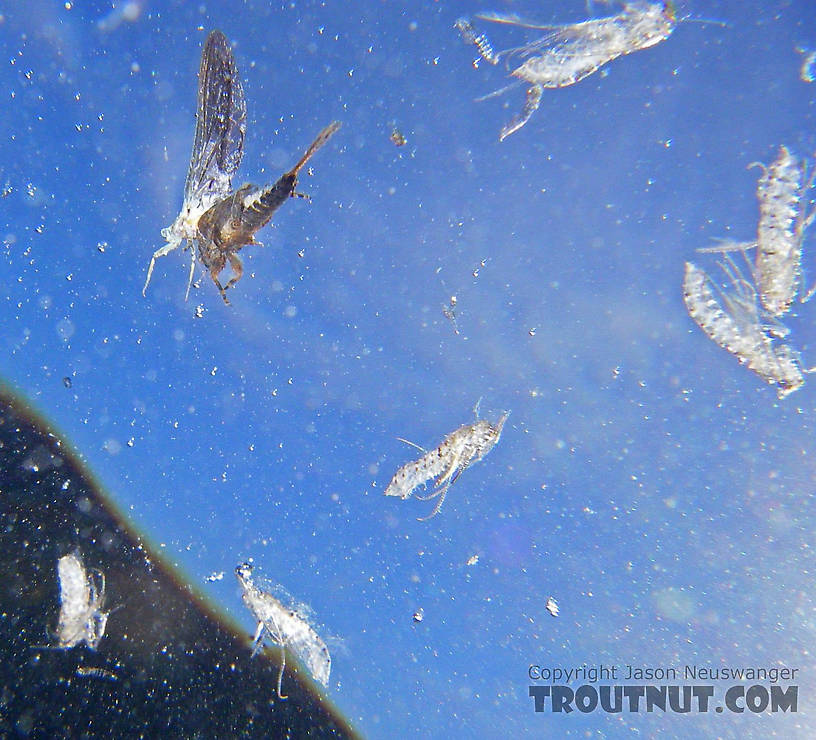
This picture from below shows a stillborn (Stillborn: In fly fishing, a stillborn insect is one which got stuck in its nymphal or pupal shuck during emergence and floats helplessly on the surface instead of flying away. It is a specific class of cripple, although it is sometimes used interchangeably with that term.) Ephemerella subvaria (Hendrickson) dun drifting on the surface amidst a number of shed pupal skins from Brachycentrus caddisflies which were heavily hatching that day.
In this picture: Mayfly Species Ephemerella subvaria (Hendrickson) and Caddisfly Species Brachycentrus appalachia (Apple Caddis).
In this picture: Mayfly Species Ephemerella subvaria (Hendrickson) and Caddisfly Species Brachycentrus appalachia (Apple Caddis).
Recent Discussions of Ephemeroptera
Missing genera (from missing list)
Latineosus, Sparbarus, Susperatus should all be included in the genera that aren't included (I think).
Andy
Replyacentrella nymph 22 Replies »Andy
Posted by Goose on Nov 3, 2006 in the genus Acentrella
Last reply on Sep 15, 2022 by Wiflyfisher
Hi Jason! Do you have a picture of the (acentrella-miniature BWO nymph) on the site? I've been fishing them and wanted a better idea of how they look.
Thanks,
Bruce
ReplyTrico nymphs and emergers 5 Replies »Thanks,
Bruce
Posted by Steamntrout on Sep 10, 2021 in the genus Tricorythodes
Last reply on Jan 4, 2022 by Partsman
Recently I decided to tie up some trico soft hackle flies, and wanted to do as I have been for a while tie up Nymphs, emergers, and drys to have a better arsenal in my offerings.
I find very little on trico nymphs, and less for emergers.
Would really like to see some photos of the actual bug with actual measurements not hook sizes.
ReplyPossible ID 2 Replies »I find very little on trico nymphs, and less for emergers.
Would really like to see some photos of the actual bug with actual measurements not hook sizes.
Posted by Sreyadig on Apr 11, 2021 in the species Apobaetis futilis
Last reply on Apr 19, 2021 by Crepuscular
In searching for nymphs in my small stream in northern Maryland, 500 yards from the PA line, I came across a 2 tailed mayfly that was not a of the Epeorus genus.
It was in a fast riffle section along with Epeorus nymphs. This was about 3/8” in overall length including tails. Darker straw coloration with dark brownish black wing cases that were pronounced in color and shape. Biggest factor was the tails. Median caudal filament was truncated, very small compared to the outer pair. Not even sure if tail/ caudal filament should be used to describe. In my books the closest thing is the Pseudocloeon futile. Which is an old taxonomic name I’m finding out.
This find seems rare in my area and experience. Hopefully I can get a photo...
ReplyHexagenia orlando 5 Replies »It was in a fast riffle section along with Epeorus nymphs. This was about 3/8” in overall length including tails. Darker straw coloration with dark brownish black wing cases that were pronounced in color and shape. Biggest factor was the tails. Median caudal filament was truncated, very small compared to the outer pair. Not even sure if tail/ caudal filament should be used to describe. In my books the closest thing is the Pseudocloeon futile. Which is an old taxonomic name I’m finding out.
This find seems rare in my area and experience. Hopefully I can get a photo...
Last reply on Nov 20, 2020 by SALTYQUILL
Does anyone have any hatch dates for hexagenia orlando in the Central Florida area? Several lakes near me have populations and I am gathering data. I have photos and one hatch record.
ReplyThere are 129 more topics.
Your Thoughts On Ephemeroptera:
Jargon Defined:
Abdomens: The rear and usually the longest (ten-segmented in mayflies) portion of an insect's body, to which the tails are attached.
Duns: Mayflies have two adult stages. They first emerge from the water as duns (scientifically known as the subimago stage). They then molt into the spinner (imago) stage, in which they mate and die. Sometimes the word "dun" is confusingly used to refer to a brownish gray color in fly tying materials.
Emergence: The transformation of a nymph or pupa into the adult winged stage of an insect. The term may refer to the emergence of an individual, or the daily or yearly event in which all individuals of a species emerge.
Instars: Many invertebrates molt through dozens of progressively larger and better-developed stages as they grow. Each of these stages is known as an instar. Hard-bodied nymphs typically molt through more instars than soft-bodied larvae.
Molt: When aquatic insects with hard exoskeletons (like mayfly and stonefly nymphs) grow bigger, their exoskeleton does not grow with them. Instead they grow a new, larger one underneath and shed the old one when it's too small. This process is called molting.
Naiads: Naiad is the technical term for nymph used by modern entomologists.
Nymphs: The juvenile, underwater stages of mayflies, stoneflies, dragonflies, and damselflies and other aquatic insects whose juvenile stages are covered by hard exoskeletons. The word can also refer to the fishing flies which imitate these creatures, in which case it is used as a blanket term for flies imitating any underwater stage of an invertebrate (except for crayfish and leeches).
Here's an underwater view of the pupal shucks of several already-emerged Brachycentrus numerosus caddisflies.
Spent: The wing position of many aquatic insects when they fall on the water after mating. The wings of both sides lay flat on the water. The word may be used to describe insects with their wings in that position, as well as the position itself.
Spinner: There are two winged stages of adult mayflies. They emerge from the water as duns, molt on land (usually) into their fully mature stage, spinners. As spinners, they mate, lay eggs, and die.
Stillborn: In fly fishing, a stillborn insect is one which got stuck in its nymphal or pupal shuck during emergence and floats helplessly on the surface instead of flying away. It is a specific class of cripple, although it is sometimes used interchangeably with that term.
Thorax: The thorax is the middle part of an insect's body, in between the abdomen and the head, and to which the legs and wings are attached.
Top 10 Fly Hatches
 Baetis
 Baetidae
 Ephemerellidae
 Hexagenia limbata
 Chironomidae
 Ephemerella subvaria
 Heptageniidae
 Ephemerella
 Isonychia
 Hydropsychidae
Top Gift Shop Designs
 I outfish my daddy!
 Electric blue Hendrickson dun.
 I love buggers. Big, green, wooly ones.
 I outfish my husband!
 Be the trout.
 Eat mayflies.
Top Insect Specimens
 Baetisca obesa Mayfly Nymph
 Corydalus Hellgrammite Larva
 Neophylax Caddisfly Adult
 Pteronarcys biloba Stonefly Nymph
 Hydropsyche aenigma Caddisfly Adult
Miscellaneous Sites
Troutnut.com is copyright © 2004-2024 Jason
Neuswanger (email Jason). See my FAQ for information about use of my images.
 privacy policy
privacy policy