
Blog & Latest Updates
Fly Fishing Articles
Insects by Common Name


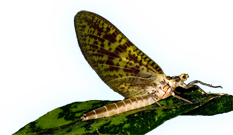
Mayfly Genus Baetis (Blue-Winged Olives)


Taxonomic Navigation -?-
Kingdom
Animalia (Animals)
» Phylum
Arthropoda (Arthropods)
» Class
Insecta (Insects)
» Order
Ephemeroptera (Mayflies)
» Family
Baetidae (Blue-Winged Olives)
» Genus Baetis (Blue-Winged Olives)


17 species aren't included.
Common Names


The genus Baetis and its species are probably the most misidentified mayflies in angling. Many who see mayflies too small to imitate with a size 16 Adams call them Baetis, especially if they're olive in coloration. In reality, Baetis (though the most prominent) is only one of several very similar and abundant genera in the family Baetidae. It seems species in the family are perpetually being reclassified, and identifying any of them, even to genus level is difficult. The angler who wants to describe what is seen streamside usually has only four choices:
1. Call them "Blue-Winged Olives" as most do. the problem is this name has lost all meaning due to being applied to dozens of species across several families (many of which have neither blue wings nor olive bodies). Besides, the name was originally coined for a species of British ephemerellid, the family where this common name should properly reside.
2. Call them "baetids", the Latin name for referring to members of the Baetidae family as a group. While technically accurate scientifically, it doesn't tell the listener or reader much about their appearance.
3. Call them outmoded scientific names - Even calling them by the updated name is usually risky for most species in the field. Adding to the difficulty by using names from outdated nomenclatures? Talk about confusion...
4. Call them "little (whatever color they are) quills." Perhaps this is the best choice as at least it's more accurately descriptive.
The fact is many are so similar that even alot of the specimens in the hatch pages can't be keyed below the family level with absolute certainty; at least from what's observable in the photos alone. They often require observation with a microscope and extensive knowledge of the subtle differences for accurate determinations. So - the next time a fishing buddy identifies a little olive mayfly from a distance using an obsolete name like Baetis vagans, just smile and nod...
For anglers raised on Schwiebert, Swisher, etc., it is often difficult to locate many important species in the newer literature. When working with older taxonomies and/or angling texts, the following hatch page links may prove helpful:
Baetis devinctus = Diphetor hageni (can be an important eastern species)
Baetis hiemalis = Baetis brunneicolor (important Midwest species with a national distribution)
Baetis insignificans = Acentrella insignificans (can be important in some western locales)
Baetis parvus = Diphetor hageni (very important western species)
Baetis propinquus = Labiobaetis propinquus (important in the West with a national distribution)
Baetis pygmaeus = Acerpenna pygmaea (can be important with distribution across all regions)
Baetis vagans = Baetis tricaudatus (most abundant and important species nationwide)
The relatively new genus Fallceon has two species of interest that are made up of several previous Baetis species. They are distributed nationally and may prove significant as more is learned about the angling opportunities they present, especially in the the South and Southwest.
Where & When
Some Baetis species are often the first major hatches in the spring and the last in the fall, and on especially stable spring creeks they may emerge throughout the winter. The genus is common nationwide.
See each species page for more on their distribution and timing.
Hatching Behavior
Time Of Day (?): Warmest part of the day during the cool season; sometimes sporadically all day long at other times
Water Temperature: 40°F and up
Baetis nymphs are normally outstanding swimmers, but they are reported to lose this ability when they emerge. They get to the surface by dead-drifting (Dead-drift: The manner in which a fly drifts on the water when not moving by itself or by the influence of a line. Trout often prefer dead-drifting prey and imitating the dead-drift in tricky currents is a major challenge of fly fishing.), buoyed by gas bubbles, or by crawling to the surface on some object and letting go to drift along in the film (rather than crawling out). They have trouble breaking through the surface film, escaping their shucks (Water Temperature: 40°F and up
 View Full Size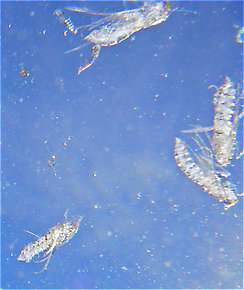
Here's an underwater view of the pupal shucks of several already-emerged Brachycentrus numerosus caddisflies.
Dismal weather invites the best hatches of Baetis mayflies; look for them on overcast, rainy days, as long as the water temperature is above 40°F.
Spinner Behavior
Timing the return of these mayflies as spinners after they hatch is difficult; some may come back within a few hours, while others take a few days.
Baetis females are among the only mayflies to lay their eggs underwater. The females land near the water after mating and crawl down to lay rows of eggs on the downstream side of rocks, sticks, and other objects. They may slip loose during the process or let go after they finish, and wet fly imitations are effective during this time. Ernest Schwiebert gives more detail in Matching the Hatch:
In moving through the surface film she folds her wings about her abdomen and uses the downstream side of the object she has selected. The passing through the surface film is the critical phase of her mating. Once she is under the surface, she inspects the rock or log carefully with her abdomen. Finally she lays her eggs with a circular sweeping motion, which leaves a little row of eggs each time. When her supply of eggs is exhausted she climbs back out of the water or is swept away in the underwater currents.
Nymph Biology
Baetis nymphs are found in almost every trout stream, but they produce more broods and thicker hatches in cold, unpolluted, alkaline (Alkaline: Having a pH higher than 7 (opposite of acidic). Moderately alkaline water is ideal for trout because it's better for the growth of phytoplankton, the usual base of the aquatic food chain, and that's good for the growth of everything higher up the chain, including trout.) waters. They inhabit almost every microhabitat in the stream except for silt beds, but gravel and vegetation are especially suitable.
Baetis Fly Fishing Tips
Because Baetis mayflies are so often called Blue-Winged Olives, some anglers try to imitate them with flies with blue wings and olive bodies. This is one of the follies of common names. Their wings are various shades of gray, maybe with a slight blue tint, and their bodies are various shades of olive or brown. When you meet a hatch, try to catch one of the live mayflies rather than assuming you know its color.
Pictures of 32 Mayfly Specimens in the Genus Baetis:
Male Baetis (Blue-Winged Olives) Mayfly Dun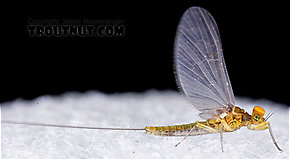 View 14 PicturesThis dun molted most of the way into a spinner (though the wings got stuck) the evening after I photographed it, so I took some more photos of the spinner.
I found a female nearby, probably of the same species.
View 14 PicturesThis dun molted most of the way into a spinner (though the wings got stuck) the evening after I photographed it, so I took some more photos of the spinner.I found a female nearby, probably of the same species.
Collected September 19, 2006 from Mystery Creek #43 in New York
Added to Troutnut.com by Troutnut on October 4, 2006
Added to Troutnut.com by Troutnut on October 4, 2006
Baetis (Blue-Winged Olives) Mayfly Nymph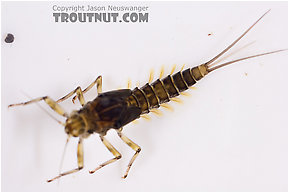 View 10 Pictures
View 10 PicturesCollected May 6, 2007 from Mongaup Creek in New York
Added to Troutnut.com by Troutnut on May 18, 2007
Added to Troutnut.com by Troutnut on May 18, 2007
Female Baetis (Blue-Winged Olives) Mayfly Dun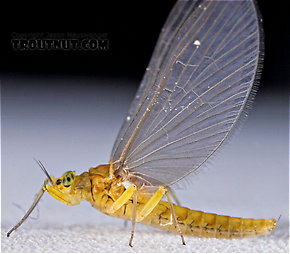 View 5 PicturesI found this female in the same area as a male with similar markings, probably of the same species.
View 5 PicturesI found this female in the same area as a male with similar markings, probably of the same species.Collected September 19, 2006 from Mystery Creek #43 in New York
Added to Troutnut.com by Troutnut on October 4, 2006
Added to Troutnut.com by Troutnut on October 4, 2006
Recent Discussions of Baetis
Big Green River, Wisconsin, late September 1 Reply »
pleased to report the emergence of a new baetis flavistriga which i have christened computatii
forum visitors using the Firefox browser who put troutnut.com on their bookmarks toolbar have undoubtedly noticed a tiny dark mayfly icon in a blue box next the bookmark.
well, it's breeding. came back this evening from a week out of town to discover that the little troutnut computatii had a pal over next the hotmail.com bookmark where formerly there was only a generic white icon. am waiting for it to show up next the other two sites that have only generic icons.
now our resident boffins will help me with the Latin ending on the new name, (i tried to use the genitive plural) and then we'll ask Jason how he got these virtual flies to multiply.
CaseyReplyflavistriga broods
Posted by Admiralb on Sep 28, 2013 in the species Baetis brunneicolor
Last reply on Sep 30, 2013 by Entoman
I hosted two visiting delegates to the T.U. National Convention in Madison, WI. on September 25, 2013, taking them to the Big Green River in Grant County near Fennimore. There was a high overcast in the morning, and these mayflies [which I merely called "BWO's" and imitated with #16 parachute dries - thin olive bodies, gray wing posts and dun parachute hackle] - were active. Both of my guests raised browns fishing a gray nymph behind a #16 parachute dry BWO. As long as my flies catch fish, I don't need to be a detailed entomologist. Nevertheless, I do sincerely appreciate the detailed scientific info, because it helps me focus my flytying and fly selection. Thank you.
ReplyBaetis flavistriga computatii 7 Replies »Posted by CaseyP on Jan 22, 2007 in the species Baetis flavistriga
Last reply on Jan 19, 2009 by Taxon
pleased to report the emergence of a new baetis flavistriga which i have christened computatii
forum visitors using the Firefox browser who put troutnut.com on their bookmarks toolbar have undoubtedly noticed a tiny dark mayfly icon in a blue box next the bookmark.
well, it's breeding. came back this evening from a week out of town to discover that the little troutnut computatii had a pal over next the hotmail.com bookmark where formerly there was only a generic white icon. am waiting for it to show up next the other two sites that have only generic icons.
now our resident boffins will help me with the Latin ending on the new name, (i tried to use the genitive plural) and then we'll ask Jason how he got these virtual flies to multiply.
Casey
Posted by Konchu on Jan 18, 2009 in the species Baetis flavistriga
Anyone have observations that they are willing to share of different flavistriga broods?
Jason says that B. flavistriga is a "combination of widely varying types in different places, it's hard to piece the information together into reliable hatch dates for the different broods in any given location." This is stated very well.
As part of my bug work, I'm trying to tease apart some of these "varying types" to see what, if anything, they might represent. Tapping into the experience base here might help.
ReplyJason says that B. flavistriga is a "combination of widely varying types in different places, it's hard to piece the information together into reliable hatch dates for the different broods in any given location." This is stated very well.
As part of my bug work, I'm trying to tease apart some of these "varying types" to see what, if anything, they might represent. Tapping into the experience base here might help.
Your Thoughts On Baetis:
Jargon Defined:
Abdomen: The rear and usually the longest (ten-segmented in mayflies) portion of an insect's body, to which the tails are attached.
Alkaline: Having a pH higher than 7 (opposite of acidic). Moderately alkaline water is ideal for trout because it's better for the growth of phytoplankton, the usual base of the aquatic food chain, and that's good for the growth of everything higher up the chain, including trout.
Broods: When a species produces more than one generation per year, each one is called a brood.
Cripples: In fly fishing, a cripple is any insect which has been injured or deformed so that it cannot escape the water. This may include stillborn emergers or fully emerged adults which have been damaged, often by wind or waves, so that they can no longer fly. Trout often favor eating crippled insects.
Dead-drifting: The manner in which a fly drifts on the water when not moving by itself or by the influence of a line. Trout often prefer dead-drifting prey and imitating the dead-drift in tricky currents is a major challenge of fly fishing.
Duns: Mayflies have two adult stages. They first emerge from the water as duns (scientifically known as the subimago stage). They then molt into the spinner (imago) stage, in which they mate and die. Sometimes the word "dun" is confusingly used to refer to a brownish gray color in fly tying materials.
Emergence: The transformation of a nymph or pupa into the adult winged stage of an insect. The term may refer to the emergence of an individual, or the daily or yearly event in which all individuals of a species emerge.
Nymphs: The juvenile, underwater stages of mayflies, stoneflies, dragonflies, and damselflies and other aquatic insects whose juvenile stages are covered by hard exoskeletons. The word can also refer to the fishing flies which imitate these creatures, in which case it is used as a blanket term for flies imitating any underwater stage of an invertebrate (except for crayfish and leeches).
Here's an underwater view of the pupal shucks of several already-emerged Brachycentrus numerosus caddisflies.
Spinner: There are two winged stages of adult mayflies. They emerge from the water as duns, molt on land (usually) into their fully mature stage, spinners. As spinners, they mate, lay eggs, and die.
Useful References:
Caucci, Al and Nastasi, Bob. 2004. Hatches II. The Lyons Press.
Fauceglia, Ted. 2005. Mayflies . Stackpole Books.
Leonard, Justin W. and Fannie A. Leonard. 1962. Mayflies of Michigan Trout Streams. Cranbrook Institute of Science.
Schwiebert, Ernest G. 1955. Matching the Hatch. MacMillan Publishing Company.
Swisher, Doug and Carl Richards. 2000. Selective Trout. The Lyons Press.
Top 10 Fly Hatches
 Baetis
 Baetidae
 Ephemerellidae
 Hexagenia limbata
 Chironomidae
 Ephemerella subvaria
 Heptageniidae
 Ephemerella
 Isonychia
 Hydropsychidae
Top Gift Shop Designs
 I outfish my daddy!
 Electric blue Hendrickson dun.
 I love buggers. Big, green, wooly ones.
 I outfish my husband!
 Be the trout.
 Eat mayflies.
Top Insect Specimens
 Baetisca obesa Mayfly Nymph
 Neophylax Caddisfly Adult
 Corydalus Hellgrammite Larva
 Isonychia bicolor Mayfly Spinner
 Ephemerella aurivillii Mayfly Spinner
Miscellaneous Sites
Troutnut.com is copyright © 2004-2024 Jason
Neuswanger (email Jason). See my FAQ for information about use of my images.
 privacy policy
privacy policy