
Blog & Latest Updates
Fly Fishing Articles
Insects by Common Name


Animal Phylum Arthropoda (Arthropods)


Taxonomic Navigation -?-
Kingdom
Animalia (Animals)
» Phylum Arthropoda (Arthropods)
| Class in Arthropoda |  |  |
| ArachnidaMites and Spiders | 0 | 1 |
| CollembolaSpringtails | 0 | 0 |
| Crustacea-MalacostracaCrayfish, Scuds, and Sowbugs | 0 | 10 |
| Crustacea-Maxillopoda | 0 | 0 |
| InsectaInsects | 0 | 114 |
Common Name
| Match | Common Name |
 | Arthropods |
Pictures of 1244 Arthropod Specimens:
Baetisca obesa (Armored Mayfly) Mayfly Nymph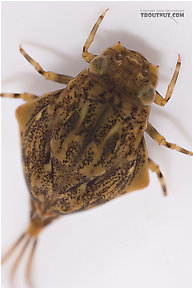 View 12 Pictures
View 12 PicturesCollected May 6, 2007 from the Neversink River (above reservoir) in New York
Added to Troutnut.com by Troutnut on May 10, 2007
Added to Troutnut.com by Troutnut on May 10, 2007
Corydalus (Dobsonflies) Hellgrammite Larva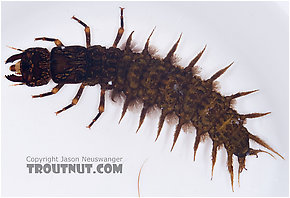 View 27 Pictures
View 27 PicturesCollected May 29, 2007 from Paradise Creek in Pennsylvania
Added to Troutnut.com by Troutnut on June 4, 2007
Added to Troutnut.com by Troutnut on June 4, 2007
Neophylax (Autumn Mottled Sedges) Caddisfly Adult View 20 PicturesThis large caddisfly looks really neat close-up.
View 20 PicturesThis large caddisfly looks really neat close-up.Collected September 19, 2006 from Mystery Creek #43 in New York
Added to Troutnut.com by Troutnut on October 4, 2006
Added to Troutnut.com by Troutnut on October 4, 2006
122 Underwater Pictures of Arthropods:


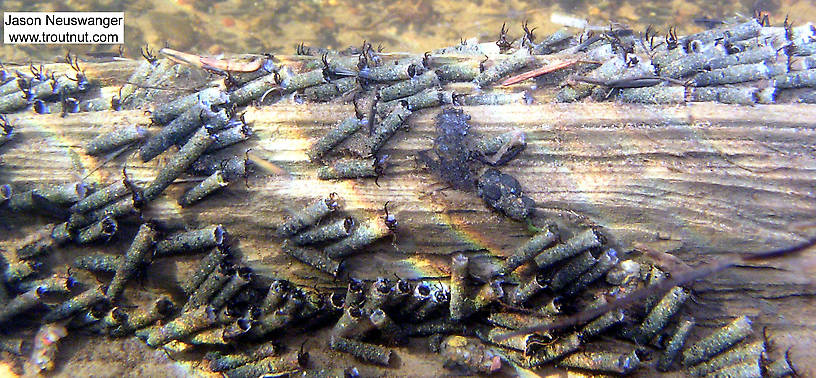
Hundreds of cased caddisfly larvae live on this log in a small brook trout stream.
In this picture: Insect Order Trichoptera (Caddisflies).
In this picture: Insect Order Trichoptera (Caddisflies).
StateWisconsin
LocationEighteenmile Creek
Date TakenApr 14, 2004
Date AddedJan 25, 2006
AuthorTroutnut
CameraOlympus C740UZ
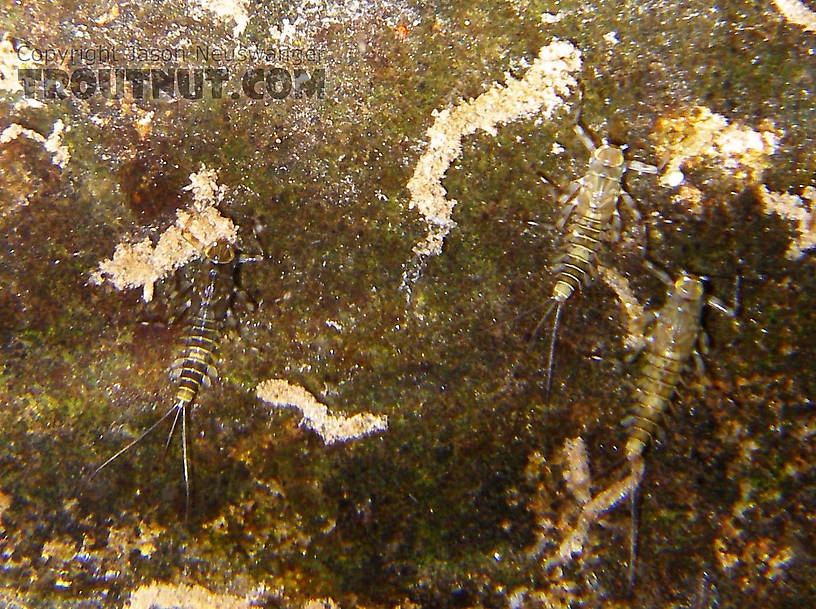
Several Baetidae nymphs line up on a rock.
In this picture: Mayfly Family Baetidae (Blue-Winged Olives).
In this picture: Mayfly Family Baetidae (Blue-Winged Olives).
StateNew York
LocationMongaup Creek
Date TakenApr 19, 2006
Date AddedApr 22, 2006
AuthorTroutnut
CameraPENTAX Optio WPi
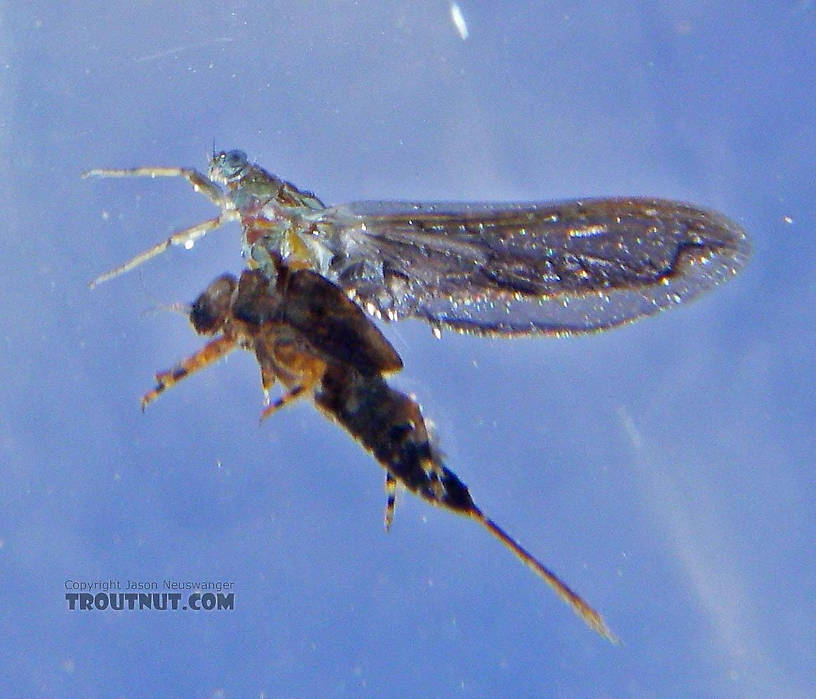
This is a close-up underwater view of a stillborn (Stillborn: In fly fishing, a stillborn insect is one which got stuck in its nymphal or pupal shuck during emergence and floats helplessly on the surface instead of flying away. It is a specific class of cripple, although it is sometimes used interchangeably with that term.) Ephemerella subvaria (Henrickson) female dun.
In this picture: Mayfly Species Ephemerella subvaria (Hendrickson).
 View Full Size
In this picture: Mayfly Species Ephemerella subvaria (Hendrickson).
Recent Discussions of Arthropoda
Missing genera (from missing list)
Latineosus, Sparbarus, Susperatus should all be included in the genera that aren't included (I think).
Andy
ReplyCorrect hatch time of year Hydropsyche slossonae? 10 Replies »Andy
Posted by AndyV on Aug 26, 2022 in the species Hydropsyche slossonae
Last reply on Oct 11, 2022 by AndyV
I've seen hatch charts (e.g. DNR hatch chart for SE MN) stating mid-May til the end of July vs June (from this site). Can anyone confirm?
Replyacentrella nymph 22 Replies »Posted by Goose on Nov 3, 2006 in the genus Acentrella
Last reply on Sep 15, 2022 by Wiflyfisher
Hi Jason! Do you have a picture of the (acentrella-miniature BWO nymph) on the site? I've been fishing them and wanted a better idea of how they look.
Thanks,
Bruce
ReplyFamily name now Thremmatidae (Little Northeastern Casemakers)Thanks,
Bruce
I believe Uenoidae is now known as Thremmatidae.
~Andy
ReplyPlectrocnemia missing~Andy
Posted by AndyV on Aug 25, 2022 in the family Polycentropodidae
I believe this is missing from the list. Unsure of it's importance. However, they was a study on Plectrocnemia conspersa relative to trout populations in Ashdown Forest streams [Schofield et al. (1988)].
ReplyThere are 3910 more topics.
Your Thoughts On Arthropoda:
Jargon Defined:
Dun: Mayflies have two adult stages. They first emerge from the water as duns (scientifically known as the subimago stage). They then molt into the spinner (imago) stage, in which they mate and die. Sometimes the word "dun" is confusingly used to refer to a brownish gray color in fly tying materials.
Larvae: Many classes of aquatic insects, such as caddisflies, midges, craneflies, dobsonflies, alderflies, and many more, are known as "larvae" rather than "nymphs" in their juvenile stages. They have mostly soft bodies rather than hard exoskeletons. These insects also advance through a "pupa" stage before reaching adulthood.
Nymphs: The juvenile, underwater stages of mayflies, stoneflies, dragonflies, and damselflies and other aquatic insects whose juvenile stages are covered by hard exoskeletons. The word can also refer to the fishing flies which imitate these creatures, in which case it is used as a blanket term for flies imitating any underwater stage of an invertebrate (except for crayfish and leeches).
Stillborn: In fly fishing, a stillborn insect is one which got stuck in its nymphal or pupal shuck during emergence and floats helplessly on the surface instead of flying away. It is a specific class of cripple, although it is sometimes used interchangeably with that term.
Top 10 Fly Hatches
 Baetis
 Baetidae
 Ephemerellidae
 Hexagenia limbata
 Chironomidae
 Ephemerella subvaria
 Heptageniidae
 Ephemerella
 Isonychia
 Hydropsychidae
Top Gift Shop Designs
 I outfish my daddy!
 Electric blue Hendrickson dun.
 I love buggers. Big, green, wooly ones.
 I outfish my husband!
 Be the trout.
 Eat mayflies.
Top Insect Specimens
 Baetisca obesa Mayfly Nymph
 Corydalus Hellgrammite Larva
 Neophylax Caddisfly Adult
 Pteronarcys biloba Stonefly Nymph
 Hydropsyche aenigma Caddisfly Adult
Miscellaneous Sites
Troutnut.com is copyright © 2004-2024 Jason
Neuswanger (email Jason). See my FAQ for information about use of my images.
 privacy policy
privacy policy