
Blog & Latest Updates
Fly Fishing Articles
Insects by Common Name


Mayfly Genus Hexagenia


Taxonomic Navigation -?-
Kingdom
Animalia (Animals)
» Phylum
Arthropoda (Arthropods)
» Class
Insecta (Insects)
» Order
Ephemeroptera (Mayflies)
» Family
Ephemeridae (Hexes and Big Drakes)
» Genus Hexagenia
| Species in Hexagenia |  |  |
| Hexagenia atrocaudataLate Hex | 0 | 0 |
| Hexagenia limbataHex | 0 | 1 |
| Hexagenia rigidaGreat Olive-Winged Drake | 0 | 0 |
4 species aren't included.
Two minor species, Hexagenia atrocaudata and Hexagenia rigida, may be noticed later in the season than limbata.
Read each species page for emergence and other details.
Pictures of 31 Mayfly Specimens in the Genus Hexagenia:
Male Hexagenia atrocaudata (Late Hex) Mayfly Spinner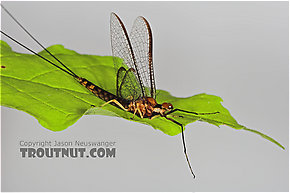 View 12 Pictures
View 12 PicturesCollected July 24, 2005 from the Namekagon River in Wisconsin
Added to Troutnut.com by Troutnut on April 15, 2006
Added to Troutnut.com by Troutnut on April 15, 2006
Female Hexagenia atrocaudata (Late Hex) Mayfly Dun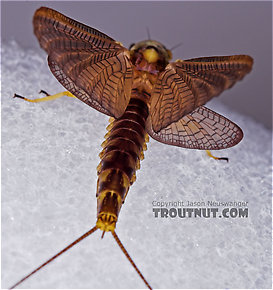 View 14 PicturesI found this lone Hexagenia atrocaudata dun fluttering by herself on the surface of a small, still stretch of river one evening as I paddled home from fishing for smallmouths in the warm August weather.
View 14 PicturesI found this lone Hexagenia atrocaudata dun fluttering by herself on the surface of a small, still stretch of river one evening as I paddled home from fishing for smallmouths in the warm August weather.Collected August 5, 2005 from the Teal River in Wisconsin
Added to Troutnut.com by Troutnut on April 14, 2006
Added to Troutnut.com by Troutnut on April 14, 2006
Male Hexagenia limbata (Hex) Mayfly Spinner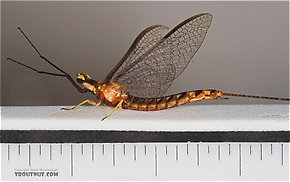 View 13 Pictures
View 13 PicturesCollected June 26, 2005 from Atkins Lake in Wisconsin
Added to Troutnut.com by Troutnut on May 26, 2006
Added to Troutnut.com by Troutnut on May 26, 2006
1 Underwater Picture of Hexagenia Mayflies:


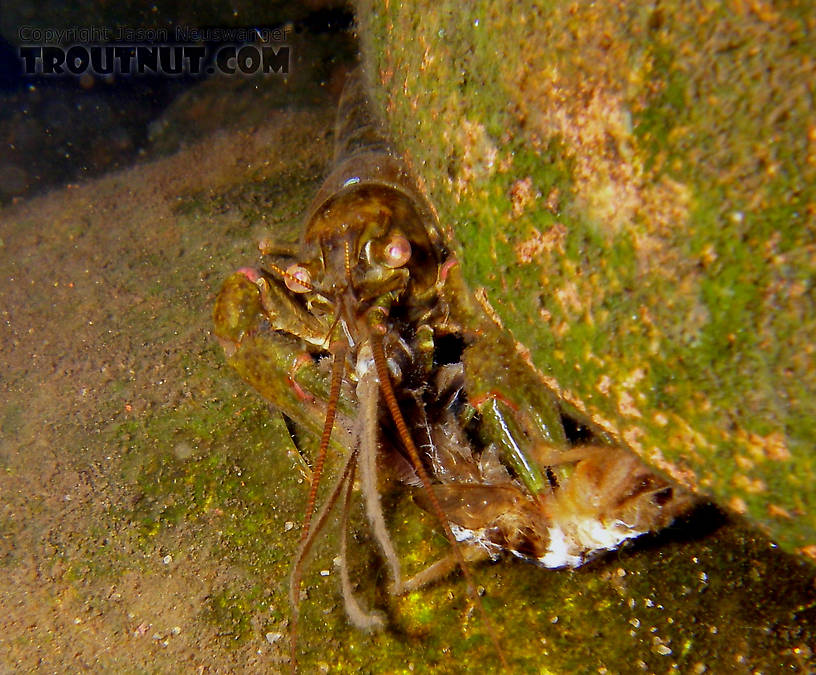
A crayfish chews on a Hexagenia limbata nymph shortly after a small Hex emergence. I didn't catch any fish, but playing around with my flashlight and camera in the rocks proved productive.
In this picture: Arthropod Order Decapoda (Crayfish) and Mayfly Species Hexagenia limbata (Hex).
In this picture: Arthropod Order Decapoda (Crayfish) and Mayfly Species Hexagenia limbata (Hex).
StateWisconsin
LocationNamekagon River
Date TakenJun 14, 2006
Date AddedJun 30, 2006
AuthorTroutnut
CameraPENTAX Optio WPi
Recent Discussions of Hexagenia
Hexagenia orlando 5 Replies »
Posted by Curtis on Feb 29, 2008
Last reply on Nov 20, 2020 by SALTYQUILL
Does anyone have any hatch dates for hexagenia orlando in the Central Florida area? Several lakes near me have populations and I am gathering data. I have photos and one hatch record.
ReplyHex hatch water temperature range? 4 Replies »Posted by NEMatt on May 23, 2014 in the species Hexagenia limbata
Last reply on Jul 5, 2016 by Bombillo
Hi,
New to the site - love it. I was wondering if there was a suggested range of water temperature at which the Hex likes to hatch.
Thanks
Matt
ReplyWhat is the big DEAL about the HEX? 21 Replies »New to the site - love it. I was wondering if there was a suggested range of water temperature at which the Hex likes to hatch.
Thanks
Matt
Posted by Spinner on Jun 21, 2006 in the species Hexagenia limbata
Last reply on Jul 5, 2016 by Bombillo
fishing in the dark.......
stepping in holes?
I hate the dark........
I don't need the hex........
Len
ReplyMayfly larvae -wigglers preservation as bait 20 Replies »stepping in holes?
I hate the dark........
I don't need the hex........
Len
Posted by Teacherprea on Jun 2, 2007 in the species Hexagenia limbata
Last reply on Apr 29, 2014 by TNEAL
I am a fly fisherman but not a "purist". A friend of mine has a place on the UP of Michigan. He just called me and said a guy told him there is a way to preserve "wigglers." They use them alot up north, those that are not fly fishermen or ladies. They are fishing perch, bluegill and crappie. He heard there is a way to "blanch" them.Drop them in hot water for a few minutes and they turn rubbery. They then will keep indefinitely. Has anyone heard of this? If so, how close to correct is the procedure I mentioned??
Thanks for anyone's help.
ReplyHex Hatch 2012 5 Replies »Thanks for anyone's help.
Posted by Hdhungryman on Apr 15, 2012
Last reply on Aug 13, 2012 by Taxon
Forget the end of the world. The Hex Hatch is just about on again. For more than 7 years now, I have been making the journey north and have encountered one of the most prolific hex hatches I have ever seen (in the West that is). We all know that there are very specific conditions that must exist in order for this amazing event to occur. There are a few notable locations though I have found Henderson Springs in Big Bend, CA to be the most exciting from the perspective of a flyfisherman.
I am constantly keeping an eye out for when the hatch starts in this region. I will do my best to keep my post current as I get further updates. Make it a great season!
ReplyI am constantly keeping an eye out for when the hatch starts in this region. I will do my best to keep my post current as I get further updates. Make it a great season!
There are 3 more topics.
Your Thoughts On Hexagenia:
Top 10 Fly Hatches
 Baetis
 Baetidae
 Ephemerellidae
 Hexagenia limbata
 Chironomidae
 Ephemerella subvaria
 Heptageniidae
 Ephemerella
 Isonychia
 Hydropsychidae
Top Gift Shop Designs
 I outfish my daddy!
 Electric blue Hendrickson dun.
 I love buggers. Big, green, wooly ones.
 I outfish my husband!
 Be the trout.
 Eat mayflies.
Top Insect Specimens
 Baetisca obesa Mayfly Nymph
 Neophylax Caddisfly Adult
 Corydalus Hellgrammite Larva
 Isonychia bicolor Mayfly Spinner
 Ephemerella aurivillii Mayfly Spinner
Miscellaneous Sites
Troutnut.com is copyright © 2004-2024 Jason
Neuswanger (email Jason). See my FAQ for information about use of my images.
 privacy policy
privacy policy