
Blog & Latest Updates
Fly Fishing Articles
Insects by Common Name


Insect Order Ephemeroptera (Mayflies)


Taxonomic Navigation -?-
Kingdom
Animalia (Animals)
» Phylum
Arthropoda (Arthropods)
» Class
Insecta (Insects)
» Order Ephemeroptera (Mayflies)


8 families aren't included.
Common Name
| Match | Common Name |
 | Mayflies |
This is page 3 of specimens of Ephemeroptera. Visit the main Ephemeroptera page for:
- The behavior and habitat of Ephemeroptera.
- 67 underwater pictures of Ephemeroptera.
Pictures of 828 Mayfly Specimens:
Male Stenacron (Light Cahills) Mayfly Dun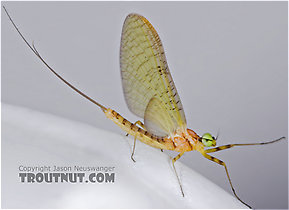 View 13 Pictures
View 13 PicturesCollected May 27, 2005 from the Teal River in Wisconsin
Added to Troutnut.com by Troutnut on May 22, 2006
Added to Troutnut.com by Troutnut on May 22, 2006
Male Ephemerella subvaria (Hendrickson) Mayfly Spinner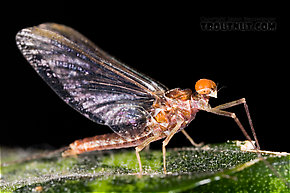 View 11 PicturesI collected this beautiful male Hendrickson specimen as a dun, along with a female Hendrickson from the same hatch. Both molted into spinners in my house within a couple of days.
View 11 PicturesI collected this beautiful male Hendrickson specimen as a dun, along with a female Hendrickson from the same hatch. Both molted into spinners in my house within a couple of days.Collected April 23, 2007 from Fall Creek in New York
Added to Troutnut.com by Troutnut on April 25, 2007
Added to Troutnut.com by Troutnut on April 25, 2007
Male Ephemerella aurivillii Mayfly Dun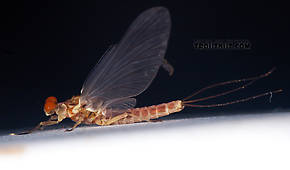 View 14 PicturesThis is the most widespread species of Ephemerella, and also the most abundant in some places, but nobody I've talked to seemed to know what its duns looked like, and there were no pictures of its duns online or in any angling books. That mystery is solved with this male dun, which hatched from a definitively identified nymph.
View 14 PicturesThis is the most widespread species of Ephemerella, and also the most abundant in some places, but nobody I've talked to seemed to know what its duns looked like, and there were no pictures of its duns online or in any angling books. That mystery is solved with this male dun, which hatched from a definitively identified nymph.Male Drunella doddsii (Western Green Drake) Mayfly Dun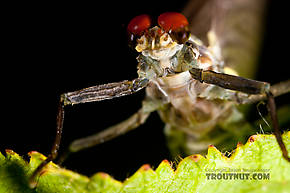 View 13 Pictures
View 13 PicturesCollected July 17, 2011 from the Gulkana River in Alaska
Added to Troutnut.com by Troutnut on July 20, 2011
Added to Troutnut.com by Troutnut on July 20, 2011
Male Hexagenia atrocaudata (Late Hex) Mayfly Spinner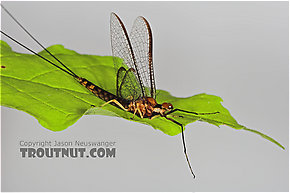 View 12 Pictures
View 12 PicturesCollected July 24, 2005 from the Namekagon River in Wisconsin
Added to Troutnut.com by Troutnut on April 15, 2006
Added to Troutnut.com by Troutnut on April 15, 2006
Male Drunella cornuta (Large Blue-Winged Olive) Mayfly Dun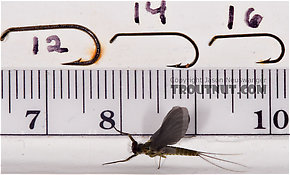 View 12 Pictures
View 12 PicturesCollected May 29, 2007 from Brodhead Creek in Pennsylvania
Added to Troutnut.com by Troutnut on June 4, 2007
Added to Troutnut.com by Troutnut on June 4, 2007
Male Epeorus albertae (Pink Lady) Mayfly Spinner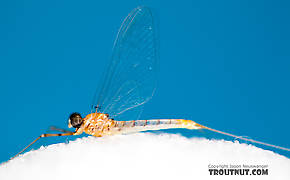 View 14 Pictures
View 14 PicturesCollected July 11, 2017 from the North Fork Stillaguamish River in Washington
Added to Troutnut.com by Troutnut on July 12, 2017
Added to Troutnut.com by Troutnut on July 12, 2017
Male Ephemerella invaria (Sulphur Dun) Mayfly Spinner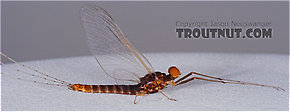 View 12 Pictures
View 12 PicturesCollected June 3, 2005 from the Teal River in Wisconsin
Added to Troutnut.com by Troutnut on May 24, 2006
Added to Troutnut.com by Troutnut on May 24, 2006
Male Baetis (Blue-Winged Olives) Mayfly Dun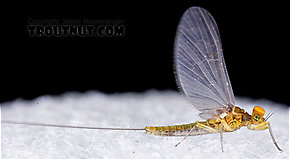 View 14 PicturesThis dun molted most of the way into a spinner (though the wings got stuck) the evening after I photographed it, so I took some more photos of the spinner.
I found a female nearby, probably of the same species.
View 14 PicturesThis dun molted most of the way into a spinner (though the wings got stuck) the evening after I photographed it, so I took some more photos of the spinner.I found a female nearby, probably of the same species.
Collected September 19, 2006 from Mystery Creek #43 in New York
Added to Troutnut.com by Troutnut on October 4, 2006
Added to Troutnut.com by Troutnut on October 4, 2006
Female Hexagenia atrocaudata (Late Hex) Mayfly Dun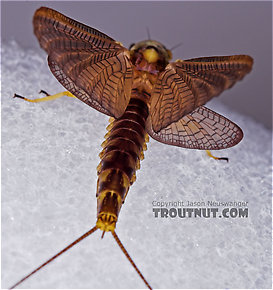 View 14 PicturesI found this lone Hexagenia atrocaudata dun fluttering by herself on the surface of a small, still stretch of river one evening as I paddled home from fishing for smallmouths in the warm August weather.
View 14 PicturesI found this lone Hexagenia atrocaudata dun fluttering by herself on the surface of a small, still stretch of river one evening as I paddled home from fishing for smallmouths in the warm August weather.Collected August 5, 2005 from the Teal River in Wisconsin
Added to Troutnut.com by Troutnut on April 14, 2006
Added to Troutnut.com by Troutnut on April 14, 2006
Top 10 Fly Hatches
 Baetis
 Baetidae
 Ephemerellidae
 Hexagenia limbata
 Chironomidae
 Heptageniidae
 Ephemerella subvaria
 Ephemerella
 Isonychia
 Hydropsychidae
Top Gift Shop Designs
 I outfish my daddy!
 Electric blue Hendrickson dun.
 I love buggers. Big, green, wooly ones.
 I outfish my husband!
 Be the trout.
 Eat mayflies.
Top Insect Specimens
 Baetisca obesa Mayfly Nymph
 Corydalus Hellgrammite Larva
 Neophylax Caddisfly Adult
 Rhyacophila fuscula Caddisfly Larva
 Pteronarcys biloba Stonefly Nymph
Miscellaneous Sites
Troutnut.com is copyright © 2004-2024 Jason
Neuswanger (email Jason). See my FAQ for information about use of my images.
 privacy policy
privacy policy