
Blog & Latest Updates
Fly Fishing Articles
Insects by Common Name


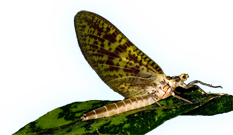
Mayfly Species Ephemera guttulata (Green Drake)


Taxonomic Navigation -?-
Kingdom
Animalia (Animals)
» Phylum
Arthropoda (Arthropods)
» Class
Insecta (Insects)
» Order
Ephemeroptera (Mayflies)
» Family
Ephemeridae (Hexes and Big Drakes)
» Genus
Ephemera
» Species guttulata (Green Drake)
Common Names


It is on par with the Midwest's Hexagenia limbata hatch for its ability to lure huge piscivorous (Piscivorous: Anything which eats primarily fish is a piscivore.) brown trout to eat insects at the surface once a year. The special charm of the Green Drake hatch is that it often takes place during pleasant Spring afternoons. It can be challenging because the large flies are easy for trout to inspect in the daylight and they feed very selectively, especially late in the hatch.
The Green Drakes are on the decline due to environmental degradation.
Where & When
This hatch begins in Pennsylvania in late May and moves into the Catskills through early June. Mid to late June sees Green Drake action in the Adirondacks and other northern New England rivers.
Hatching Behavior
Time Of Day (?): Noticeable emergence all day long, peaking in late evening, sometimes all compressed to dusk
Habitat: Best in slow to moderate current
Green drakes nymphs swim to the surface and emerge from their shucks (Habitat: Best in slow to moderate current
 View Full Size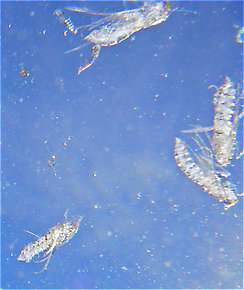
Here's an underwater view of the pupal shucks of several already-emerged Brachycentrus numerosus caddisflies.
"They emerged from their shucks (Shuck: The shed exoskeleton left over when an insect molts into its next stage or instar. Most often it describes the last nymphal or pupal skin exited during emergence into a winged adult.) with such speed that I was usually left with an empty shuck (Here's an underwater view of the pupal shucks of several already-emerged Brachycentrus numerosus caddisflies.Shuck: The shed exoskeleton left over when an insect molts into its next stage or instar. Most often it describes the last nymphal or pupal skin exited during emergence into a winged adult.) and the subimago (Subimago: Mayfly nymphs emerge from the water into subimagoes, better known to anglers as "duns." They are a sexually immature, winged, recognizably adult stage and they must molt one more time into imagoes or "spinners" before they can mate.) with which I was already familiar. I began to think that catching the trout was easier than catching the nymphs that the trout were catching."Here's an underwater view of the pupal shucks of several already-emerged Brachycentrus numerosus caddisflies.
This haste makes emerger patterns unimportant, but luckily the duns take a long time to get off the water. They flutter around and make several awkward attempts, drawing explosive strikes from trout. Hackled imitations that can be twitched to match this behavior are popular.
Knopp and Cormier write that the best hatches happen during "sustained periods of warm weather."
Spinner Behavior
Time Of Day: Dusk
These spinner falls can be extremely intense and they are the most anticipated part of the Green Drake action. They return to mate about three days after emerging as duns.Just like Ephemera simulans, Ephemera guttulata spinners in the air do not always mean spinners on the water. Subtle shifts in weather may push promising spinner clouds of both species back into the trees for the night. This usually happens when they are still gathering at treetop level. Once the swarms descend and you find yourself surrounded by them, they are almost sure to fall on the water, and good fishing will follow unless the trout have just filled up on nymphs and duns during the hatch.
The spinners are known as "Coffin Flies" and they are black and white. They look like a completely different species than the greenish yellow duns.
Nymph Biology
Substrate: Silt and detritus (Detritus: Small, loose pieces of decaying organic matter underwater.), sometimes fine gravel and sand
Environmental Tolerance: Low tolerance for pollution and warm water
Most writers say Green Drakes tend more toward the silty habitats of Hexagenia than do Ephemera simulans and Ephemera varia. It does not, however, require the same vast beds of silt for a good hatch, and the nymphs may do well in small patches of silt which pile up in the quiet spots in pocket water and rocky pools. They are reported to inhabit sand and fine gravel in sufficiently fertile streams. In Ted Fauceglia's recent book Mayflies he says they are actually more abundant in this typical Ephemera habitat.Environmental Tolerance: Low tolerance for pollution and warm water
Ephemera guttulata Fly Fishing Tips
The mature nymphs of this species are darker than the yellow bodies of other Ephemera nymphs. Ernest Schwiebert described them as "dark greyish-brown."
The males are smaller than the females, and both genders vary greatly in size depending on the fertility of the water. You should size your flies based on naturals you collect or on the local fly shops; don't just buy a few from a national outlet and expect them to match your river's hatch.
Pictures of 3 Mayfly Specimens in the Species Ephemera guttulata:
Female Ephemera guttulata (Green Drake) Mayfly Dun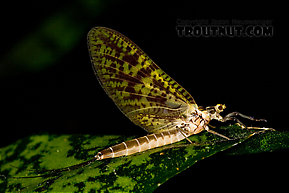 View 16 PicturesIt's about time I got a green drake on this site!
View 16 PicturesIt's about time I got a green drake on this site!Collected June 1, 2007 from the West Branch of the Delaware River in New York
Added to Troutnut.com by Troutnut on June 4, 2007
Added to Troutnut.com by Troutnut on June 4, 2007
Male Ephemera guttulata (Green Drake) Mayfly Spinner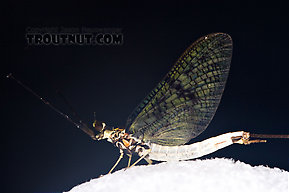 View 12 PicturesThis spinner was the only member of its species I saw all night during an incredibly thick and tricky mixed hatch on Penn's Creek a few days before the real start of its famous green drake hatch.
View 12 PicturesThis spinner was the only member of its species I saw all night during an incredibly thick and tricky mixed hatch on Penn's Creek a few days before the real start of its famous green drake hatch.Collected May 26, 2007 from Penn's Creek in Pennsylvania
Added to Troutnut.com by Troutnut on June 4, 2007
Added to Troutnut.com by Troutnut on June 4, 2007
Female Ephemera guttulata (Green Drake) Mayfly Spinner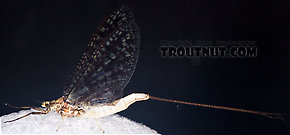 View 7 Pictures
View 7 PicturesCollected June 1, 2007 from the West Branch of the Delaware River in New York
Added to Troutnut.com by Troutnut on June 4, 2007
Added to Troutnut.com by Troutnut on June 4, 2007
Recent Discussions of Ephemera guttulata
Green Drake Hatch Temp? 1 Reply »
Hi
I was looking for a water temperature range for the Green Drake hatch. Anyone know?
ReplyGD Shuck 10 Replies »I was looking for a water temperature range for the Green Drake hatch. Anyone know?
Posted by Martinlf on May 29, 2013
Last reply on Jun 2, 2013 by Crepuscular
Jason's photo of a GD shuck suggests that at hatch time the backs of the nymphs may be a greyish or grey olive color. Possibly useful information, if this is an accurate surmise.
ReplyEmergence period of green drakes 5 Replies »Emergence periods for green drakes usually run for 7-10 days in most streams. However, there are streams in the east where emergence periods are prolonged by some of the nymphs being parasitized by Nanocladius and Epoicocladius midge larvae. In these streams, emergence may be prolonged to 21 days. Unparasitized nymphs emerge before parasitized nymphs, with each group showing separate peaks of emergence about a week apart. This is based upon my own research on green drake emergence in streams with these midge species.
My question here is this: does anybody know of streams that have this type of prolonged emergence (2-3 weeks) in NY, PA, MD, or WV?
ReplyGreen Drake Hatch Frustrations 7 Replies »My question here is this: does anybody know of streams that have this type of prolonged emergence (2-3 weeks) in NY, PA, MD, or WV?
We were fortunate this past weekend to be on Pine Creek during the Green Drake hatch. The spinner fall was incredible. A question I have is why do we miss so many strikes and yet, using the same techniques, the ones we do catch and release practically hook themselves. We were getting strikes on Green Drake Duns and Cripples and Spinners.
One individual described it to us that after observing the trout underwater during a Green Drake hatch, many of the strikes pull a small part of the fly (wing, leg) underwater and they swirl and swallow it there. If that is true, then I can rationalize missing more than 18 fish this weekend. If anyone has observed this please post your observations. Normally we do not have such a great contrast in miss to hookup ratio.
ReplyOne individual described it to us that after observing the trout underwater during a Green Drake hatch, many of the strikes pull a small part of the fly (wing, leg) underwater and they swirl and swallow it there. If that is true, then I can rationalize missing more than 18 fish this weekend. If anyone has observed this please post your observations. Normally we do not have such a great contrast in miss to hookup ratio.
Your Thoughts On Ephemera guttulata:
Jargon Defined:
Detritus: Small, loose pieces of decaying organic matter underwater.
Duns: Mayflies have two adult stages. They first emerge from the water as duns (scientifically known as the subimago stage). They then molt into the spinner (imago) stage, in which they mate and die. Sometimes the word "dun" is confusingly used to refer to a brownish gray color in fly tying materials.
Emergence: The transformation of a nymph or pupa into the adult winged stage of an insect. The term may refer to the emergence of an individual, or the daily or yearly event in which all individuals of a species emerge.
Naturals: A natural is a real insect (or similar creature) a trout might eat. The term is used to specify the real thing as opposed to its artificial imitation.
Nymphs: The juvenile, underwater stages of mayflies, stoneflies, dragonflies, and damselflies and other aquatic insects whose juvenile stages are covered by hard exoskeletons. The word can also refer to the fishing flies which imitate these creatures, in which case it is used as a blanket term for flies imitating any underwater stage of an invertebrate (except for crayfish and leeches).
Piscivorous: Anything which eats primarily fish is a piscivore.
Here's an underwater view of the pupal shucks of several already-emerged Brachycentrus numerosus caddisflies.
Spinner: There are two winged stages of adult mayflies. They emerge from the water as duns, molt on land (usually) into their fully mature stage, spinners. As spinners, they mate, lay eggs, and die.
Subimago: Mayfly nymphs emerge from the water into subimagoes, better known to anglers as "duns." They are a sexually immature, winged, recognizably adult stage and they must molt one more time into imagoes or "spinners" before they can mate.
Useful References:
Arbona, Fred Jr. 1989. Mayflies, the Angler, and the Trout. Nick Lyons Books.
Caucci, Al and Nastasi, Bob. 2004. Hatches II. The Lyons Press.
Fauceglia, Ted. 2005. Mayflies . Stackpole Books.
Knopp, Malcolm and Robert Cormier. 1997. Mayflies: An Angler's Study of Trout Water Ephemeroptera . The Lyons Press.
Schwiebert, Ernest G. 1955. Matching the Hatch. MacMillan Publishing Company.
Swisher, Doug and Carl Richards. 2000. Selective Trout. The Lyons Press.
Top 10 Fly Hatches
 Baetis
 Baetidae
 Ephemerellidae
 Hexagenia limbata
 Chironomidae
 Ephemerella subvaria
 Heptageniidae
 Ephemerella
 Isonychia
 Hydropsychidae
Top Gift Shop Designs
 I outfish my daddy!
 Electric blue Hendrickson dun.
 I love buggers. Big, green, wooly ones.
 I outfish my husband!
 Be the trout.
 Eat mayflies.
Top Insect Specimens
 Baetisca obesa Mayfly Nymph
 Neophylax Caddisfly Adult
 Corydalus Hellgrammite Larva
 Isonychia bicolor Mayfly Spinner
 Ephemerella aurivillii Mayfly Spinner
Miscellaneous Sites
Troutnut.com is copyright © 2004-2024 Jason
Neuswanger (email Jason). See my FAQ for information about use of my images.
 privacy policy
privacy policy