
Blog & Latest Updates
Fly Fishing Articles
Insects by Common Name


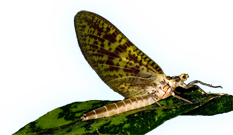
Mayfly Species Ephemera varia (Yellow Drake)


Taxonomic Navigation -?-
Kingdom
Animalia (Animals)
» Phylum
Arthropoda (Arthropods)
» Class
Insecta (Insects)
» Order
Ephemeroptera (Mayflies)
» Family
Ephemeridae (Hexes and Big Drakes)
» Genus
Ephemera
» Species varia (Yellow Drake)
Common Names


Where & When
Adults of this species begin to show in mid-June in the Pennsylvania mountain ranges. The Catskills start a week or so later and hatches can be found in that region through early August. Farther north, and in the Upper Midwest, the hatch begins in mid-July and lasts into mid-August.
Some authors say this hatch is more important in the Midwest than in the East.
Hatching Behavior
Yellow Drakes drakes take a long time and make a lot of commotion trying to get off the water. Their imitations are effective.
Several authors have remarked on the wide range of habitats from which this species will emerge. They apparently show no preference.
The hatch is best on cool, dry days. On cloudy days, according to Swisher and Richards in Selective Trout, the duns may emerge all day long. This behavior does not seem to be as prevalent as it is in Ephemera guttulata.
Spinner Behavior
Time Of Day: Late evening to dusk, sometimes later
Habitat: Riffles, possibly elsewhere
The spinners return to the stream the day after they emerge. The females are reported to ride the water to oviposit, initially in the upright or semispent positions. However, I have also watched them repeatedly dip to the surface to lay eggs and rise back to knee height. Caucci and Nastasi in Hatches II recommend carrying both spent (Spent: The wing position of many aquatic insects when they fall on the water after mating. The wings of both sides lay flat on the water. The word may be used to describe insects with their wings in that position, as well as the position itself.) and semispent imitations for the females. The males fall completely spent (Spent: The wing position of many aquatic insects when they fall on the water after mating. The wings of both sides lay flat on the water. The word may be used to describe insects with their wings in that position, as well as the position itself.).Habitat: Riffles, possibly elsewhere
There is some disagreement between authors about the precise spinner fall timing. It is generally late in the evening and may occur in the dark. I have encountered sporadic females ovipositing more than an hour before dark, and later I saw many more spinners in the air near the treetops.
Nymph Biology
Current Speed: Slow to medium
Substrate: Silt or sand and gravel
Like Ephemera simulans, these burrowers are at home in deposits of sand and fine gravel in freestone streams. This accounts for their good populations throughout the East. They also do well in silt like the Hexagenia mayflies. They usually mature in one year but may take two.Substrate: Silt or sand and gravel
Ephemera varia Fly Fishing Tips
Don't let the common name of this species fool you into fishing a yellow-bodied fly. As my pictures show and other authors have pointed out, these mayflies have a creamy off-white body color. The duns are the same color as the spinners.
According to Knopp and Cormier, trout may fill up on nymphs during the hatch and leave the duns and spinners untouched.
Pictures of 3 Mayfly Specimens in the Species Ephemera varia:
Female Ephemera varia (Yellow Drake) Mayfly Spinner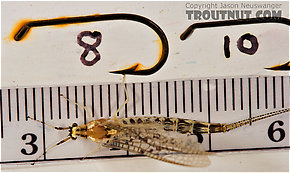 View 6 PicturesI found this female spinner ovipositing in a small stream. She came along while I was playing a trout -- every good bug seemed to do that last night! I didn't have my bug net, so I caught the trout in my landing net, released the trout, and caught the mayfly in my landing net. Her wing got a bit messed up from that.
View 6 PicturesI found this female spinner ovipositing in a small stream. She came along while I was playing a trout -- every good bug seemed to do that last night! I didn't have my bug net, so I caught the trout in my landing net, released the trout, and caught the mayfly in my landing net. Her wing got a bit messed up from that.Collected July 7, 2006 from Cayuta Creek in New York
Added to Troutnut.com by Troutnut on July 8, 2006
Added to Troutnut.com by Troutnut on July 8, 2006
Female Ephemera varia (Yellow Drake) Mayfly Dun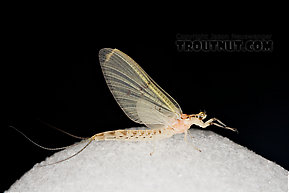 View 7 PicturesThis yellow drake dun hatched out of my aquarium over a month before her brethren in the wild are slated to emerge. She seems a bit small, and that might be the reason.
View 7 PicturesThis yellow drake dun hatched out of my aquarium over a month before her brethren in the wild are slated to emerge. She seems a bit small, and that might be the reason.Ephemera varia (Yellow Drake) Mayfly Nymph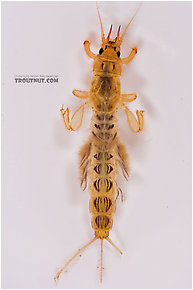 View 4 Pictures
View 4 PicturesCollected March 29, 2006 from Fall Creek in New York
Added to Troutnut.com by Troutnut on April 6, 2006
Added to Troutnut.com by Troutnut on April 6, 2006
Your Thoughts On Ephemera varia:
Top 10 Fly Hatches
 Baetis
 Baetidae
 Ephemerellidae
 Hexagenia limbata
 Chironomidae
 Ephemerella subvaria
 Heptageniidae
 Ephemerella
 Isonychia
 Hydropsychidae
Top Gift Shop Designs
 I outfish my daddy!
 Electric blue Hendrickson dun.
 I love buggers. Big, green, wooly ones.
 I outfish my husband!
 Be the trout.
 Eat mayflies.
Top Insect Specimens
 Baetisca obesa Mayfly Nymph
 Neophylax Caddisfly Adult
 Corydalus Hellgrammite Larva
 Isonychia bicolor Mayfly Spinner
 Ephemerella aurivillii Mayfly Spinner
Miscellaneous Sites
Troutnut.com is copyright © 2004-2024 Jason
Neuswanger (email Jason). See my FAQ for information about use of my images.
 privacy policy
privacy policy