
Blog & Latest Updates
Fly Fishing Articles
Insects by Common Name


Mayfly Genus Ephemera


Taxonomic Navigation -?-
Kingdom
Animalia (Animals)
» Phylum
Arthropoda (Arthropods)
» Class
Insecta (Insects)
» Order
Ephemeroptera (Mayflies)
» Family
Ephemeridae (Hexes and Big Drakes)
» Genus Ephemera
| Species in Ephemera |  |  |
| Ephemera blanda | 0 | 0 |
| Ephemera guttulataGreen Drake | 0 | 0 |
| Ephemera simulansBrown Drake | 0 | 2 |
| Ephemera variaYellow Drake | 0 | 0 |
1 species isn't included.
Ephemera blanda is a very localized species and unimportant to most anglers. Ephemera compar, sometimes mentioned in older books as a minor Western hatch, is now considered to be extinct.
Several important characteristics vary between the three important species. Read about each one for details.
Nymph Biology
Most Ephemera species burrow into rougher substrate than Hexagenia nymphs do. They inhabit sand and fine gravel more frequently than firm silt, although they are found in those environments too.
Pictures of 21 Mayfly Specimens in the Genus Ephemera:
Female Ephemera guttulata (Green Drake) Mayfly Dun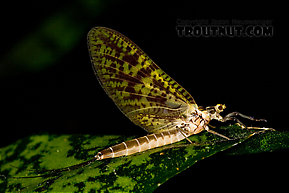 View 16 PicturesIt's about time I got a green drake on this site!
View 16 PicturesIt's about time I got a green drake on this site!Collected June 1, 2007 from the West Branch of the Delaware River in New York
Added to Troutnut.com by Troutnut on June 4, 2007
Added to Troutnut.com by Troutnut on June 4, 2007
Male Ephemera guttulata (Green Drake) Mayfly Spinner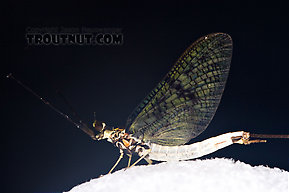 View 12 PicturesThis spinner was the only member of its species I saw all night during an incredibly thick and tricky mixed hatch on Penn's Creek a few days before the real start of its famous green drake hatch.
View 12 PicturesThis spinner was the only member of its species I saw all night during an incredibly thick and tricky mixed hatch on Penn's Creek a few days before the real start of its famous green drake hatch.Collected May 26, 2007 from Penn's Creek in Pennsylvania
Added to Troutnut.com by Troutnut on June 4, 2007
Added to Troutnut.com by Troutnut on June 4, 2007
Female Ephemera varia (Yellow Drake) Mayfly Spinner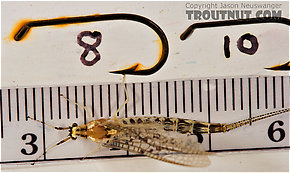 View 6 PicturesI found this female spinner ovipositing in a small stream. She came along while I was playing a trout -- every good bug seemed to do that last night! I didn't have my bug net, so I caught the trout in my landing net, released the trout, and caught the mayfly in my landing net. Her wing got a bit messed up from that.
View 6 PicturesI found this female spinner ovipositing in a small stream. She came along while I was playing a trout -- every good bug seemed to do that last night! I didn't have my bug net, so I caught the trout in my landing net, released the trout, and caught the mayfly in my landing net. Her wing got a bit messed up from that.Collected July 7, 2006 from Cayuta Creek in New York
Added to Troutnut.com by Troutnut on July 8, 2006
Added to Troutnut.com by Troutnut on July 8, 2006
2 Underwater Pictures of Ephemera Mayflies:

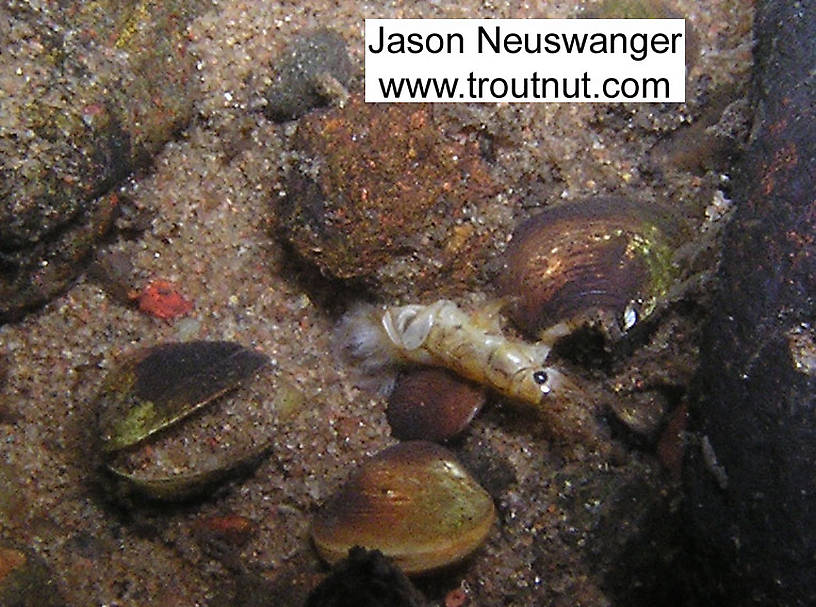
StateWisconsin
LocationNamekagon River
Date TakenApr 16, 2004
Date AddedJan 25, 2006
AuthorTroutnut
CameraOlympus C740UZ

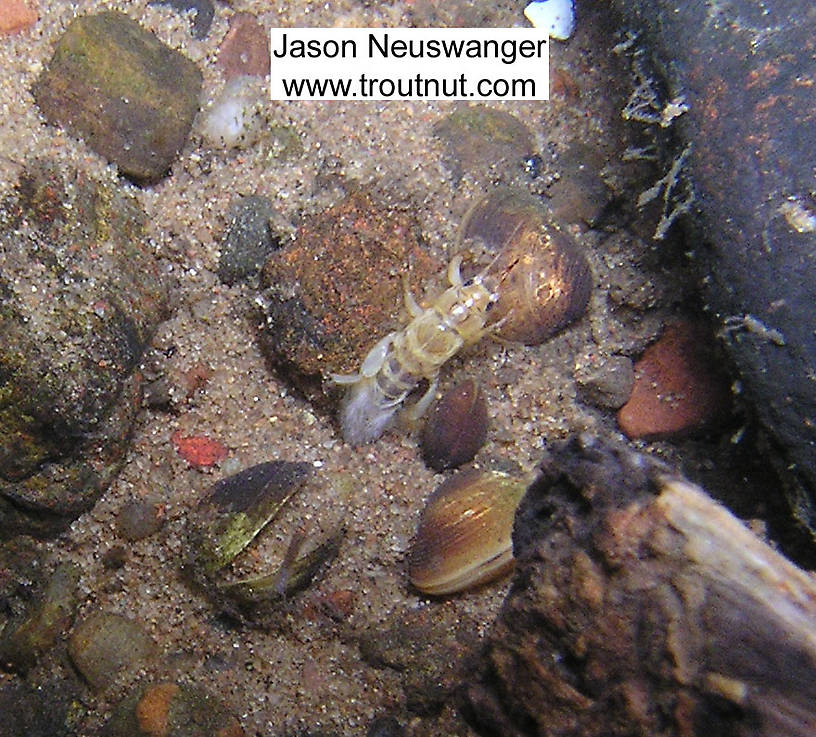
I lifted a rock in pursuit of a stonefly nymph that had scurried beneath it, and instead I found this Ephemera simulans burrowing mayfly nymph waiting to be photographed.
In this picture: Mayfly Species Ephemera simulans (Brown Drake).
In this picture: Mayfly Species Ephemera simulans (Brown Drake).
StateWisconsin
LocationNamekagon River
Date TakenApr 16, 2004
Date AddedJan 25, 2006
AuthorTroutnut
CameraOlympus C740UZ
Recent Discussions of Ephemera
Green Drake Hatch Temp? 1 Reply »
Posted by NEMatt on May 23, 2014 in the species Ephemera guttulata
Last reply on May 24, 2014 by Entoman
Hi
I was looking for a water temperature range for the Green Drake hatch. Anyone know?
ReplyGD Shuck 10 Replies »I was looking for a water temperature range for the Green Drake hatch. Anyone know?
Posted by Martinlf on May 29, 2013 in the species Ephemera guttulata
Last reply on Jun 2, 2013 by Crepuscular
Jason's photo of a GD shuck suggests that at hatch time the backs of the nymphs may be a greyish or grey olive color. Possibly useful information, if this is an accurate surmise.
ReplyBrown Drake? 20 Replies »Posted by Derdmann on Jun 19, 2011 in the species Ephemera simulans
Last reply on Jun 29, 2011 by TNEAL
Came across a mayfly on the Paint River by Crystal Falls, Michigan on June 17th. Is it a brown drake?
Thanks.
ReplyEmergence period of green drakes 5 Replies »Thanks.
Posted by Beardius on Aug 1, 2008 in the species Ephemera guttulata
Last reply on Dec 5, 2008 by Beardius
Emergence periods for green drakes usually run for 7-10 days in most streams. However, there are streams in the east where emergence periods are prolonged by some of the nymphs being parasitized by Nanocladius and Epoicocladius midge larvae. In these streams, emergence may be prolonged to 21 days. Unparasitized nymphs emerge before parasitized nymphs, with each group showing separate peaks of emergence about a week apart. This is based upon my own research on green drake emergence in streams with these midge species.
My question here is this: does anybody know of streams that have this type of prolonged emergence (2-3 weeks) in NY, PA, MD, or WV?
ReplyGreen Drake Hatch Frustrations 7 Replies »My question here is this: does anybody know of streams that have this type of prolonged emergence (2-3 weeks) in NY, PA, MD, or WV?
Posted by Billy on Jun 6, 2007 in the species Ephemera guttulata
Last reply on Jun 12, 2007 by GONZO
We were fortunate this past weekend to be on Pine Creek during the Green Drake hatch. The spinner fall was incredible. A question I have is why do we miss so many strikes and yet, using the same techniques, the ones we do catch and release practically hook themselves. We were getting strikes on Green Drake Duns and Cripples and Spinners.
One individual described it to us that after observing the trout underwater during a Green Drake hatch, many of the strikes pull a small part of the fly (wing, leg) underwater and they swirl and swallow it there. If that is true, then I can rationalize missing more than 18 fish this weekend. If anyone has observed this please post your observations. Normally we do not have such a great contrast in miss to hookup ratio.
ReplyOne individual described it to us that after observing the trout underwater during a Green Drake hatch, many of the strikes pull a small part of the fly (wing, leg) underwater and they swirl and swallow it there. If that is true, then I can rationalize missing more than 18 fish this weekend. If anyone has observed this please post your observations. Normally we do not have such a great contrast in miss to hookup ratio.
There are 2 more topics.
Your Thoughts On Ephemera:
Top 10 Fly Hatches
 Baetis
 Baetidae
 Ephemerellidae
 Hexagenia limbata
 Chironomidae
 Ephemerella subvaria
 Heptageniidae
 Ephemerella
 Isonychia
 Hydropsychidae
Top Gift Shop Designs
 I outfish my daddy!
 Electric blue Hendrickson dun.
 I love buggers. Big, green, wooly ones.
 I outfish my husband!
 Be the trout.
 Eat mayflies.
Top Insect Specimens
 Baetisca obesa Mayfly Nymph
 Neophylax Caddisfly Adult
 Corydalus Hellgrammite Larva
 Isonychia bicolor Mayfly Spinner
 Ephemerella aurivillii Mayfly Spinner
Miscellaneous Sites
Troutnut.com is copyright © 2004-2024 Jason
Neuswanger (email Jason). See my FAQ for information about use of my images.
 privacy policy
privacy policy