
Blog & Latest Updates
Fly Fishing Articles
Insects by Common Name

Mayfly Family Leptohyphidae (Tricos)


Taxonomic Navigation -?-
Kingdom
Animalia (Animals)
» Phylum
Arthropoda (Arthropods)
» Class
Insecta (Insects)
» Order
Ephemeroptera (Mayflies)
» Family Leptohyphidae (Tricos)
| Genus in Leptohyphidae |  |  |
| TricorythodesTricos | 0 | 1 |
7 genera aren't included.
Common Name
| Match | Common Name |
 | Tricos |
Most of the other genera are found only in warm waters in Mexico and the Southwest.
Pictures of 9 Mayfly Specimens in the Family Leptohyphidae:
Female Tricorythodes (Tricos) Mayfly Spinner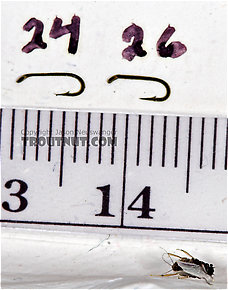 View 9 PicturesI photographed this Trico alive, although it didn't have much time left. These things die very quickly after they mate and it's hard to rush them back to the studio.
View 9 PicturesI photographed this Trico alive, although it didn't have much time left. These things die very quickly after they mate and it's hard to rush them back to the studio.Collected September 8, 2006 from the Neversink River in New York
Added to Troutnut.com by Troutnut on October 4, 2006
Added to Troutnut.com by Troutnut on October 4, 2006
Female Tricorythodes (Tricos) Mayfly Spinner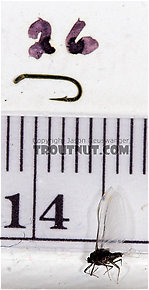 View 4 PicturesThis recently deceased Trico was smaller and darker than the others I photographed from the same morning.
View 4 PicturesThis recently deceased Trico was smaller and darker than the others I photographed from the same morning.Collected September 8, 2006 from the Neversink River in New York
Added to Troutnut.com by Troutnut on October 4, 2006
Added to Troutnut.com by Troutnut on October 4, 2006
Tricorythodes (Tricos) Mayfly Larva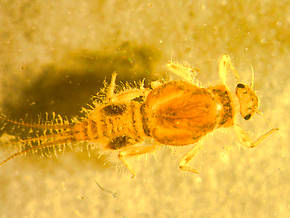 View 1 Pictures
View 1 PicturesCollected June 15, 2002 from Willow Creek in Oregon
Added to Troutnut.com by Bnewell on June 26, 2011
Added to Troutnut.com by Bnewell on June 26, 2011
1 Underwater Picture of Leptohyphidae Mayflies:


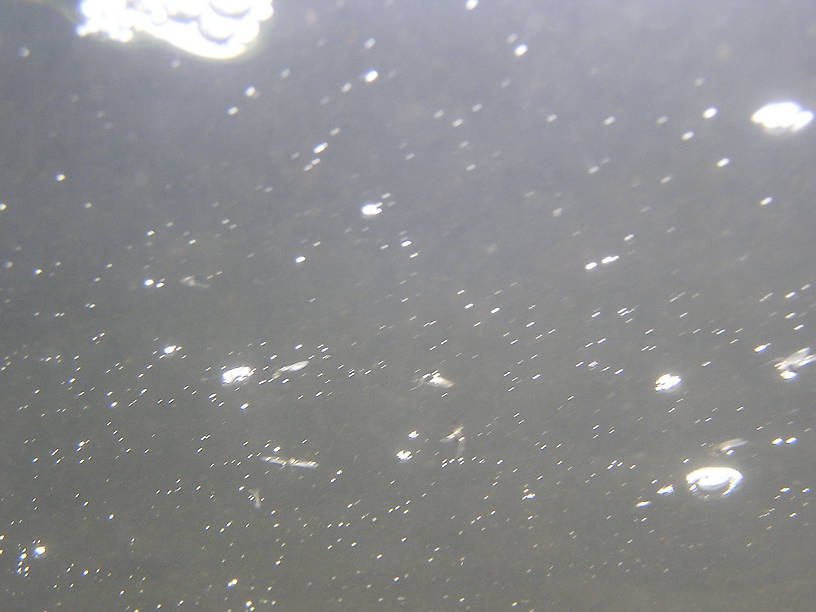
Here's the surface of the river viewed from below during a Tricorythodes spinner fall. Several dead spinners are visible.
In this picture: Mayfly Genus Tricorythodes (Tricos).
In this picture: Mayfly Genus Tricorythodes (Tricos).
StateWisconsin
LocationNamekagon River
Date TakenJul 18, 2004
Date AddedJan 25, 2006
AuthorTroutnut
CameraOlympus C740UZ
Recent Discussions of Leptohyphidae
Trico nymphs and emergers 5 Replies »
Posted by Steamntrout on Sep 10, 2021 in the genus Tricorythodes
Last reply on Jan 4, 2022 by Partsman
Recently I decided to tie up some trico soft hackle flies, and wanted to do as I have been for a while tie up Nymphs, emergers, and drys to have a better arsenal in my offerings.
I find very little on trico nymphs, and less for emergers.
Would really like to see some photos of the actual bug with actual measurements not hook sizes.
ReplyTrico emergers 6 Replies »I find very little on trico nymphs, and less for emergers.
Would really like to see some photos of the actual bug with actual measurements not hook sizes.
Posted by Bwoklink on Jul 14, 2018 in the genus Tricorythodes
Last reply on Sep 11, 2020 by Martinlf
Anyone have experience fishing Trico emergers patterns? I’ve had experience fishing the winged and spinner stage, but haven’t heard of anyone fishing emergers during the early morning female hatch. Anyone used emerger patterns and if so would you might sharing which ones you have found effective?
ReplyTrico Tips 50 Replies »Posted by Martinlf on Jul 21, 2007 in the genus Tricorythodes
Last reply on Jul 31, 2020 by Martinlf
I'll start with a fly patterns, follow with a bit of what I think I know about Tricos (Entomologists, please offer corrections if needed), and close with a few questions.
I love designing different patterns for Tricos, partly to keep myself entertained, and partly to show the fish something new from time to time. Jason's photos and the opinions of some fussy fish have led me to tie an extra large thorax recently on all my Tricos. My old standby is a parachute tied reverse, with a high vis post over the bend of the hook, and grizzly hackle, with no tails. It's modeled on Al's Trico, which could be found on the Little Lehigh Flyshop website until Rod closed the shop. An internet search may provide images now. It's very visible and fish generally approve. My newest fly is a take off from one of Gonzo's (Lloyd Gonzales) patterns in his book Fly-fishing Pressured Water, and it also shows the influence of Al's Trico. Gonzo ties an upside down Trico on a wide gap hook using synthetic material for the wing. I tie this fly also, and it certainly does catch fish, but I recently tied a version with grizzly hackle, making an oversize thorax and palmering hackle over the thorax to create a full wing. I then clipped hackle from the top of the fly (which becomes the bottom, as this is an upside down fly) so that the fly would sit flat, upside down, on my tying table. A drop of Locktite brush-on super glue on the bare recently clipped thorax after darkening the hackle stem with black marker and the fly was done. (By the way, I put tails on this one to balance it [P.S. Later correction: this pattern doesn't need the tails. I've caught plenty fish now on a tailless version] .) It caught several fish the first time I tried it on a heavily fished stream.
I believe for some, if not most species of Tricos, males hatch at night, females in the morning, and that the spinners fall when the air temperature hits the upper 60's. This generally means that as the season goes on, spinners hit the water later and later. Sometimes by 7:00 am (or earlier) in the early summer, by 10:00 (or later) in the fall.
It's been unseasonably cool in the Northeast the past couple of days, and I would have gone out this morning but for taking my daughter to a midnight showing of The Order of the Phoenix (I just couldn't get up) but I'm wondering if the spinner fall happens later than normal on cool mid-summer mornings like today's. I hope to find out Monday, but am curious if anyone has experiences to share. Also, does anyone have an effective Trico pattern to share? I'm always looking for ideas.
ReplyDifferences I'm dying to know about 2 Replies »I love designing different patterns for Tricos, partly to keep myself entertained, and partly to show the fish something new from time to time. Jason's photos and the opinions of some fussy fish have led me to tie an extra large thorax recently on all my Tricos. My old standby is a parachute tied reverse, with a high vis post over the bend of the hook, and grizzly hackle, with no tails. It's modeled on Al's Trico, which could be found on the Little Lehigh Flyshop website until Rod closed the shop. An internet search may provide images now. It's very visible and fish generally approve. My newest fly is a take off from one of Gonzo's (Lloyd Gonzales) patterns in his book Fly-fishing Pressured Water, and it also shows the influence of Al's Trico. Gonzo ties an upside down Trico on a wide gap hook using synthetic material for the wing. I tie this fly also, and it certainly does catch fish, but I recently tied a version with grizzly hackle, making an oversize thorax and palmering hackle over the thorax to create a full wing. I then clipped hackle from the top of the fly (which becomes the bottom, as this is an upside down fly) so that the fly would sit flat, upside down, on my tying table. A drop of Locktite brush-on super glue on the bare recently clipped thorax after darkening the hackle stem with black marker and the fly was done. (By the way, I put tails on this one to balance it [P.S. Later correction: this pattern doesn't need the tails. I've caught plenty fish now on a tailless version] .) It caught several fish the first time I tried it on a heavily fished stream.
I believe for some, if not most species of Tricos, males hatch at night, females in the morning, and that the spinners fall when the air temperature hits the upper 60's. This generally means that as the season goes on, spinners hit the water later and later. Sometimes by 7:00 am (or earlier) in the early summer, by 10:00 (or later) in the fall.
It's been unseasonably cool in the Northeast the past couple of days, and I would have gone out this morning but for taking my daughter to a midnight showing of The Order of the Phoenix (I just couldn't get up) but I'm wondering if the spinner fall happens later than normal on cool mid-summer mornings like today's. I hope to find out Monday, but am curious if anyone has experiences to share. Also, does anyone have an effective Trico pattern to share? I'm always looking for ideas.
Posted by Reify on Jul 8, 2018 in the genus Tricorythodes
Last reply on Jul 9, 2018 by Martinlf
What are the differences between Baetis, Caenis and Tricorythodes may flies. I get different answers from different FF buddies.
Thanks in advance
ReplyThe Tully Trico season 10 Replies »Thanks in advance
Posted by BioGriz on Jun 24, 2013 in the genus Tricorythodes
Last reply on Dec 17, 2013 by 12345
Preface: Any hatch where you are knee deep in trout rising and sipping bugs is awesome, regardeless if you are struggling to get a tight line. But on my home water the Tulpehocken Creek (Tully), which many of you from PA have fished before, Trico hatch brings problems...
1) Stressfull/unhealthy conditions for the trout. i.e. low water & high temps
2) A lot more fishing pressure from the "fair weather" community
I am a relative greenhorn compared to some of you who have decades of experience under your belt, and am just fishing for some general opinions here.
Had a great day at rebers using sze 22 trike spinner but i am noticing the tully temp is climbing. What kind of impact can we make on the stream? Is fishing in the morning and laying off the trout in the afternoon ok? or should the tully be left alone completely??
Thanks for your input!
Reply1) Stressfull/unhealthy conditions for the trout. i.e. low water & high temps
2) A lot more fishing pressure from the "fair weather" community
I am a relative greenhorn compared to some of you who have decades of experience under your belt, and am just fishing for some general opinions here.
Had a great day at rebers using sze 22 trike spinner but i am noticing the tully temp is climbing. What kind of impact can we make on the stream? Is fishing in the morning and laying off the trout in the afternoon ok? or should the tully be left alone completely??
Thanks for your input!
There are 5 more topics.
Your Thoughts On Leptohyphidae:
Top 10 Fly Hatches
 Baetis
 Baetidae
 Ephemerellidae
 Hexagenia limbata
 Chironomidae
 Ephemerella subvaria
 Heptageniidae
 Ephemerella
 Isonychia
 Hydropsychidae
Top Gift Shop Designs
 I outfish my daddy!
 Electric blue Hendrickson dun.
 I love buggers. Big, green, wooly ones.
 I outfish my husband!
 Be the trout.
 Eat mayflies.
Top Insect Specimens
 Baetisca obesa Mayfly Nymph
 Corydalus Hellgrammite Larva
 Neophylax Caddisfly Adult
 Pteronarcys biloba Stonefly Nymph
 Hydropsyche aenigma Caddisfly Adult
Miscellaneous Sites
Troutnut.com is copyright © 2004-2024 Jason
Neuswanger (email Jason). See my FAQ for information about use of my images.
 privacy policy
privacy policy