
Blog & Latest Updates
Fly Fishing Articles
Insects by Common Name


Mayfly Family Isonychiidae (Slate Drakes)


Taxonomic Navigation -?-
Kingdom
Animalia (Animals)
» Phylum
Arthropoda (Arthropods)
» Class
Insecta (Insects)
» Order
Ephemeroptera (Mayflies)
» Family Isonychiidae (Slate Drakes)
| Genus in Isonychiidae |  |  |
| IsonychiaSlate Drakes | 0 | 0 |
Common Name
| Match | Common Name |
 | Slate Drakes |
Pictures of 20 Mayfly Specimens in the Family Isonychiidae:
Male Isonychia bicolor (Mahogany Dun) Mayfly Spinner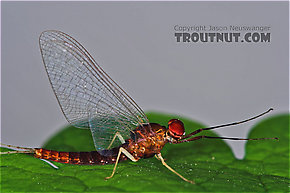 View 15 PicturesI got several really nice pictures of this spinner. I also collected a female on the same trip.
View 15 PicturesI got several really nice pictures of this spinner. I also collected a female on the same trip.Collected August 9, 2006 from the West Branch of Owego Creek in New York
Added to Troutnut.com by Troutnut on August 11, 2006
Added to Troutnut.com by Troutnut on August 11, 2006
Female Isonychia bicolor (Mahogany Dun) Mayfly Dun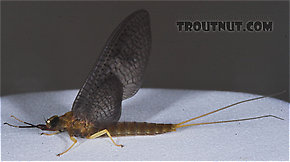 View 13 Pictures
View 13 PicturesCollected June 14, 2005 from the Namekagon River in Wisconsin
Added to Troutnut.com by Troutnut on May 26, 2006
Added to Troutnut.com by Troutnut on May 26, 2006
Female Isonychia bicolor (Mahogany Dun) Mayfly Spinner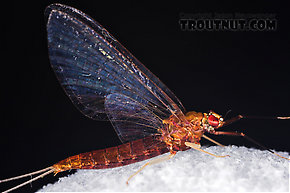 View 10 PicturesI collected this female together with a male.
View 10 PicturesI collected this female together with a male.Collected August 9, 2006 from the West Branch of Owego Creek in New York
Added to Troutnut.com by Troutnut on August 11, 2006
Added to Troutnut.com by Troutnut on August 11, 2006
Recent Discussions of Isonychiidae
Isonichya Bicolor 21 Replies »
I think the Iso. b. female was referred to a generation or so ago as the white gloved howdy. I love those old names. Too bad there are no pics of Potamanthus (golden drake). They may be extinct (siltation and acid rain?)...talked with Charlie Meck about that a few years ago. A beautiful mayfly...an important hatch of years past. I couldn't find any ref. to Epherons. An important hatch for me in about any area of the country. This my first post...love the site...very nice photog. Lets see what the strange weather of the year does to the hatches and fishing for this year. Overall, I expect it can't be good. CK
ReplyAre Isonychia mayflies technically multibrooded? 4 Replies »Here's what I've written in my article on Isonychia about their hatching:
I'm curious if they can really be called multibrooded or not, since they don't produce more than one generation per year (as far as I know). They simply have distinct populations within the same generation which emerge at different times during the year. Does that count?
All my books are packed up in boxes right now so I don't have a technical definition of the term handy.
ReplyPenns Creek Slate Draker's 4 Replies »Some Isonychia species are multibrooded, but not in the same way as most other multibrooded mayflies like the Baetidae. In those species, the flies emerging in midsummer or Fall are the offspring of the earlier hatch from the same year. In Isonychia, the Fall emergers are offspring from the previous Fall. They are present as half-grown nymphs when the first of their generation emerge. Although Isonychia broods have distinct peaks, some may be found on the water at any time in between.
I'm curious if they can really be called multibrooded or not, since they don't produce more than one generation per year (as far as I know). They simply have distinct populations within the same generation which emerge at different times during the year. Does that count?
All my books are packed up in boxes right now so I don't have a technical definition of the term handy.
Penns is one of the few places where a #10 iso will nail em' all year long
ReplyIso 1 Reply »Posted by JMV on Sep 21, 2006 in the species Isonychia bicolor
Last reply on Sep 21, 2006 by Troutnut
Great site, I'm an Iso. fanatic... JM
ReplyThere are 2 more topics.
Your Thoughts On Isonychiidae:
Top 10 Fly Hatches
 Baetis
 Baetidae
 Ephemerellidae
 Hexagenia limbata
 Chironomidae
 Ephemerella subvaria
 Heptageniidae
 Ephemerella
 Isonychia
 Hydropsychidae
Top Gift Shop Designs
 I outfish my daddy!
 Electric blue Hendrickson dun.
 I love buggers. Big, green, wooly ones.
 I outfish my husband!
 Be the trout.
 Eat mayflies.
Top Insect Specimens
 Baetisca obesa Mayfly Nymph
 Neophylax Caddisfly Adult
 Corydalus Hellgrammite Larva
 Isonychia bicolor Mayfly Spinner
 Ephemerella aurivillii Mayfly Spinner
Miscellaneous Sites
Troutnut.com is copyright © 2004-2024 Jason
Neuswanger (email Jason). See my FAQ for information about use of my images.
 privacy policy
privacy policy