
Blog & Latest Updates
Fly Fishing Articles
Insects by Common Name


Insect Order Hemiptera (True Bugs)


Taxonomic Navigation -?-
Kingdom
Animalia (Animals)
» Phylum
Arthropoda (Arthropods)
» Class
Insecta (Insects)
» Order Hemiptera (True Bugs)
| Family in Hemiptera |  |  |
| BelostomatidaeGiant Water Bugs | 0 | 0 |
| CicadellidaeLeafhoppers | 0 | 0 |
| CicadidaeCicadas | 0 | 0 |
| CorixidaeWater Boatmen | 0 | 7 |
| MembracidaeTreehoppers | 0 | 0 |
| NepidaeWater Scorpions | 0 | 0 |
| NotonectidaeBackswimmers | 0 | 0 |
11 families aren't included.
Common Name
| Match | Common Name |
 | True Bugs |
Perhaps the best known are the water boatmen of Corixidae, which are a primary trout food source at times in many high lakes, spring ponds, and slow-moving rivers. They are generally aquatic, although they may come out of the water to mate. I have seen good numbers of them flying over a northwoods river in late March, a sight that had me baffled until I captured one of the odd insects that kept flying past me and plunging into the water.
Other aquatic true bugs have received very little attention in
fly fishing literature, but they probably deserve more, because they are among the largest insects native to the trout's environment. The giant water bugs of Belostoma are especially favored, but trout also feed on the water scorpions of Nepidae. I plan soon to spend more time researching and imitating these insects to confirm my hunches and early observations.
The most famous terrestrial (Terrestrial: Insects which live on land and are fed on by trout only when they incidentally fall into the water are known as "terrestrials" to fly anglers, and they're very important in late summer.) members of Hemiptera are the cicadas, which make for good fishing on those rare years when a large brood appears. Late every summer some fly fishers turn to tiny related terrestrials (Terrestrial: Insects which live on land and are fed on by trout only when they incidentally fall into the water are known as "terrestrials" to fly anglers, and they're very important in late summer.) they call Jassids, which are the leaf hoppers and tree hoppers of the families Membracidae and Cicadellidae.
Pictures of 9 True Bug Specimens:
Belostoma flumineum (Electric Light Bug) Giant Water Bug Adult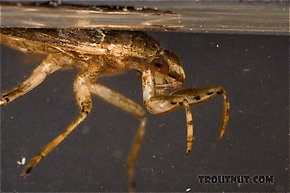 View 13 PicturesI'm glad I finally got one of these Belostoma water bugs under my good camera. I had been hoping to get one in my kick-net samples for a while with no luck, but I ended up finding this one drifting midstream just below the surface while I fished. I have frequently seen water scorpions do that, too, and I'm beginning to suspect that is a common situation travel for these large Hemiptera bugs, and perhaps the way trout are used to seeing them.
View 13 PicturesI'm glad I finally got one of these Belostoma water bugs under my good camera. I had been hoping to get one in my kick-net samples for a while with no luck, but I ended up finding this one drifting midstream just below the surface while I fished. I have frequently seen water scorpions do that, too, and I'm beginning to suspect that is a common situation travel for these large Hemiptera bugs, and perhaps the way trout are used to seeing them.Collected April 24, 2007 from the West Branch of Owego Creek in New York
Added to Troutnut.com by Troutnut on April 24, 2007
Added to Troutnut.com by Troutnut on April 24, 2007
Cicadidae (Cicadas) Cicada Adult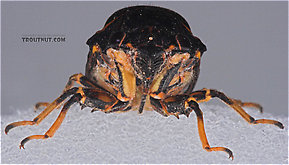 View 4 PicturesI found this cicada and several like it in the grass near my car as I put my waders on. Some of them were singing in the trees above the river, too, but I did not see any fall into the water.
View 4 PicturesI found this cicada and several like it in the grass near my car as I put my waders on. Some of them were singing in the trees above the river, too, but I did not see any fall into the water.Collected July 1, 2005 from the Bois Brule River in Wisconsin
Added to Troutnut.com by Troutnut on April 22, 2006
Added to Troutnut.com by Troutnut on April 22, 2006
Ranatra Water Scorpion Adult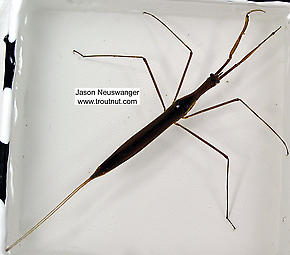 View 7 PicturesHere's a big water scorpion (no relation to actual scorpions). These guys are just about the most sinister-looking creatures you could find, and what's especially creepy is that they can come up out of the water and fly around, as I learned when one left my aquarium and buzzed my head while I was peeking into the microscope at a mayfly nymph.
View 7 PicturesHere's a big water scorpion (no relation to actual scorpions). These guys are just about the most sinister-looking creatures you could find, and what's especially creepy is that they can come up out of the water and fly around, as I learned when one left my aquarium and buzzed my head while I was peeking into the microscope at a mayfly nymph.Collected March 10, 2004 from unknown in Wisconsin
Added to Troutnut.com by Troutnut on January 25, 2006
Added to Troutnut.com by Troutnut on January 25, 2006
7 Underwater Pictures of True Bugs:


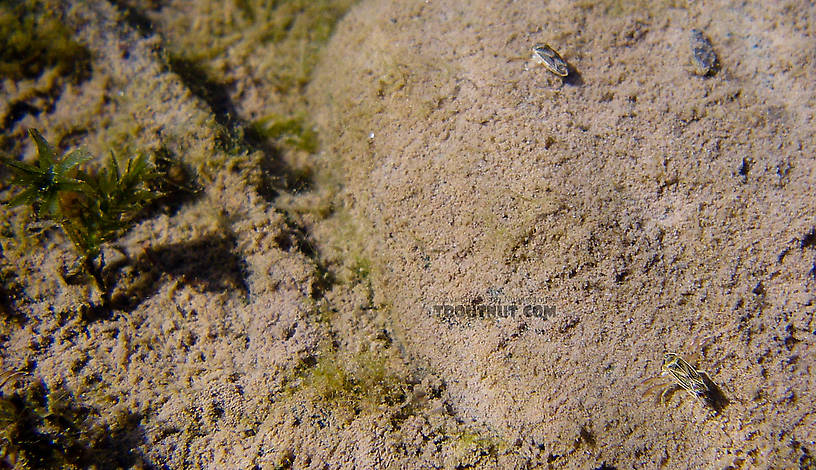
A careful look at this picture reveals at least three water boatmen swimming around.
In this picture: True Bug Family Corixidae (Water Boatmen).
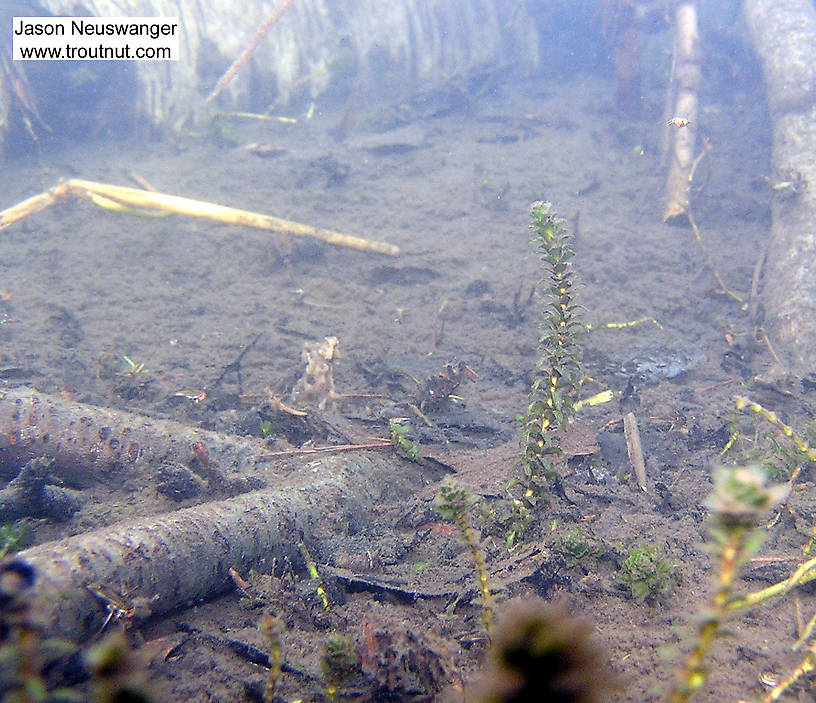
In this picture: True Bug Family Corixidae (Water Boatmen).
StateWisconsin
LocationNamekagon River
Date TakenMar 24, 2004
Date AddedJan 25, 2006
AuthorTroutnut
CameraOlympus C740UZ
StateWisconsin
LocationNamekagon River
Date TakenMar 24, 2004
Date AddedJan 25, 2006
AuthorTroutnut
CameraOlympus C740UZ
Recent Discussions of Hemiptera
DO You Remember??? 6 Replies »
My brother and I have a disagreement about bugs from our childhood.
I remember a swarm of cicadas (17-year locusts), and I'm trying to place the year. It would be 1954 to 1959, I believe. I remember the cicadas' distinctive call ringing through the summer (spring?) night. They covered anything that shed light—lampposts, storefront windows, porch lights. They were about in huge numbers. When you walked down the street, you couldn't avoid stepping on them, and they crunched. (Big bugs.)
My brother says he only recalls a mayfly swarm—post 1959—that was so bad it caused auto accidents on the freeway because cars ran over the mayfly bodies and collectively they were greasy and caused cars to skid.
So does anyone out there remember either of these events. I think both probably occurred. We'd like to pin down the years.
Janney
ReplyAnyone else find these to be important? 2 Replies »I remember a swarm of cicadas (17-year locusts), and I'm trying to place the year. It would be 1954 to 1959, I believe. I remember the cicadas' distinctive call ringing through the summer (spring?) night. They covered anything that shed light—lampposts, storefront windows, porch lights. They were about in huge numbers. When you walked down the street, you couldn't avoid stepping on them, and they crunched. (Big bugs.)
My brother says he only recalls a mayfly swarm—post 1959—that was so bad it caused auto accidents on the freeway because cars ran over the mayfly bodies and collectively they were greasy and caused cars to skid.
So does anyone out there remember either of these events. I think both probably occurred. We'd like to pin down the years.
Janney
Posted by Troutnut on Jul 26, 2006 in the species Belostoma flumineum
Last reply on Oct 9, 2006 by GONZO
Back when I was just starting to learn to fly fish and still kept quite a few fish, I autopsied the stomachs of a couple 17-19 inch brown trout in August and found them packed with these Belostoma flumineum bugs.
I haven't tied a reasonable imitation yet, but if those fish (from a few miles apart on the same river) were so fond of them an imitation is probably a great idea. It would be good to figure out where and when these things are important.
None of the fly fishing literatue I've seen has dealt with them at all, except for mentioning their existence in passing.
ReplyI haven't tied a reasonable imitation yet, but if those fish (from a few miles apart on the same river) were so fond of them an imitation is probably a great idea. It would be good to figure out where and when these things are important.
None of the fly fishing literatue I've seen has dealt with them at all, except for mentioning their existence in passing.
Your Thoughts On Hemiptera:
Top 10 Fly Hatches
 Baetis
 Baetidae
 Ephemerellidae
 Hexagenia limbata
 Chironomidae
 Ephemerella subvaria
 Heptageniidae
 Ephemerella
 Isonychia
 Hydropsychidae
Top Gift Shop Designs
 I outfish my daddy!
 Electric blue Hendrickson dun.
 I love buggers. Big, green, wooly ones.
 I outfish my husband!
 Be the trout.
 Eat mayflies.
Top Insect Specimens
 Baetisca obesa Mayfly Nymph
 Neophylax Caddisfly Adult
 Corydalus Hellgrammite Larva
 Isonychia bicolor Mayfly Spinner
 Ephemerella aurivillii Mayfly Spinner
Miscellaneous Sites
Troutnut.com is copyright © 2004-2024 Jason
Neuswanger (email Jason). See my FAQ for information about use of my images.
 privacy policy
privacy policy