
Blog & Latest Updates
Fly Fishing Articles
Insects by Common Name


Caddisfly Family Philopotamidae


Taxonomic Navigation -?-
Kingdom
Animalia (Animals)
» Phylum
Arthropoda (Arthropods)
» Class
Insecta (Insects)
» Order
Trichoptera (Caddisflies)
» Family Philopotamidae
| Genus in Philopotamidae |  |  |
| ChimarraLittle Black Sedges | 2 | 10 |
| DolophilodesMedium Evening Sedges | 5 | 27 |
| WormaldiaLittle Autumn Sedges | 0 | 0 |
Larva & Pupa Biology
Shelter Type: Very fine-meshed nets
Pictures of 8 Caddisfly Specimens in the Family Philopotamidae:
Male Dolophilodes distinctus (Tiny Black Gold Speckled-Winged Caddis) Caddisfly Adult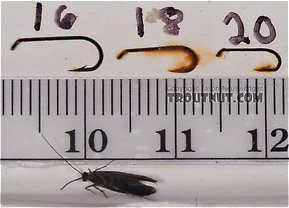 View 6 PicturesThis caddis species was dancing high over the stream, spaced a foot or two apart across most of its width, very much like Ephemera mayfly spinners but with more side-to-side motion mixed in. There were more than enough to get the trout interested, but I wasn't able to stick around until they fell on the water (if they did at all).
View 6 PicturesThis caddis species was dancing high over the stream, spaced a foot or two apart across most of its width, very much like Ephemera mayfly spinners but with more side-to-side motion mixed in. There were more than enough to get the trout interested, but I wasn't able to stick around until they fell on the water (if they did at all).Collected May 28, 2007 from Mystery Creek #42 in Pennsylvania
Added to Troutnut.com by Troutnut on June 4, 2007
Added to Troutnut.com by Troutnut on June 4, 2007
Female Dolophilodes distinctus (Tiny Black Gold Speckled-Winged Caddis) Caddisfly Adult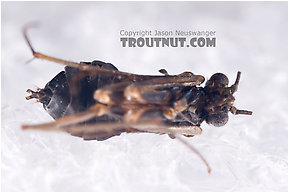 View 6 PicturesThis is a really strange specimen. I would guess it's one of the dry caddis pupa that scoots across the surface of the water as a pupa rather than emerging right away. Its "wing pads (
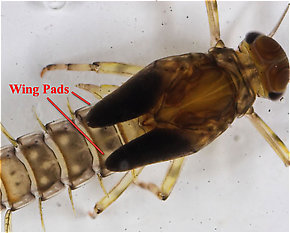 Wing pad: A protrusion from the thorax of an insect nymph which holds the developing wings. Black wing pads usually indicate that the nymph is nearly ready to emerge into an adult.)" sure don't look right, though. Maybe they're deformed and that's why I was able to find this one as a pupa in the first place. It also looks like it might be a caddis adult missing its wings, but since I found three of them, that kind of rules out such an anomalous maiming.
I found this one and one other on a midstream rock. The previous day, I caught a similar creature kicking around on the water's surface.
This one died and shriveled a little bit before I could photograph it, but it's basically in its original shape.
View 6 PicturesThis is a really strange specimen. I would guess it's one of the dry caddis pupa that scoots across the surface of the water as a pupa rather than emerging right away. Its "wing pads (
The wing pads on this final instar Baetidae mayfly nymph are extremely dark.
I found this one and one other on a midstream rock. The previous day, I caught a similar creature kicking around on the water's surface.
This one died and shriveled a little bit before I could photograph it, but it's basically in its original shape.
Collected May 29, 2007 from Brodhead Creek in Pennsylvania
Added to Troutnut.com by Troutnut on June 4, 2007
Added to Troutnut.com by Troutnut on June 4, 2007
Chimarra (Little Black Sedges) Caddisfly Larva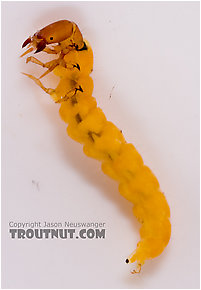 View 6 Pictures
View 6 PicturesCollected March 30, 2007 from Fall Creek in New York
Added to Troutnut.com by Troutnut on April 2, 2007
Added to Troutnut.com by Troutnut on April 2, 2007
Recent Discussions of Philopotamidae
Emerger pictures anyone??? 7 Replies »
I would like to see a picture of an emerging Chimarra or a pupa stage before emerging if anyone has one. I am baffled and curious to how and when they change from a yellow/orange larva to a black adult fly. Also, what would be a good emerger pattern for this fly? Lafontaine emerger in what color?
Replyovipositing? 6 Replies »Posted by Btopbuckeye on Mar 4, 2015 in the genus Chimarra
Last reply on Mar 6, 2015 by Crepuscular
I had a large swarm of black sedges in a size 16 ovipositing today.the females hadvblack wings and body with a green egg sack was just wondering if that is this genus or something totally different
ReplyPupa color? 6 Replies »Seems like dead drifting the pupa pattern during the emergence time is a good way to fish this before the adults are on the water.
Does the pupa retain the orange color of the larva or do they have the color of the adult?
Replybright green? 1 Reply »Does the pupa retain the orange color of the larva or do they have the color of the adult?
Posted by Phishheaduj on Jan 12, 2009 in the genus Chimarra
Last reply on Jan 12, 2009 by Taxon
i recently came across with a bright green one of these. Is that the same or a completely different species?
ReplyThere are 10 more topics.
Your Thoughts On Philopotamidae:
Jargon Defined:
Emergence: The transformation of a nymph or pupa into the adult winged stage of an insect. The term may refer to the emergence of an individual, or the daily or yearly event in which all individuals of a species emerge.
Pupa: Any insect which spends most of its juvenile lifetime as a larva first becomes a pupa for a time before emerging as a fully grown adult. Depending on the species, the pupal form can be very important for fly fishermen to imitate.
The wing pads on this final instar Baetidae mayfly nymph are extremely dark.
Useful References:
LaFontaine, Gary. 1981. Caddisflies. The Lyons Press.
Top 10 Fly Hatches
 Baetis
 Baetidae
 Ephemerellidae
 Hexagenia limbata
 Chironomidae
 Ephemerella subvaria
 Heptageniidae
 Ephemerella
 Isonychia
 Hydropsychidae
Top Gift Shop Designs
 I outfish my daddy!
 Electric blue Hendrickson dun.
 I love buggers. Big, green, wooly ones.
 I outfish my husband!
 Be the trout.
 Eat mayflies.
Top Insect Specimens
 Baetisca obesa Mayfly Nymph
 Neophylax Caddisfly Adult
 Corydalus Hellgrammite Larva
 Isonychia bicolor Mayfly Spinner
 Ephemerella aurivillii Mayfly Spinner
Miscellaneous Sites
Troutnut.com is copyright © 2004-2024 Jason
Neuswanger (email Jason). See my FAQ for information about use of my images.
 privacy policy
privacy policy