
Blog & Latest Updates
Fly Fishing Articles
Insects by Common Name


Insect Order Diptera (True Flies)


Taxonomic Navigation -?-
Kingdom
Animalia (Animals)
» Phylum
Arthropoda (Arthropods)
» Class
Insecta (Insects)
» Order Diptera (True Flies)


21 families aren't included.
Common Name
| Match | Common Name |
 | True Flies |
This is page 2 of specimens of Diptera. Visit the main Diptera page for:
- The behavior and habitat of Diptera.
- 9 underwater pictures of Diptera.
Pictures of 56 True Fly Specimens:
Pedicia albivitta (Giant Eastern Crane Fly) True Fly Larva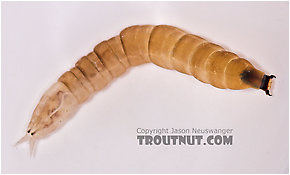 View 9 Pictures
View 9 PicturesCollected March 29, 2005 from Fall Creek in New York
Added to Troutnut.com by Troutnut on April 6, 2006
Added to Troutnut.com by Troutnut on April 6, 2006
Stenochironomus poecilopterus Midge Adult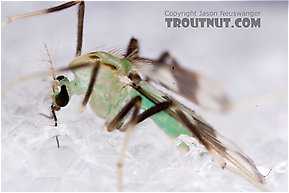 View 6 Pictures
View 6 PicturesCollected May 6, 2007 from Mystery Creek #62 in New York
Added to Troutnut.com by Troutnut on May 18, 2007
Added to Troutnut.com by Troutnut on May 18, 2007
Chironomidae (Midges) Midge Larva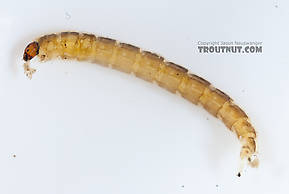 View 3 Pictures
View 3 PicturesCollected July 17, 2011 from the Gulkana River in Alaska
Added to Troutnut.com by Troutnut on July 20, 2011
Added to Troutnut.com by Troutnut on July 20, 2011
Female Chironomidae (Midges) Midge Adult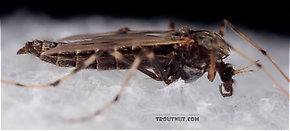 View 5 PicturesThis midge and several like it, including a male I also photographed, hatched from larvae which were living in some fine mud I'm using as substrate in my bug-rearing aquarium. This one flew away before I could photograph it on the ruler, but it would have measured slightly smaller than the male.
View 5 PicturesThis midge and several like it, including a male I also photographed, hatched from larvae which were living in some fine mud I'm using as substrate in my bug-rearing aquarium. This one flew away before I could photograph it on the ruler, but it would have measured slightly smaller than the male.Collected April 10, 2007 from Mystery Creek #62 in New York
Added to Troutnut.com by Troutnut on April 10, 2007
Added to Troutnut.com by Troutnut on April 10, 2007
Rheotanytarsus Midge Larva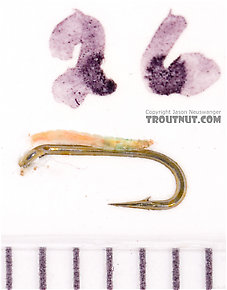 View 6 PicturesThis peculiar midge lived in a case tightly fixed to a rock, with several others of its kind. The case seems to be made of tiny grains of sand. I'm not sure what the function is for the little lines sticking out the front, because they aren't legs.
View 6 PicturesThis peculiar midge lived in a case tightly fixed to a rock, with several others of its kind. The case seems to be made of tiny grains of sand. I'm not sure what the function is for the little lines sticking out the front, because they aren't legs.Collected April 14, 2007 from Cayuta Creek in New York
Added to Troutnut.com by Troutnut on April 22, 2007
Added to Troutnut.com by Troutnut on April 22, 2007
Simuliidae (Black Flies) Black Fly Larva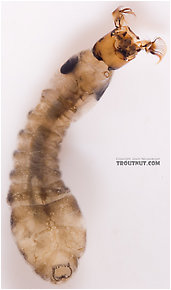 View 6 Pictures
View 6 PicturesCollected March 30, 2007 from Fall Creek in New York
Added to Troutnut.com by Troutnut on April 2, 2007
Added to Troutnut.com by Troutnut on April 2, 2007
Chironomidae (Midges) Midge Larva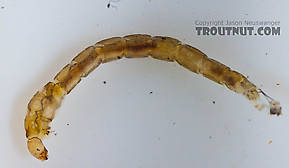 View 5 Pictures
View 5 PicturesCollected May 10, 2008 from the Chena River in Alaska
Added to Troutnut.com by Troutnut on April 20, 2011
Added to Troutnut.com by Troutnut on April 20, 2011
Ptychopteridae (Phantom Crane Flies) Phantom Crane Fly Larva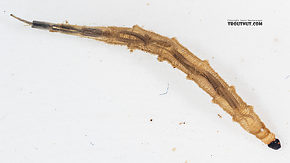 View 7 Pictures
View 7 PicturesCollected July 28, 2019 from Mystery Creek #199 in Washington
Added to Troutnut.com by Troutnut on July 30, 2019
Added to Troutnut.com by Troutnut on July 30, 2019
Tipulidae (Crane Flies) Crane Fly Larva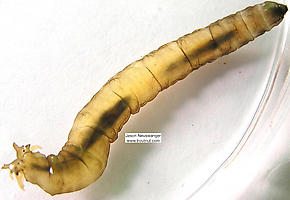 View 4 Pictures
View 4 PicturesCollected January 14, 2004 from unknown in Wisconsin
Added to Troutnut.com by Troutnut on January 25, 2006
Added to Troutnut.com by Troutnut on January 25, 2006
Hexatoma True Fly Larva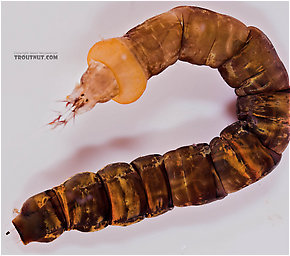 View 6 PicturesI'm not sure if this cranefly larva is in the genus Hexatoma or Limnophila, but the habitat suggests Hexatoma. Its coloring is iridescent, and I've never heard of that before. However, there is an insect virus genus Iridovirus which can infect craneflies and causes iridescence. It has not been reported in this region as far as I can tell, but perhaps it is the culprit. It makes for beautiful pictures.
View 6 PicturesI'm not sure if this cranefly larva is in the genus Hexatoma or Limnophila, but the habitat suggests Hexatoma. Its coloring is iridescent, and I've never heard of that before. However, there is an insect virus genus Iridovirus which can infect craneflies and causes iridescence. It has not been reported in this region as far as I can tell, but perhaps it is the culprit. It makes for beautiful pictures.Collected April 19, 2006 from Mongaup Creek in New York
Added to Troutnut.com by Troutnut on April 21, 2006
Added to Troutnut.com by Troutnut on April 21, 2006
Top 10 Fly Hatches
 Baetis
 Baetidae
 Ephemerellidae
 Hexagenia limbata
 Chironomidae
 Ephemerella subvaria
 Heptageniidae
 Ephemerella
 Isonychia
 Hydropsychidae
Top Gift Shop Designs
 I outfish my daddy!
 Electric blue Hendrickson dun.
 I love buggers. Big, green, wooly ones.
 I outfish my husband!
 Be the trout.
 Eat mayflies.
Top Insect Specimens
 Baetisca obesa Mayfly Nymph
 Neophylax Caddisfly Adult
 Corydalus Hellgrammite Larva
 Isonychia bicolor Mayfly Spinner
 Ephemerella aurivillii Mayfly Spinner
Miscellaneous Sites
Troutnut.com is copyright © 2004-2024 Jason
Neuswanger (email Jason). See my FAQ for information about use of my images.
 privacy policy
privacy policy