
Blog & Latest Updates
Fly Fishing Articles
Insects by Common Name

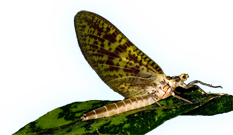
Mayfly Genus Maccaffertium (March Browns and Cahills)


Taxonomic Navigation -?-
Kingdom
Animalia (Animals)
» Phylum
Arthropoda (Arthropods)
» Class
Insecta (Insects)
» Order
Ephemeroptera (Mayflies)
» Genus Maccaffertium (March Browns and Cahills)


8 species aren't included.
Common Name
| Match | Common Name |
 | March Browns and Cahills |
"There is a matrimony between Stenonema flies and Catskill rivers that is as synonymous as ham and eggs."
A lot has changed in the intervening years. Excepting a handful of species moved to Stenacron, most have been moved to the new genus Maccaffertium. By far the most important species is Maccaffertium vicarium (March Brown & Gray Fox). Of the others in the "Cahill" group, Maccaffertium ithaca is the next most important, along with Maccaffertium modestum and Maccaffertium pulchellum that also produce localized fishable hatches. These lesser species together with a few species of Stenacron and the last remaining species in Stenonema (femoratum) represent the sporadic Light Cahill hatches on evenings in late Spring that often continue throughout the Summer.
Anglers looking for information on the popular species Stenonema fuscum (Gray Fox) should know that it has been combined with Maccaffertium vicarium (March Brown) and is now only considered a lighter and slightly smaller version of the same species.
Where & When
Regions: East, Midwest
This genus is only important in the East and Midwest. In the spring there are superhatches of Maccaffertium vicarium. The lesser species are primary players on the barren stage of summer evening mayfly hatches. Most of them emerge sporadically for months. Anglers know them as Light Cahills and Cream Cahills, and they often reinforce hatches of the closely related Light Cahill species Stenacron interpunctatum.Hatching Behavior
The early-season species of Maccaffertium crawl to slow, shallow water before emerging. Apparently they lose their grip or otherwise end up in the drift during this movement, because they are common in the trout's diet in the weeks before they emerge. Common attractor (Attractor: Flies not designed to imitate any particular insect, but to incorporate characteristics attractive to trout. When trout aren't feeding selectively, attractors often outperform careful imitations as searching patterns because they are easier to see and incorporate more strike-triggering characteristics. They include legends like the Adams, Bivisible, and Royal Wulff.) nymphs like the Hare's Ear are good likenesses of this genus.
Most of them are good dry fly insects because they take a long time to emerge and ride the water for a while before getting airborne. They are generally sporadic emergers, but their high populations put at least a few of these insects on the water most nights of the spring and summer.
Nymph Biology
Maccaffertium mayfly nymphs are very adept clingers, but most species are at home in all stream habitats. They (and their close relatives in Stenonema and Stenacron) do not have the high oxygen requirements of the other genera in Heptageniidae.
Pictures of 59 Mayfly Specimens in the Genus Maccaffertium:
Female Maccaffertium (March Browns and Cahills) Mayfly Adult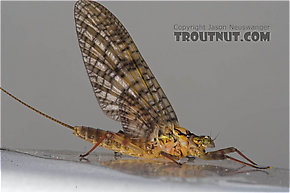 View 13 Pictures
View 13 PicturesCollected May 26, 2005 from the Namekagon River in Wisconsin
Added to Troutnut.com by Troutnut on May 16, 2006
Added to Troutnut.com by Troutnut on May 16, 2006
Female Maccaffertium ithaca (Light Cahill) Mayfly Dun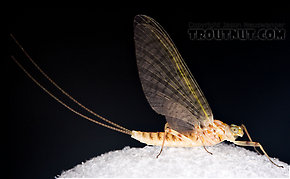 View 10 PicturesThis female looks very much like a male I collected a few hundred miles away a few days later, so I'm guessing it's the same species, which I believe is Maccaffertium mediopunctatum.
View 10 PicturesThis female looks very much like a male I collected a few hundred miles away a few days later, so I'm guessing it's the same species, which I believe is Maccaffertium mediopunctatum.Collected May 23, 2007 from the Little Juniata River in Pennsylvania
Added to Troutnut.com by Troutnut on June 4, 2007
Added to Troutnut.com by Troutnut on June 4, 2007
Male Maccaffertium vicarium (March Brown) Mayfly Dun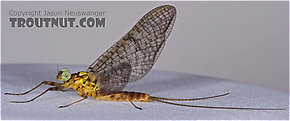 View 10 PicturesI collected this mayfly on the same trip as a female of the same species. After these photos it molted into a spinner. This is the form of Maccaffertium vicarium which anglers call the "Gray Fox."
View 10 PicturesI collected this mayfly on the same trip as a female of the same species. After these photos it molted into a spinner. This is the form of Maccaffertium vicarium which anglers call the "Gray Fox."Collected May 28, 2005 from the Namekagon River in Wisconsin
Added to Troutnut.com by Troutnut on May 24, 2006
Added to Troutnut.com by Troutnut on May 24, 2006
1 Underwater Picture of Maccaffertium Mayflies:


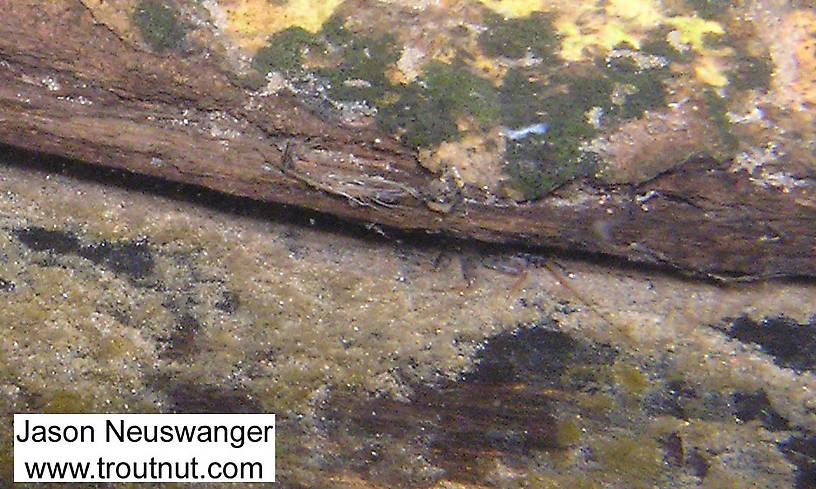
StateWisconsin
LocationNamekagon River
Date TakenApr 25, 2004
Date AddedJan 25, 2006
AuthorTroutnut
CameraOlympus C740UZ
Recent Discussions of Maccaffertium
M. ithaca in M. mediopunctatum section? 3 Replies »
Posted by GONZO on Sep 1, 2012 in the species Maccaffertium mediopunctatum
Last reply on Sep 4, 2012 by Entoman
Hi Jason,
In this section, the Midwestern nymphs (#573 & #574) with the dark irregular ventral bars across the anterior portion of the sternites look like Maccaffertium mediopunctatum arwini (the Midwestern ssp.), but the two Eastern duns (#733 & #765) and the associated shuck (of #765) and nymph (#764) look more like Maccaffertium ithaca to me.
Three Maccaffertium species can have very similar ventral markings in the nymph—dark, sinuate, chevron-shaped bars on many of the sternites and dark lateral marks (sometimes connected to form an inverted U-shaped mark) on segment 9. The Eastern mediopunctatum subspecies, M. m. mediopunctatum, has these markings, as does M. ithaca. Similar markings also appear as a less-common variant marking of M. modestum (or the M. modestum species complex). However, these species differ in the length and location of posterolateral projections, leg markings, the appearance of the subs and adults, and size.
Although interpretation of posterolateral projections can be tricky, those projections should help to separate the nymph (and husk) from mediopunctatum. On mediopunctatum, projections are usually on segments 3-9, 4-9, or 5-9, and those on 8 and 9 are fairly long. On ithaca, projections are usually on segments 6-9 or 7-9, and those on 8 and 9 are somewhat shorter (when compared to mediopunctatum). The twin brown bands on the femora of the nymphs should also help to separate them from modestum and mediopunctatum (usually three or four in those species).
The brown posterior margins and median dorsal stripes of the duns (similar to those found in M. vicarium) are typical of ithaca. In McDunnough’s original description of mediopunctatum (1926), he mentions that some of his (paratype) specimens were reared from subimagos, and he describes those subimagos as “quite pale whitish in coloration.”
Size might also be somewhat helpful in distinguishing these specimens from M. m. mediopunctatum (about 7-10 mm at maturity) and modestum (about 8-11 mm at maturity). M. ithaca is about 9-14 mm at maturity. The relatively mature nymph (#764) is at least 11 mm, the female dun (#733) is about 13 mm, and the male dun (#765) is about 11 mm.
When all of these factors are considered, it seems to me that M. ithaca is a more likely ID for the Eastern specimens. (See Bednarik and McCafferty 1979 and Lewis 1974.) I would suggest the following placement for specimens currently in this section:
M. ithaca nymph: http://www.troutnut.com/specimen/764
M. ithaca female dun: http://www.troutnut.com/specimen/733
M. ithaca male dun: http://www.troutnut.com/specimen/765
M. mediopunctatum arwini nymph: http://www.troutnut.com/specimen/573
M. mediopunctatum arwini nymph: http://www.troutnut.com/specimen/574
Best,
Lloyd
Reply2 tails or 3 1 Reply »In this section, the Midwestern nymphs (#573 & #574) with the dark irregular ventral bars across the anterior portion of the sternites look like Maccaffertium mediopunctatum arwini (the Midwestern ssp.), but the two Eastern duns (#733 & #765) and the associated shuck (of #765) and nymph (#764) look more like Maccaffertium ithaca to me.
Three Maccaffertium species can have very similar ventral markings in the nymph—dark, sinuate, chevron-shaped bars on many of the sternites and dark lateral marks (sometimes connected to form an inverted U-shaped mark) on segment 9. The Eastern mediopunctatum subspecies, M. m. mediopunctatum, has these markings, as does M. ithaca. Similar markings also appear as a less-common variant marking of M. modestum (or the M. modestum species complex). However, these species differ in the length and location of posterolateral projections, leg markings, the appearance of the subs and adults, and size.
Although interpretation of posterolateral projections can be tricky, those projections should help to separate the nymph (and husk) from mediopunctatum. On mediopunctatum, projections are usually on segments 3-9, 4-9, or 5-9, and those on 8 and 9 are fairly long. On ithaca, projections are usually on segments 6-9 or 7-9, and those on 8 and 9 are somewhat shorter (when compared to mediopunctatum). The twin brown bands on the femora of the nymphs should also help to separate them from modestum and mediopunctatum (usually three or four in those species).
The brown posterior margins and median dorsal stripes of the duns (similar to those found in M. vicarium) are typical of ithaca. In McDunnough’s original description of mediopunctatum (1926), he mentions that some of his (paratype) specimens were reared from subimagos, and he describes those subimagos as “quite pale whitish in coloration.”
Size might also be somewhat helpful in distinguishing these specimens from M. m. mediopunctatum (about 7-10 mm at maturity) and modestum (about 8-11 mm at maturity). M. ithaca is about 9-14 mm at maturity. The relatively mature nymph (#764) is at least 11 mm, the female dun (#733) is about 13 mm, and the male dun (#765) is about 11 mm.
When all of these factors are considered, it seems to me that M. ithaca is a more likely ID for the Eastern specimens. (See Bednarik and McCafferty 1979 and Lewis 1974.) I would suggest the following placement for specimens currently in this section:
M. ithaca nymph: http://www.troutnut.com/specimen/764
M. ithaca female dun: http://www.troutnut.com/specimen/733
M. ithaca male dun: http://www.troutnut.com/specimen/765
M. mediopunctatum arwini nymph: http://www.troutnut.com/specimen/573
M. mediopunctatum arwini nymph: http://www.troutnut.com/specimen/574
Best,
Lloyd
Posted by Snagy on Feb 5, 2010 in the species Maccaffertium vicarium
Last reply on Feb 6, 2010 by Taxon
I notice that while the dun, nymph, and spinner photos on the page are all listed as March Brown (maccaffertium vicarium). While the coloration patterns all seem to follow other March Browns I have seen, I notice that the winged flies pictures all have 2 tails, but the nymphs in the photos have 3. I was under the impression this species was a 2 tailed mayfly. Is the nymph mislabelled?
ReplyAnybody know more about Maccaffertium terminatum? 3 Replies »Posted by Troutnut on Jun 8, 2007 in the species Maccaffertium terminatum
Last reply on Jun 11, 2007 by Konchu
I just wrote up what I found on the page for this species. I was mildly surprised to see so many of a species I've never seen mentioned in an angling context -- at least a few dozen throughout the evening. They piqued my curiosity.
Replydiff between march brown &gray fox 7 Replies »Posted by Jrcald on Mar 12, 2007 in the species Maccaffertium vicarium
Last reply on Mar 13, 2007 by Troutnut
i know that gray foxs and march browns are classified in the same family but what are the differences ? what is the color differences are both bodies the same color tan ?
ReplyThere is 1 more topic.
Your Thoughts On Maccaffertium:
Top 10 Fly Hatches
 Baetis
 Baetidae
 Ephemerellidae
 Hexagenia limbata
 Chironomidae
 Ephemerella subvaria
 Heptageniidae
 Ephemerella
 Isonychia
 Hydropsychidae
Top Gift Shop Designs
 I outfish my daddy!
 Electric blue Hendrickson dun.
 I love buggers. Big, green, wooly ones.
 I outfish my husband!
 Be the trout.
 Eat mayflies.
Top Insect Specimens
 Baetisca obesa Mayfly Nymph
 Corydalus Hellgrammite Larva
 Neophylax Caddisfly Adult
 Pteronarcys biloba Stonefly Nymph
 Hydropsyche aenigma Caddisfly Adult
Miscellaneous Sites
Troutnut.com is copyright © 2004-2024 Jason
Neuswanger (email Jason). See my FAQ for information about use of my images.
 privacy policy
privacy policy