
Blog & Latest Updates
Fly Fishing Articles
Insects by Common Name


Mayfly Genus Ephemerella (Hendricksons, Sulphurs, PMDs)


Taxonomic Navigation -?-
Kingdom
Animalia (Animals)
» Phylum
Arthropoda (Arthropods)
» Class
Insecta (Insects)
» Order
Ephemeroptera (Mayflies)
» Genus Ephemerella (Hendricksons, Sulphurs, PMDs)


11 species aren't included.
Common Name
| Match | Common Name |
 | Hendricksons, Sulphurs, PMDs |
This is page 3 of specimens of Ephemerella. Visit the main Ephemerella page for:
- The behavior and habitat of Ephemerella.
- 37 underwater pictures of Ephemerella.
Pictures of 158 Mayfly Specimens in the Genus Ephemerella:
Ephemerella subvaria (Hendrickson) Mayfly Nymph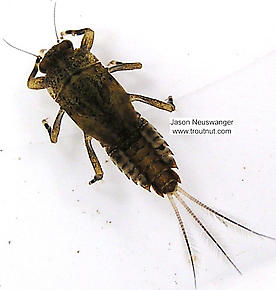 View 7 PicturesThis is another unusual brown Ephemerella nymph. The "fan-tail" which defines the Ephemerella genus is particularly evident on this specimen.
View 7 PicturesThis is another unusual brown Ephemerella nymph. The "fan-tail" which defines the Ephemerella genus is particularly evident on this specimen.Collected February 7, 2004 from unknown in Wisconsin
Added to Troutnut.com by Troutnut on January 25, 2006
Added to Troutnut.com by Troutnut on January 25, 2006
Ephemerella aurivillii Mayfly Nymph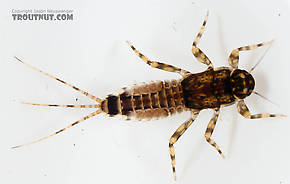 View 7 Pictures
View 7 PicturesCollected May 10, 2008 from the Chena River in Alaska
Added to Troutnut.com by Troutnut on April 20, 2011
Added to Troutnut.com by Troutnut on April 20, 2011
Female Ephemerella subvaria (Hendrickson) Mayfly Dun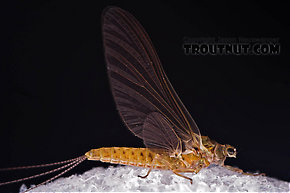 View 9 PicturesI collected this female Hendrickson dun and a male in the pool on the Beaverkill where the popular Hendrickson pattern was first created. She is descended from mayfly royalty.
View 9 PicturesI collected this female Hendrickson dun and a male in the pool on the Beaverkill where the popular Hendrickson pattern was first created. She is descended from mayfly royalty.Collected April 19, 2006 from the Beaverkill River in New York
Added to Troutnut.com by Troutnut on April 22, 2006
Added to Troutnut.com by Troutnut on April 22, 2006
Ephemerella excrucians (Pale Morning Dun) Mayfly Nymph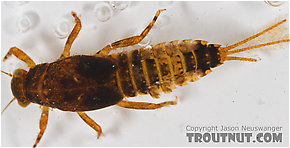 View 5 PicturesI spent (Spent: The wing position of many aquatic insects when they fall on the water after mating. The wings of both sides lay flat on the water. The word may be used to describe insects with their wings in that position, as well as the position itself.) a while with a microscope to fairly positively identify this specimen as Ephemerella excrucians.
View 5 PicturesI spent (Spent: The wing position of many aquatic insects when they fall on the water after mating. The wings of both sides lay flat on the water. The word may be used to describe insects with their wings in that position, as well as the position itself.) a while with a microscope to fairly positively identify this specimen as Ephemerella excrucians.Collected June 9, 2005 from the Bois Brule River in Wisconsin
Added to Troutnut.com by Troutnut on May 26, 2006
Added to Troutnut.com by Troutnut on May 26, 2006
Ephemerella needhami (Little Dark Hendrickson) Mayfly Nymph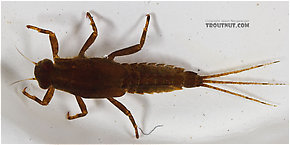 View 5 PicturesI took quite a few notes at the microscope when I collected this specimen. They're attached to the appropriate pictures.
I found this specimen in the same collection as a similar one. Since I only have strange views of this one, it's possible that they're actually the same specimen and I somehow confused my picture-ordering and got the impression that they're different nymphs.
View 5 PicturesI took quite a few notes at the microscope when I collected this specimen. They're attached to the appropriate pictures.I found this specimen in the same collection as a similar one. Since I only have strange views of this one, it's possible that they're actually the same specimen and I somehow confused my picture-ordering and got the impression that they're different nymphs.
Collected June 8, 2005 from the Namekagon River in Wisconsin
Added to Troutnut.com by Troutnut on May 26, 2006
Added to Troutnut.com by Troutnut on May 26, 2006
Ephemerella aurivillii Mayfly Nymph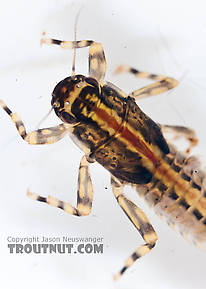 View 7 Pictures
View 7 PicturesCollected May 10, 2008 from the Chena River in Alaska
Added to Troutnut.com by Troutnut on April 20, 2011
Added to Troutnut.com by Troutnut on April 20, 2011
Ephemerella invaria (Sulphur Dun) Mayfly Nymph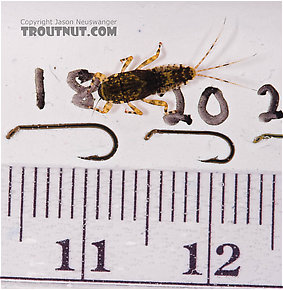 View 8 PicturesThis small Ephemerella invaria nymph was at least a month away from emergence.
View 8 PicturesThis small Ephemerella invaria nymph was at least a month away from emergence.Collected April 19, 2006 from the Beaverkill River in New York
Added to Troutnut.com by Troutnut on April 21, 2006
Added to Troutnut.com by Troutnut on April 21, 2006
Ephemerella needhami (Little Dark Hendrickson) Mayfly Nymph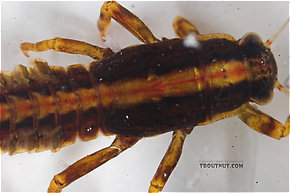 View 5 PicturesThis specimen strikingly resembles another specimen from about 1300 miles away in the Catskills, which I tentatively called Ephemerella aurivillii. This one has much more prominent abdominal tubercles (
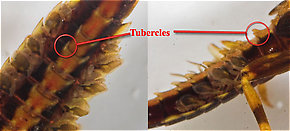 Tubercle: Various peculiar little bumps or projections on an insect. Their character is important for the identification of many kinds of insects, such as the nymphs of Ephemerellidae mayflies.). It may be that they're both the same species and I don't have my identifications straight.
View 5 PicturesThis specimen strikingly resembles another specimen from about 1300 miles away in the Catskills, which I tentatively called Ephemerella aurivillii. This one has much more prominent abdominal tubercles (
A few (not all) of the abdominal tubercles on this Ephemerella needhami nymph are circled. They are especially large in this species.
Collected June 5, 2005 from the Long Lake Branch of the White River in Wisconsin
Added to Troutnut.com by Troutnut on May 24, 2006
Added to Troutnut.com by Troutnut on May 24, 2006
Female Ephemerella invaria (Sulphur Dun) Mayfly Spinner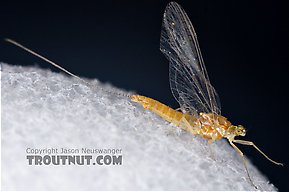 View 5 Pictures
View 5 PicturesCollected May 26, 2007 from Penn's Creek in Pennsylvania
Added to Troutnut.com by Troutnut on June 4, 2007
Added to Troutnut.com by Troutnut on June 4, 2007
Ephemerella (Hendricksons, Sulphurs, PMDs) Mayfly Nymph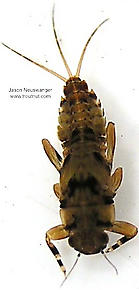 View 6 PicturesThis pretty Ephemerella nymph has really weird markings. It has one band on the tibiae (
 Tibia: A middle segments in the leg of an insect, located between the femur and the tarsus.) and a thin but distinct dorsal (Dorsal: Top.) stripe faded in the center which looks very different from the stripes on Ephemerella needhami and Ephemerella aurivillii. It definitely has the fan tail characteristic of the Ephemerella genus.
View 6 PicturesThis pretty Ephemerella nymph has really weird markings. It has one band on the tibiae (
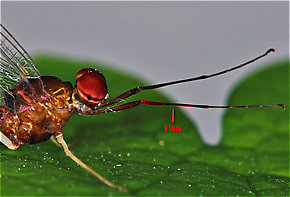
The tibia of this Isonychia bicolor mayfly spinner is highlighted in red.
Collected February 7, 2004 from unknown in Wisconsin
Added to Troutnut.com by Troutnut on January 25, 2006
Added to Troutnut.com by Troutnut on January 25, 2006
Jargon Defined:
Dorsal: Top.
Dun: Mayflies have two adult stages. They first emerge from the water as duns (scientifically known as the subimago stage). They then molt into the spinner (imago) stage, in which they mate and die. Sometimes the word "dun" is confusingly used to refer to a brownish gray color in fly tying materials.
Emergence: The transformation of a nymph or pupa into the adult winged stage of an insect. The term may refer to the emergence of an individual, or the daily or yearly event in which all individuals of a species emerge.
Nymph: The juvenile, underwater stages of mayflies, stoneflies, dragonflies, and damselflies and other aquatic insects whose juvenile stages are covered by hard exoskeletons. The word can also refer to the fishing flies which imitate these creatures, in which case it is used as a blanket term for flies imitating any underwater stage of an invertebrate (except for crayfish and leeches).
Spent: The wing position of many aquatic insects when they fall on the water after mating. The wings of both sides lay flat on the water. The word may be used to describe insects with their wings in that position, as well as the position itself.
The tibia of this Isonychia bicolor mayfly spinner is highlighted in red.
A few (not all) of the abdominal tubercles on this Ephemerella needhami nymph are circled. They are especially large in this species.
Useful References:
Knopp, Malcolm and Robert Cormier. 1997. Mayflies: An Angler's Study of Trout Water Ephemeroptera . The Lyons Press.
Top 10 Fly Hatches
 Baetis
 Baetidae
 Ephemerellidae
 Hexagenia limbata
 Chironomidae
 Ephemerella subvaria
 Heptageniidae
 Ephemerella
 Isonychia
 Hydropsychidae
Top Gift Shop Designs
 I outfish my daddy!
 Electric blue Hendrickson dun.
 I love buggers. Big, green, wooly ones.
 I outfish my husband!
 Be the trout.
 Eat mayflies.
Top Insect Specimens
 Baetisca obesa Mayfly Nymph
 Neophylax Caddisfly Adult
 Corydalus Hellgrammite Larva
 Isonychia bicolor Mayfly Spinner
 Ephemerella aurivillii Mayfly Spinner
Miscellaneous Sites
Troutnut.com is copyright © 2004-2024 Jason
Neuswanger (email Jason). See my FAQ for information about use of my images.
 privacy policy
privacy policy