
Blog & Latest Updates
Fly Fishing Articles
Insects by Common Name


Stonefly Species Pteronarcys californica (Giant Salmonfly)


Taxonomic Navigation -?-
Kingdom
Animalia (Animals)
» Phylum
Arthropoda (Arthropods)
» Class
Insecta (Insects)
» Order
Plecoptera (Stoneflies)
» Family
Pteronarcyidae (Salmonflies)
» Genus
Pteronarcys (Salmonflies)
» Species californica (Giant Salmonfly)
Common Names
| Match | Common Name |
 | Giant Salmonfly |
 | Salmonfly |
In cycles of plenty their numbers are truly astounding. They make up a large percentage of the biomass and this large lumbering grazer has had its niche likened to the huge herds of bison that once roamed the plains and foothills their rivers flow through. The hatch progresses upriver quickly, with adults being in the air or on the water for a given stretch only a few days or so. For reasons not fully understood, the nymphs prefer certain locations over others for "staging" prior to the hatch. An angler can stand on shore and notice very few of them while 50 yards up or down the rocks and bushes can be crawling. Competent guides and astute locals are aware of these locations and often fish them "in front of the hatch" for spectacular nymph fishing. An added bonus is they are also "in front of the crowds." Visiting anglers would do well to fish upriver of the latest angling reports. Fishing water based on "yesterday's news" often leads to seeing more anglers than salmonflies.
Where & When
This species' densest populations are found in large mid-elevation rivers flowing over cobble substrate. They give way to sister species at higher elevations in the headwaters and tributaries. The coastal states can see these hatches starting in April while the northern Rockies may see them well into July.
Hatching Behavior
As their emergence date approaches, they migrate into the shallows at preferred locations. When they are ready, they crawl out of the water onto exposed cobble or riparian plant life to split their husks and emerge. This usually takes place in the early morning hours but can also take place in the evening or even midday under cloud cover.
Egg-Laying Behavior
It is the ovipositing females that cause the bulk of the dry fly opportunity. Though some are known to land and lay their eggs, most gravid females fly low over the water in a lumbering flight path and drop their large pea sized olive black egg sacks from above. This method of ovipositing wouldn't normally present good fishing opportunities if it weren't for two other factors. They aren't the best fliers and the West's ever present breezes often knock them to the water. Sometimes they flop around on the surface for awhile, sometimes in softer water they will ride docilely with their wings folded. These are dense animals not designed for long floats stuck in the surface film. If uneaten, they will expire and sink rather quickly, though sometimes individuals will die with their wings fully spread, locking their bodies suspended under the meniscus a little longer. All of these scenarios are grist for the fly designer's mill.
Nymph Biology
Pteronarcys californica nymphs develop for three years before emerging. This means that in the months prior to the hatch, there are three sizes in the river. After the hatch, there are only two. Angling author Charles brooks did a lot of snorkeling in their habitat and noted an interesting phenomenon. While the predaceous Perlidae nymphs could be seen constantly scurrying about in pursuit of a meal, the detritivorous salmonflies were hidden in crevices with only their antennae exposed for most of the day. Starting in the mornings often after first light, the first year brood would emerge en masse and graze for awhile before retreating back to their hidies. This was quickly followed by the second year brood followed last by the nymphs of the year. The entire process is again repeated in the evening. The mystery of the waiving antennea is intriguing. The simplest and most obvious explanation is they are sensing for predator activity, but some speculate this may be related to their synchronized feeding activity as well.
Pteronarcys californica Fly Fishing Tips
The two colors used in salmonfly imitations are Dk. brown & orange in various shades. Depending on locale, the brown can vary from almost black to coffee brown and occasionally even gray brown. The orange can vary from almost yellow to a deep salmon red. Color can be important and anglers who only have the ubiquitous black and hot orange shop flies can be at a serious disadvantage.
Nymphs should be carried in three sizes to simulate the three years of development and in two styles. Simple and impressionistic patterns for fishing deep in heavy water (anglers will go through a lot of these) and lighter more imitative flies for the softer margins. Sizes run from 3XL #2 to #10 depending on the strain & brood. The anglers selection can be trimmed down by the fact that the nymphs of the year are either non-existant or in the shallows during the fishing season so the big deep ones can be left home, especially after the hatch. Conversly the smaller flies used for prospecting are usually fished deep in the runs so the shallow imitative designs are often unnecessary. Heavy water requires bushy stimulator/sofa pillow designs or a lot of foam, unless the angler is willing to go wet (a strategy often much more successful). The egg-laying females can make a great deal of commotion and imitations should be fished accordingly. Sometimes slapping them down with a splat and twitching them around like you would a grasshopper pattern is just the ticket. Other times they will be placid and the fish will want them dead drift. This is especially true in the softer margins that often call for flush floating highly imitative designs.
Pictures of 9 Stonefly Specimens in the Species Pteronarcys californica:
Female Pteronarcys californica (Giant Salmonfly) Stonefly Adult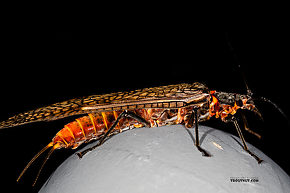 View 11 Pictures
View 11 PicturesCollected July 2, 2019 from the Gallatin River in Montana
Added to Troutnut.com by Troutnut on July 18, 2019
Added to Troutnut.com by Troutnut on July 18, 2019
Male Pteronarcys californica (Giant Salmonfly) Stonefly Adult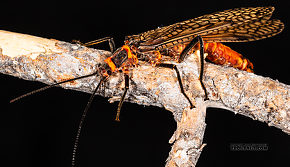 View 16 Pictures
View 16 PicturesCollected July 2, 2019 from the Gallatin River in Montana
Added to Troutnut.com by Troutnut on July 18, 2019
Added to Troutnut.com by Troutnut on July 18, 2019
Female Pteronarcys californica (Giant Salmonfly) Stonefly Adult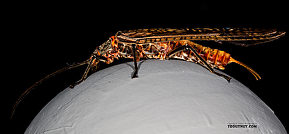 View 13 Pictures
View 13 PicturesCollected June 30, 2019 from the Madison River in Montana
Added to Troutnut.com by Troutnut on July 17, 2019
Added to Troutnut.com by Troutnut on July 17, 2019
Recent Discussions of Pteronarcys californica
High Water 8 Replies »
Posted by Dbar on Apr 13, 2007
Last reply on Jun 11, 2017 by Ricofreako
The hatch often occurs during high water (just after peak) so you sometimes have limited visibility during the hatch. Also - I believe that they can occur above 7000 feet.
Love ths site.
ReplySalmonfly question for you westerners 7 Replies »Love ths site.
I don't have many reliable sources about this species, so it'd be great if you western fishermen could read over the article and make sure I haven't said anything stupid or omitted anything important. I'll be happy to incorporate any additions you have.
ReplyYour Thoughts On Pteronarcys californica:
Top 10 Fly Hatches
 Baetis
 Baetidae
 Ephemerellidae
 Hexagenia limbata
 Chironomidae
 Ephemerella subvaria
 Heptageniidae
 Ephemerella
 Isonychia
 Hydropsychidae
Top Gift Shop Designs
 I outfish my daddy!
 Electric blue Hendrickson dun.
 I love buggers. Big, green, wooly ones.
 I outfish my husband!
 Be the trout.
 Eat mayflies.
Top Insect Specimens
 Baetisca obesa Mayfly Nymph
 Neophylax Caddisfly Adult
 Corydalus Hellgrammite Larva
 Isonychia bicolor Mayfly SpinnerBaetis Mayfly Dun
Miscellaneous Sites
Troutnut.com is copyright © 2004-2024 Jason
Neuswanger (email Jason). See my FAQ for information about use of my images.
 privacy policy
privacy policy