
Blog & Latest Updates
Fly Fishing Articles
Insects by Common Name


Caddisfly Genus Dicosmoecus (October Caddisflies)


Taxonomic Navigation -?-
Kingdom
Animalia (Animals)
» Phylum
Arthropoda (Arthropods)
» Class
Insecta (Insects)
» Order
Trichoptera (Caddisflies)
» Family
Limnephilidae (Northern Caddisflies)
» Genus Dicosmoecus (October Caddisflies)
| Species in Dicosmoecus |  |  |
| Dicosmoecus atripesOctober Caddis | 1 | 6 |
| Dicosmoecus gilvipesOctober Caddis | 3 | 22 |
2 species aren't included.
Common Names


The question for fly fishermen seeking big trout is: "Which insects provide the best opportunity for catching such fish?" My list would be: Giant Orange Sedge (Dicosmoecus sp.), Salmon Fly (Pteronarcys californica, a stonefly), and the Michigan Mayfly (Hexagenia limbata). Dicosmoecus is the most important -- and the contest is not even close.
His reasons for this judgement are five traits of Dicosmoecus:
- Very large size: Adults 30mm long, and thick.
- Activity concentrated within 2-3 weeks.
- Emerges in the low, clear water of fall.
- Active during afternoon and evening.
- Abundant in rivers with sea-run trout.
I have never fished the West to experience Dicosmoecus, but I have enough experience with Hexagenia limbata to know that a greater insect must be truly amazing.
Where & When
See the species pages for details about distribution and emergence times.
Hatching Behavior
Emerging Dicosmoecus pupae may be the least important stage of the hatch. They will crawl out onto rocks to emerge when ideal rocks are nearby, but otherwise they emerge on the surface. Either behavior is likely to take place in water too shallow for trout to comfortably feed. The minority of the pupae emerging in deeper water are probably still prolific enough, at times, to excite the trout.
Egg-Laying Behavior
Time Of Day: Late afternoon through nightfall, peaking at sunset
The mating activity begins within two days of the first emergence. Ovipositing females fall and struggle on the surface to lay their eggs, making them perfect insects for the angler.Larva & Pupa Biology
Diet: Detritus (Detritus: Small, loose pieces of decaying organic matter underwater.), algae, dead animals
Current Speed: Slow water early; faster water in later instars (Instar: Many invertebrates molt through dozens of progressively larger and better-developed stages as they grow. Each of these stages is known as an instar. Hard-bodied nymphs typically molt through more instars than soft-bodied larvae.)
Shelter Type: Plant matter early; gravel in the later instars (Instar: Many invertebrates molt through dozens of progressively larger and better-developed stages as they grow. Each of these stages is known as an instar. Hard-bodied nymphs typically molt through more instars than soft-bodied larvae.)
The larvae are unusually prone to behavioral drift (Behavioral drift: The nymphs and larvae of many aquatic insects sometimes release their grip on the bottom and drift downstream for a while with synchronized timing. This phenomenon increases their vulnerability to trout just like emergence, but it is invisible to the angler above the surface. In many species it occurs daily, most often just after dusk or just before dawn.) during the daytime in June and July, usually around 4:00 p.m. They may be in between cases when they do this, making them especially appealing and visible to hungry trout.Current Speed: Slow water early; faster water in later instars (Instar: Many invertebrates molt through dozens of progressively larger and better-developed stages as they grow. Each of these stages is known as an instar. Hard-bodied nymphs typically molt through more instars than soft-bodied larvae.)
Shelter Type: Plant matter early; gravel in the later instars (Instar: Many invertebrates molt through dozens of progressively larger and better-developed stages as they grow. Each of these stages is known as an instar. Hard-bodied nymphs typically molt through more instars than soft-bodied larvae.)
In mid- to late summer they enter diapause (Diapause: A state of complete dormancy deeper even than hibernation. While in diapause, an organism does not move around, eat, or even grow. Some caddisfly larvae enter diapause for a few weeks to several months. Some species of microscopic zooplankton can enter diapause for several hundred years.) until cooler fall temperatures trigger them to pupate in a synchronized way.
Pictures of 4 Caddisfly Specimens in the Genus Dicosmoecus:
Female Dicosmoecus atripes (October Caddis) Caddisfly Adult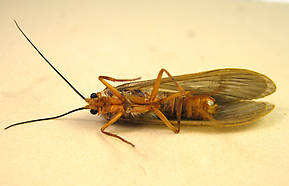 View 6 PicturesThis specimen is 26 mm.
- Entoman
View 6 PicturesThis specimen is 26 mm.- Entoman
Collected September 27, 2013 from the St. Joe River in Idaho
Added to Troutnut.com by Entoman on September 29, 2013
Added to Troutnut.com by Entoman on September 29, 2013
Dicosmoecus gilvipes (October Caddis) Caddisfly Nymph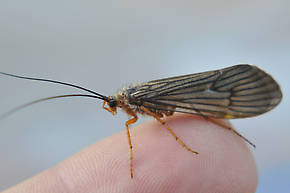 View 3 Pictures
View 3 PicturesCollected October 5, 2010 from the Touchet River in Washington
Added to Troutnut.com by Bnewell on June 27, 2011
Added to Troutnut.com by Bnewell on June 27, 2011
Dicosmoecus gilvipes (October Caddis) Caddisfly Adult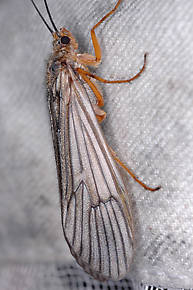 View 2 Pictures
View 2 PicturesCollected September 5, 2010 from the Touchet River in Washington
Added to Troutnut.com by Bnewell on June 27, 2011
Added to Troutnut.com by Bnewell on June 27, 2011
1 Underwater Picture of Dicosmoecus Caddisflies:


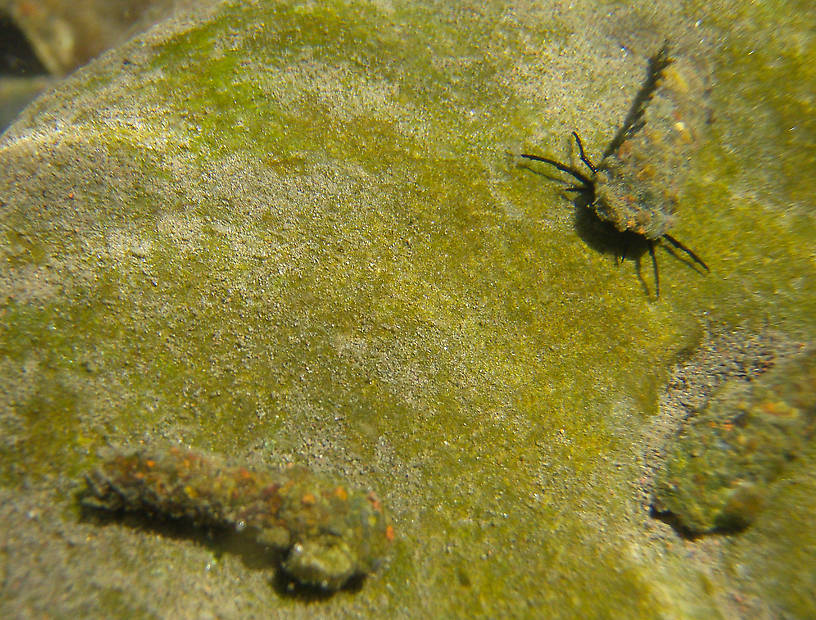
These are probably 3rd instar larvae of Dicosmoecus gilvipes. The 4th instar larvae will be the round case made of sand grains.
In this picture: Caddisfly Species Dicosmoecus gilvipes (October Caddis).
In this picture: Caddisfly Species Dicosmoecus gilvipes (October Caddis).
StateWashington
LocationTouchet River
Date TakenJun 23, 2011
Date AddedJun 27, 2011
AuthorBnewell
Camerau770SW,S770SW
Recent Discussions of Dicosmoecus
october caddis
Posted by Amosg on Oct 6, 2011
In Alberta they exist in very small numbers but are not important to fishermen--Amos
ReplyYou Western anglers - any experience with the Giant Orange Sedges? 7 Replies »This seems to be a very important insect for which I have no experience and few sources. I want to be sure that my writeup is accurate and fairly complete. Do any of you who fish out west know any details I've left out?
ReplyOctober Caddis 19 Replies »Jason-
In the Pacific NW, Dicosmoecus are generally referred to as either October Caddis or Fall Caddis. The field guide I generally recommend for western fly fishers is Hatch Guide For Western Streams by Jim Schollmeyer. This is what he has to say about Dicosmoecus pupae, and I believe it clarifies any ambiguity of the passage you quoted from Caddisflies:
ReplyA good Dicosmoecus discussion 1 Reply »In the Pacific NW, Dicosmoecus are generally referred to as either October Caddis or Fall Caddis. The field guide I generally recommend for western fly fishers is Hatch Guide For Western Streams by Jim Schollmeyer. This is what he has to say about Dicosmoecus pupae, and I believe it clarifies any ambiguity of the passage you quoted from Caddisflies:
In the early or mid summer, the larvae reach maturity and move from the faster currents to the slower flows that are generally found along the margins of the stream. Then they attach their cases to the rocks, seal themselves inside, and begin pupation. This transformation takes about two months. When the pupae are ready to emerge anytime between late afternoon and dark, they chew open the front of their cases and swim or crawl to the surface. The ones that find exposed rocks cling to them close to or just above the waterline; their pupal shucks split open and the adults emerge. Larvae that took refuge and pupated behind unexposed mid-stream rocks pupate and emerge in the open water. Most pupae emerge from waters that are too shallow or too exposed for trout. Any pupae that emerge in deep or open waters are vulnerable as they swim to shore or the surface.
There's a good topic with people sharing their experiences with Dicosmoecus over at the Washington Fly Fishing Forum.
ReplyYour Thoughts On Dicosmoecus:
Top 10 Fly Hatches
 Baetis
 Baetidae
 Ephemerellidae
 Hexagenia limbata
 Chironomidae
 Ephemerella subvaria
 Heptageniidae
 Ephemerella
 Isonychia
 Hydropsychidae
Top Gift Shop Designs
 I outfish my daddy!
 Electric blue Hendrickson dun.
 I love buggers. Big, green, wooly ones.
 I outfish my husband!
 Be the trout.
 Eat mayflies.
Top Insect Specimens
 Baetisca obesa Mayfly Nymph
 Corydalus Hellgrammite Larva
 Neophylax Caddisfly Adult
 Pteronarcys biloba Stonefly Nymph
 Hydropsyche aenigma Caddisfly Adult
Miscellaneous Sites
Troutnut.com is copyright © 2004-2024 Jason
Neuswanger (email Jason). See my FAQ for information about use of my images.
 privacy policy
privacy policy