
Blog & Latest Updates
Fly Fishing Articles
Insects by Common Name


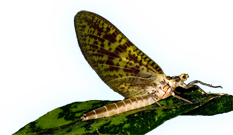
Blue-Winged Olives


Scientific Names


Like most common names, "Blue-Winged Olive" can refer to more than one taxon. They're previewed below, along with 27 specimens. For more detail click through to the scientific names.
Mayfly Family Baetidae
These are pretty much always called Blue-Winged Olives.
"These little critters supplant the importance of many other well-known mayfly hatches."
-Fred Arbona in Mayflies, the Angler, and the Trout
Arbona did not overestimate these critters. Their great numbers and multiple broods each season make up for their size, which is rarely larger than size 16 and often smaller than size 20.
Hardly mentioned in angling literature prior to the middle of the last century, baetids have become increasingly important to anglers, rivaling any other family of mayflies in this regard. This is largely due to the extension of fishing seasons that now include the early and late periods when this family’s species usually dominate hatching activity. Another important reason is the tremendous improvement in tackle allowing more practical imitation of these little mayflies. The dramatic ecological changes in many of our watersheds and the subsequent impact this has had on the makeup of taxa populations is also a factor.
Taxonomically speaking, this is a most unruly family. The entomological community seems to be perpetually reclassifying its genera and species to the chagrin of many anglers. These changes are not capricious. The reason is older nomenclatures haven't provided the taxonomic flexibility required as more becomes known about the complexities of baetid relationships. Classification of this family’s genera and species is very much a work in progress. The changes have been so extensive that it is beyond the scope of this hatch page to track the taxonomic history effectively without interjecting even more confusion. If you are frustrated by the inability to find some of the old familiar names, you're not alone. Rest assured these popular hatches are listed here, just under the latest classifications. The old famous names are referenced in their hatch pages.
Common baetid hatches with a national distribution are the species Acentrella turbida, Baetis brunneicolor, and Baetis tricaudatus. In the West, Baetis bicaudatus, Diphetor hageni and Plauditus punctiventris can also be common. In the East and the Midwest, look for Baetis intercalaris and Plauditus dubius. The species Iswaeon anoka is important in both the West and Midwest. Some of the Procloeon and Anafroptilum (prev. Centroptilum) species are coming to the increasing notice of anglers across the country.
Stillwater anglers are likely to run across Callibaetis ferrugineus ferrugineus in the East and Midwest. Western anglers will find Callibaetis californicus and Callibaetis ferrugineus hageni to be very important.
Streamside identification of these mayflies to specific and often even generic level has always been difficult. This is now even more so as new taxonomic evidence has shown hind wing conformation (or lack of hind wings) and other features are less dependable as ways to tell the genera apart. Many of the lesser-known species probably produce excellent local hatches but have not caught enough attention to be properly recognized by anglers. The lesson is that we should not assume anything about the identity of many Baetidae hatches we come across; they may not even be in the Baetis genus, let alone familiar species.
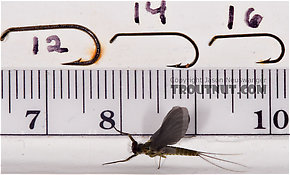
Male Baetidae (Blue-Winged Olives) Mayfly Nymph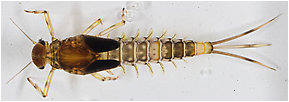 View 10 PicturesThis male nymph is probably in its final instar (Instar: Many invertebrates molt through dozens of progressively larger and better-developed stages as they grow. Each of these stages is known as an instar. Hard-bodied nymphs typically molt through more instars than soft-bodied larvae.). The wing pads (
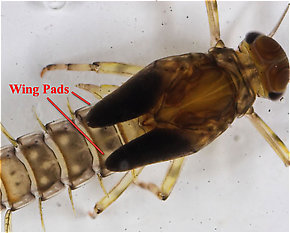 Wing pad: A protrusion from the thorax of an insect nymph which holds the developing wings. Black wing pads usually indicate that the nymph is nearly ready to emerge into an adult.) are extremely black and the large turbinate (
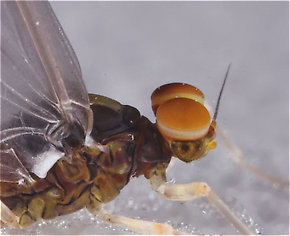 Turbinate: Shaped like a top or elevated on a stalk; usually refers to the eyes of some adult male Baetidae mayflies which are wider near the tip than at the base.) eyes are very apparent inside the nymph's head.
View 10 PicturesThis male nymph is probably in its final instar (Instar: Many invertebrates molt through dozens of progressively larger and better-developed stages as they grow. Each of these stages is known as an instar. Hard-bodied nymphs typically molt through more instars than soft-bodied larvae.). The wing pads (
The wing pads on this final instar Baetidae mayfly nymph are extremely dark.
This male Baetidae dun has slightly turbinate eyes.
Male Baetis (Blue-Winged Olives) Mayfly Dun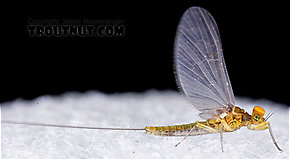 View 14 PicturesThis dun molted most of the way into a spinner (though the wings got stuck) the evening after I photographed it, so I took some more photos of the spinner.
I found a female nearby, probably of the same species.
View 14 PicturesThis dun molted most of the way into a spinner (though the wings got stuck) the evening after I photographed it, so I took some more photos of the spinner.I found a female nearby, probably of the same species.
Female Baetidae (Blue-Winged Olives) Mayfly Spinner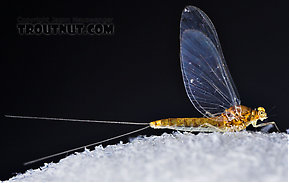 View 12 PicturesThis species is probably in Centroptilum, Cloeon, or Procloeon. I captured this spinner on the same night as a dun which is probably of the same species.
View 12 PicturesThis species is probably in Centroptilum, Cloeon, or Procloeon. I captured this spinner on the same night as a dun which is probably of the same species.Callibaetis ferrugineus (Speckled Spinner) Mayfly Adult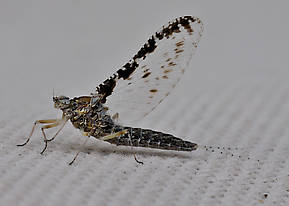 View 3 PicturesThese adults are probably C. ferrugineus.
View 3 PicturesThese adults are probably C. ferrugineus.See 99 more specimens...
Mayfly Genus Baetis
These are pretty much always called Blue-Winged Olives.
This is one of the most prolific genera of mayflies in North American trout streams. Their small size permits the growth of up to three generations per year, and they are good dry-fly insects because they often hatch in impressive numbers and the duns ride the water for a long time before taking flight.
The genus Baetis and its species are probably the most misidentified mayflies in angling. Many who see mayflies too small to imitate with a size 16 Adams call them Baetis, especially if they're olive in coloration. In reality, Baetis (though the most prominent) is only one of several very similar and abundant genera in the family Baetidae. It seems species in the family are perpetually being reclassified, and identifying any of them, even to genus level is difficult. The angler who wants to describe what is seen streamside usually has only four choices:
1. Call them "Blue-Winged Olives" as most do. the problem is this name has lost all meaning due to being applied to dozens of species across several families (many of which have neither blue wings nor olive bodies). Besides, the name was originally coined for a species of British ephemerellid, the family where this common name should properly reside.
2. Call them "baetids", the Latin name for referring to members of the Baetidae family as a group. While technically accurate scientifically, it doesn't tell the listener or reader much about their appearance.
3. Call them outmoded scientific names - Even calling them by the updated name is usually risky for most species in the field. Adding to the difficulty by using names from outdated nomenclatures? Talk about confusion...
4. Call them "little (whatever color they are) quills." Perhaps this is the best choice as at least it's more accurately descriptive.
The fact is many are so similar that even alot of the specimens in the hatch pages can't be keyed below the family level with absolute certainty; at least from what's observable in the photos alone. They often require observation with a microscope and extensive knowledge of the subtle differences for accurate determinations. So - the next time a fishing buddy identifies a little olive mayfly from a distance using an obsolete name like Baetis vagans, just smile and nod...
For anglers raised on Schwiebert, Swisher, etc., it is often difficult to locate many important species in the newer literature. When working with older taxonomies and/or angling texts, the following hatch page links may prove helpful:
Baetis devinctus = Diphetor hageni (can be an important eastern species)
Baetis hiemalis = Baetis brunneicolor (important Midwest species with a national distribution)
Baetis insignificans = Acentrella insignificans (can be important in some western locales)
Baetis parvus = Diphetor hageni (very important western species)
Baetis propinquus = Labiobaetis propinquus (important in the West with a national distribution)
Baetis pygmaeus = Acerpenna pygmaea (can be important with distribution across all regions)
Baetis vagans = Baetis tricaudatus (most abundant and important species nationwide)
The relatively new genus Fallceon has two species of interest that are made up of several previous Baetis species. They are distributed nationally and may prove significant as more is learned about the angling opportunities they present, especially in the the South and Southwest.
The genus Baetis and its species are probably the most misidentified mayflies in angling. Many who see mayflies too small to imitate with a size 16 Adams call them Baetis, especially if they're olive in coloration. In reality, Baetis (though the most prominent) is only one of several very similar and abundant genera in the family Baetidae. It seems species in the family are perpetually being reclassified, and identifying any of them, even to genus level is difficult. The angler who wants to describe what is seen streamside usually has only four choices:
1. Call them "Blue-Winged Olives" as most do. the problem is this name has lost all meaning due to being applied to dozens of species across several families (many of which have neither blue wings nor olive bodies). Besides, the name was originally coined for a species of British ephemerellid, the family where this common name should properly reside.
2. Call them "baetids", the Latin name for referring to members of the Baetidae family as a group. While technically accurate scientifically, it doesn't tell the listener or reader much about their appearance.
3. Call them outmoded scientific names - Even calling them by the updated name is usually risky for most species in the field. Adding to the difficulty by using names from outdated nomenclatures? Talk about confusion...
4. Call them "little (whatever color they are) quills." Perhaps this is the best choice as at least it's more accurately descriptive.
The fact is many are so similar that even alot of the specimens in the hatch pages can't be keyed below the family level with absolute certainty; at least from what's observable in the photos alone. They often require observation with a microscope and extensive knowledge of the subtle differences for accurate determinations. So - the next time a fishing buddy identifies a little olive mayfly from a distance using an obsolete name like Baetis vagans, just smile and nod...
For anglers raised on Schwiebert, Swisher, etc., it is often difficult to locate many important species in the newer literature. When working with older taxonomies and/or angling texts, the following hatch page links may prove helpful:
Baetis devinctus = Diphetor hageni (can be an important eastern species)
Baetis hiemalis = Baetis brunneicolor (important Midwest species with a national distribution)
Baetis insignificans = Acentrella insignificans (can be important in some western locales)
Baetis parvus = Diphetor hageni (very important western species)
Baetis propinquus = Labiobaetis propinquus (important in the West with a national distribution)
Baetis pygmaeus = Acerpenna pygmaea (can be important with distribution across all regions)
Baetis vagans = Baetis tricaudatus (most abundant and important species nationwide)
The relatively new genus Fallceon has two species of interest that are made up of several previous Baetis species. They are distributed nationally and may prove significant as more is learned about the angling opportunities they present, especially in the the South and Southwest.
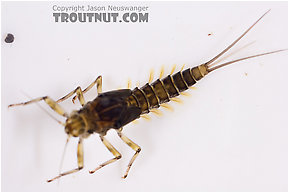
Male Baetis (Blue-Winged Olives) Mayfly Dun
View 14 PicturesThis dun molted most of the way into a spinner (though the wings got stuck) the evening after I photographed it, so I took some more photos of the spinner.
I found a female nearby, probably of the same species.
View 14 PicturesThis dun molted most of the way into a spinner (though the wings got stuck) the evening after I photographed it, so I took some more photos of the spinner.I found a female nearby, probably of the same species.
Female Baetis (Blue-Winged Olives) Mayfly Spinner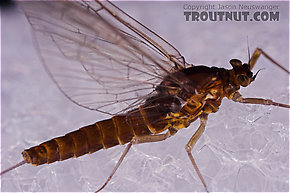 View 4 PicturesI captured and photographed this specimen as a dun before she molted into the spinner photographed here. Her wings got a bit torn up in the process.
View 4 PicturesI captured and photographed this specimen as a dun before she molted into the spinner photographed here. Her wings got a bit torn up in the process.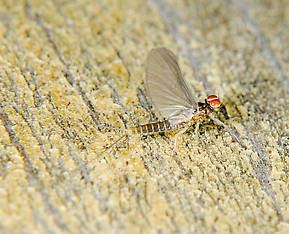
See 28 more specimens...
Mayfly Genus Diphetor
These are pretty much always called Blue-Winged Olives.
The only species of this genus, Diphetor hageni, is one of the most important in the Baetidae family for western anglers. It was previously known as Baetis parvus in the West and its synonymy Baetis devinctus in the East.
Mayfly Genus Fallceon
These are pretty much always called Blue-Winged Olives.
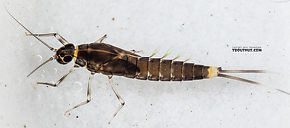
Species of the Fallceon genus can be identified by having typical Baetis dark or olivaceous coloration and the hooked process on its hind wings of Anafroptilum (prev. Centroptilum). This genus has only two species of possible interest to anglers:
Fallceon quilleri - a former species of Baetis that has had eight former Baetis species synonymized with it. It has a continental distribution.
Fallceon thermophilos - a former species of Baetis that has had one species from Baetis synonymized with it. It has a Northwest distribution.
Fallceon quilleri - a former species of Baetis that has had eight former Baetis species synonymized with it. It has a continental distribution.
Fallceon thermophilos - a former species of Baetis that has had one species from Baetis synonymized with it. It has a Northwest distribution.
Mayfly Species Baetis tricaudatus
These are pretty much always called Blue-Winged Olives.
Baetis tricaudatus is undeniably the most widespread and abundant baetid on the continent and arguably the most important mayfly species to trout and anglers alike. Eastern anglers used to know these important mayflies by the storied name of Baetis vagans. Conversely, the usually much larger and late Fall hatching brood of Baetis tricaudatus was considered an important Western species with its own tradition. But, entomologists recently determined that they are both in fact the same species. The nomenclature conventions guiding entomologists do not account for a name's regional fame among fishermen, and new or obscure species names may replace their old favorites. Sometimes taxa with disparate traditions are combined. Baetis vagans is one such casualty. Fortunately, trout think like Shakespeare: A rose by any other name would smell as sweet. The rose that was vagans has lost none of its charm. This species is multibrooded (Multibrooded: Producing more than one generation in a single year. Baetis mayflies are a classic example. Insects which produce a single generation with two distinct peaks (like the June and September hatches of Isonychia bicolor mayflies) are not multibrooded, because the fall insects are offspring from the previous fall instead of the current year's spring.) with the hatches of Spring being larger flies. As the weather warms the following broods are composed of progressively smaller flies. In the East, they range in size from 16 to 20. In the West, they may run a size larger.
Baetis tricaudatus (Blue-Winged Olive) Mayfly Nymph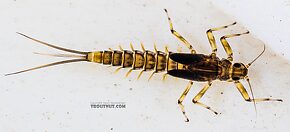 View 20 PicturesA nymph of the same species as this one emerged into a dun in my studio so I got photos of both stages.
NOTE: I missed an important key characteristic the first time I tried to identify this one (robust setae (Seta: Little hairs on insects.) on the abdominal sternites (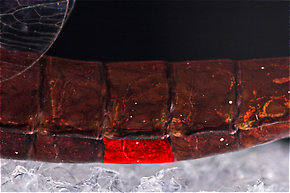 Sternite: The bottom (ventral) part of a single segment on an insect's abdomen.), which were harder to see than I expected but are clearly present), so I went on a bit of a wild goose chase and landed at a dead end. After spotting that characteristic, this one keys more straightforwardly to either Baetis tricaudatus or the Baetis piscatoris complex. It doesn't seem to be a perfect fit for either one in the key, but I'm going with tricaudatus based on range and abundance. It's not certain.
However, I'm leaving the flawed analysis below with this disclaimer, because some aspects of how I approached that dead end might be informative in the future.
----Incorrect analysis below----
After spending a lot of time with this one under my shiny new microscope, I'm still not quite sure what it is. I botched my attempt to expose the mouth parts that might make the ID more definitive. Based on the key in Webb et al 2018's "Baetis Larvae of North America," here's my reasoning at each key couplet.
Couplet 1. The pronotum (Pronotum: The top of the insect prothorax.) lacks dark, submedian U-shaped markings. Also, if I were to follow through to couplet 2, there seem to be characteristics that rule out each of the options: the intercalaris complex is ruled out by the abdominal markings, and the caudal (Caudal: Toward the posterior tip of the body.) filaments have neither a dark median band (ruling out the flavistriga complex) nor uniform pale coloration (ruling out Baetis notos). This sends me with decent confidence to couplet 4.
Couplet 4. I cannot find robust setae (Seta: Little hairs on insects.) in my microscope on the scapes, pedicels, paraprocts, or sterna. I also do not see a pair of dark, bilobed markings on the pronotum (Pronotum: The top of the insect prothorax.). Unless I overlooked these characteristics, proceed to couplet 9.
Couplet 9. Abdominal tergum (Tergum: the dorsal part of an abdominal segment or segments (terga). Also used to describe the entire abdominal dorsum or the thoracic dorsal segments of Odonata.) 5 is a bit paler than adjacent terga (Tergum: the dorsal part of an abdominal segment or segments (terga). Also used to describe the entire abdominal dorsum or the thoracic dorsal segments of Odonata.), but "distinctly paler"? The figure for Baetis alius in the paper, as well as a very nice picture posted by Millcreek in the forum here, shows that Baetis alius would have darker tergites (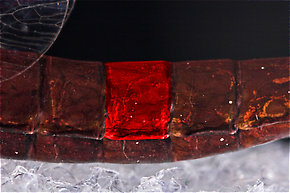 Tergite: The top (dorsal) part of a single segment on an insect's abdomen when it consists of a single chitinous plate (sclerite), or an individual sclerite if the segment has more than one.) surrounding #5. So proceed to couplet 11.
Couplet 11. The length of the gills is obviously less than 2X their width. This leads to the Baetis vernus complex, which could include that species or Baetis brunneicolor. This key doesn't say how to tell those species apart.
Switching over to Burien et al 2018 as the source, the characteristics used to distinguish vernus from brunneicolor seem to rule out either one. Brunneicolor should have more uniformly brown abdominal tergites (
Tergite: The top (dorsal) part of a single segment on an insect's abdomen when it consists of a single chitinous plate (sclerite), or an individual sclerite if the segment has more than one.), whereas vernus should have a lack of visible tracheation in most of the gills.
The fore femur (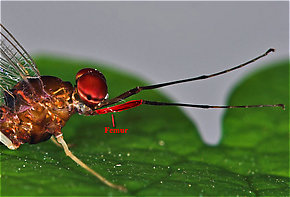 Femur: The main segment of an insect's leg close to the body, in between the tibia and the trochanter.) length is about 3.8x its width.
Also worth noting: In the genus ID, I thought I could see the villipore in my microscope, but I'm not sure. If I back out of Baetis altogether and assume there's no villipore, I end up at Fallceon, but this specimen doesn't seem to have the frontal keel on the head that's supposed to be present on Fallceon quilleri. So that seems like a dead end as well.
View 20 PicturesA nymph of the same species as this one emerged into a dun in my studio so I got photos of both stages.NOTE: I missed an important key characteristic the first time I tried to identify this one (robust setae (Seta: Little hairs on insects.) on the abdominal sternites (
One sternite of this Isonychia bicolor mayfly spinner is highlighted in red.
However, I'm leaving the flawed analysis below with this disclaimer, because some aspects of how I approached that dead end might be informative in the future.
----Incorrect analysis below----
After spending a lot of time with this one under my shiny new microscope, I'm still not quite sure what it is. I botched my attempt to expose the mouth parts that might make the ID more definitive. Based on the key in Webb et al 2018's "Baetis Larvae of North America," here's my reasoning at each key couplet.
Couplet 1. The pronotum (Pronotum: The top of the insect prothorax.) lacks dark, submedian U-shaped markings. Also, if I were to follow through to couplet 2, there seem to be characteristics that rule out each of the options: the intercalaris complex is ruled out by the abdominal markings, and the caudal (Caudal: Toward the posterior tip of the body.) filaments have neither a dark median band (ruling out the flavistriga complex) nor uniform pale coloration (ruling out Baetis notos). This sends me with decent confidence to couplet 4.
Couplet 4. I cannot find robust setae (Seta: Little hairs on insects.) in my microscope on the scapes, pedicels, paraprocts, or sterna. I also do not see a pair of dark, bilobed markings on the pronotum (Pronotum: The top of the insect prothorax.). Unless I overlooked these characteristics, proceed to couplet 9.
Couplet 9. Abdominal tergum (Tergum: the dorsal part of an abdominal segment or segments (terga). Also used to describe the entire abdominal dorsum or the thoracic dorsal segments of Odonata.) 5 is a bit paler than adjacent terga (Tergum: the dorsal part of an abdominal segment or segments (terga). Also used to describe the entire abdominal dorsum or the thoracic dorsal segments of Odonata.), but "distinctly paler"? The figure for Baetis alius in the paper, as well as a very nice picture posted by Millcreek in the forum here, shows that Baetis alius would have darker tergites (
One tergite of this Isonychia bicolor mayfly spinner is highlighted in red.
Couplet 11. The length of the gills is obviously less than 2X their width. This leads to the Baetis vernus complex, which could include that species or Baetis brunneicolor. This key doesn't say how to tell those species apart.
Switching over to Burien et al 2018 as the source, the characteristics used to distinguish vernus from brunneicolor seem to rule out either one. Brunneicolor should have more uniformly brown abdominal tergites (
One tergite of this Isonychia bicolor mayfly spinner is highlighted in red.
The fore femur (
The femur of this Isonychia bicolor mayfly spinner is highlighted in red.
Also worth noting: In the genus ID, I thought I could see the villipore in my microscope, but I'm not sure. If I back out of Baetis altogether and assume there's no villipore, I end up at Fallceon, but this specimen doesn't seem to have the frontal keel on the head that's supposed to be present on Fallceon quilleri. So that seems like a dead end as well.
Male Baetis tricaudatus (Blue-Winged Olive) Mayfly Dun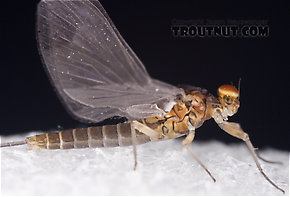 View 8 PicturesThis male was associated with a female of the same species.
View 8 PicturesThis male was associated with a female of the same species.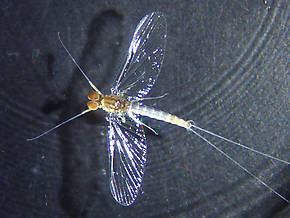
See 8 more specimens...
Mayfly Genus Drunella
These are often called Blue-Winged Olives.
This genus contains most of the important Blue-Winged Olive ephemerellids that make up some very important hatches across the country.
In the East, there are the morning hatches of Drunella cornuta (Large Blue-Winged Olive) followed as the season progresses by the smaller Drunella cornutella and Drunella lata species, both commonly called Little Blue-Winged Olives. These hatches usually begin in late spring and can continue well into midsummer on many Eastern and Midwestern streams.
In the West, the Drunella genus is even more prominent. Besides having abundant Blue-Winged Olive hatches represented by the common species Drunella coloradensis (Little Western Green Drake), Drunella spinifera (Western Slate-winged Olive Dun) and Drunella flavilinea (Western Blue-winged Olive or "Flav") the region also has the Drunella group of famous Western Green Drakes made up of the curious flat-faced nymph species Drunella doddsii and the three subspecies (Subspecies: Entomologists sometimes further divide a species into distinct groups called subspecies, which have two lower-case words on the end of their scientific name instead of one. The latter is the sub-species name. For example, Maccaffertium mexicanum mexicanum and Maccaffertium mexicanum integrum are two different subspecies of Maccaffertium mexicanum.) of Drunella grandis. Coloration ranges widely by region, going from dark brown to bright green. Most commonly they will be in the olive range. The wings too can range from dark slate to medium dun, often with yellow or olive pigment in the basal (Basal: close to the base; root or beginning) costal region (lower leading edge) of the forewings.
There have been many changes in taxonomic nomenclature affecting the Ephemerellidae over the years with few impacted more than the species of this genus. Anglers interested in "connecting the dots" with entomological information provided in fishing literature of the past need to take note of this.
In the East, there are the morning hatches of Drunella cornuta (Large Blue-Winged Olive) followed as the season progresses by the smaller Drunella cornutella and Drunella lata species, both commonly called Little Blue-Winged Olives. These hatches usually begin in late spring and can continue well into midsummer on many Eastern and Midwestern streams.
In the West, the Drunella genus is even more prominent. Besides having abundant Blue-Winged Olive hatches represented by the common species Drunella coloradensis (Little Western Green Drake), Drunella spinifera (Western Slate-winged Olive Dun) and Drunella flavilinea (Western Blue-winged Olive or "Flav") the region also has the Drunella group of famous Western Green Drakes made up of the curious flat-faced nymph species Drunella doddsii and the three subspecies (Subspecies: Entomologists sometimes further divide a species into distinct groups called subspecies, which have two lower-case words on the end of their scientific name instead of one. The latter is the sub-species name. For example, Maccaffertium mexicanum mexicanum and Maccaffertium mexicanum integrum are two different subspecies of Maccaffertium mexicanum.) of Drunella grandis. Coloration ranges widely by region, going from dark brown to bright green. Most commonly they will be in the olive range. The wings too can range from dark slate to medium dun, often with yellow or olive pigment in the basal (Basal: close to the base; root or beginning) costal region (lower leading edge) of the forewings.
There have been many changes in taxonomic nomenclature affecting the Ephemerellidae over the years with few impacted more than the species of this genus. Anglers interested in "connecting the dots" with entomological information provided in fishing literature of the past need to take note of this.
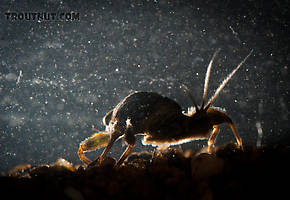
Drunella pelosa Mayfly Larva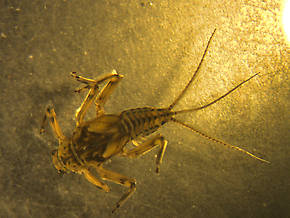 View 1 PicturesThis is a common species in states like Oregon and Washington but this is only the second time it has been collected in Montana.
View 1 PicturesThis is a common species in states like Oregon and Washington but this is only the second time it has been collected in Montana.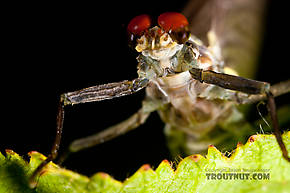
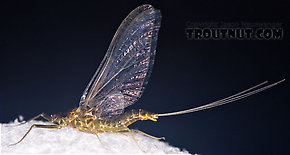
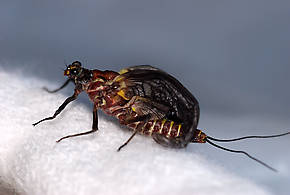
See 46 more specimens...
Mayfly Species Drunella cornuta
These are often called Blue-Winged Olives.
Though not as well known as the Hendrickson and Sulphur hatches of the Ephemerella genus, Drunella cornuta (Olive Morning Dun or Large Blue-Winged Olive) is nonetheless an important Eastern hatch.
Lloyd Gonzales, in his book Fly-Fishing Pressured Water, notes that this attractive olive-green mayfly can provide good-to-excellent morning fishing in the faster sections of many streams. He also mentions that it can hatch in surprising numbers and usually faces less competition for the trout's attention than many of the spring or evening-emerging ephemerellids. Yet, cornuta and its sister species have largely escaped the limelight. The renowned twilight hatches of big Ephemera drakes and many other popular mayfly species command fly fisher's attention at this time of year. As the days lengthen, fishing all of the available mayfly hatches would require a pretty long day astream, so most anglers choose to focus on the late afternoon and evening activity.
Nature seems to have several recurrent color themes, and one of these is gray-winged/olive-bodied aquatic insects. Perhaps this explains why the name "Blue-Winged Olive" is often held up as the poster child for common name confusion. It has been freely applied to a multitude of mayflies in various families, genera, and species. Prior to having a well-established common name, this mayfly was referred to by Gonzales as the Olive Morning Dun. However, it has already been added to the long list of "BWOs" on many Eastern/Midwestern hatch charts.
Lloyd Gonzales, in his book Fly-Fishing Pressured Water, notes that this attractive olive-green mayfly can provide good-to-excellent morning fishing in the faster sections of many streams. He also mentions that it can hatch in surprising numbers and usually faces less competition for the trout's attention than many of the spring or evening-emerging ephemerellids. Yet, cornuta and its sister species have largely escaped the limelight. The renowned twilight hatches of big Ephemera drakes and many other popular mayfly species command fly fisher's attention at this time of year. As the days lengthen, fishing all of the available mayfly hatches would require a pretty long day astream, so most anglers choose to focus on the late afternoon and evening activity.
Nature seems to have several recurrent color themes, and one of these is gray-winged/olive-bodied aquatic insects. Perhaps this explains why the name "Blue-Winged Olive" is often held up as the poster child for common name confusion. It has been freely applied to a multitude of mayflies in various families, genera, and species. Prior to having a well-established common name, this mayfly was referred to by Gonzales as the Olive Morning Dun. However, it has already been added to the long list of "BWOs" on many Eastern/Midwestern hatch charts.
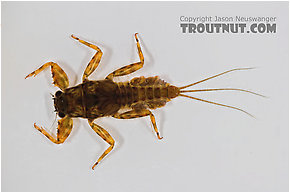
See 3 more specimens...
Mayfly Species Drunella lata
These are often called Blue-Winged Olives.
When Selective Trout was first published in 1971, Swisher and Richards included Drunella lata (Small Blue-Winged Olive, Slate-Winged Olive) as a Midwestern "superhatch." Although it can also be found in many Eastern trout streams, it is probably more important to Midwestern anglers. Typically a morning emerger, this species often competes for the attention of trout with more abundant Tricorythodes and small baetids during parts of July and August. For this reason, the authors of Selective Trout considered the concentrated evening spinner falls to be more important than the somewhat sporadic morning emergence. From an angling standpoint, this situation is nearly the opposite of the earlier Drunella cornuta emergence in the East, where the morning emergence is usually the main event and spinner falls are often of little consequence.
Currently, Drunella lata shares its name with another mayfly, the former D. longicornis. That mayfly can be important in mountainous areas in the Southeast, but they are larger and the nymphs lack the distinctive pale markings mentioned in the Juvenile Characteristics section. (The information on this page does not describe D. longicornis)
Currently, Drunella lata shares its name with another mayfly, the former D. longicornis. That mayfly can be important in mountainous areas in the Southeast, but they are larger and the nymphs lack the distinctive pale markings mentioned in the Juvenile Characteristics section. (The information on this page does not describe D. longicornis)
Mayfly Species Dannella simplex
These are often called Blue-Winged Olives.
Although by no means a superhatch, this species can be important. Authors who discuss it lament the general lack of credit it receives for the fine hatches it produces on some streams.
Mayfly Species Attenella attenuata
These are sometimes called Blue-Winged Olives.
This intriguing species has received a lot of attention in past angling books. Recent authors suspect that much of this credit was a case of mistaken identity, with Attenella attenuata receiving praise for the hatches of Drunella lata and Dannella simplex. Much of the credit was legitimate and accurate, but this species is no longer thought to be on par with its most popular cousins in Ephemerella and Drunella.
I have several specimens listed under this species, but I'm not positive the identification is correct.
I have several specimens listed under this species, but I'm not positive the identification is correct.
Female Attenella attenuata (Small Eastern Blue-Winged Olive) Mayfly Dun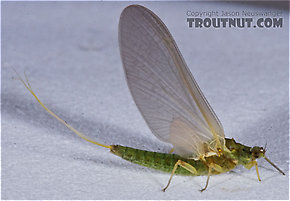 View 4 PicturesThis specimen came from the same hatch as a male.
View 4 PicturesThis specimen came from the same hatch as a male.See 2 more specimens...
Mayfly Species Drunella cornutella
These are sometimes called Blue-Winged Olives.
Few anglers can claim to have fished to hatches of this little olive mayfly, even though the species has been mentioned in popular angling entomologies like Caucci and Nastasi's Hatches or Knopp and Cormier's Mayflies. On many of the larger Eastern freestones, their emergence happens after the waters have warmed and dedicated anglers have turned their attention to streams that remain cold: headwaters, spring creeks, or tailwaters. Because good populations are usually not found in tiny streams, it is on some the Eastern tailwaters, like the branches of the Delaware, that fly fishers take notice of this species.
Drunella cornutella looks like a Mini-Me version of Drunella cornuta. In streams where the two species cohabit, size is the only easy way to tell them apart. Although there is some slight overlap between the largest cornutella and the smallest cornuta, the average difference is usually pretty obvious. Both share very similar coloration and morphology (Morphology: The form and structure of an organism, or the study of the form and structure of organisms.) in all stages, even down to the little curved horns coming out of the frontal shelves of the nymph's heads.
Drunella cornutella looks like a Mini-Me version of Drunella cornuta. In streams where the two species cohabit, size is the only easy way to tell them apart. Although there is some slight overlap between the largest cornutella and the smallest cornuta, the average difference is usually pretty obvious. Both share very similar coloration and morphology (Morphology: The form and structure of an organism, or the study of the form and structure of organisms.) in all stages, even down to the little curved horns coming out of the frontal shelves of the nymph's heads.
Mayfly Species Drunella walkeri
These are sometimes called Blue-Winged Olives.
Ernest Schwiebert had this to say about the hatches of this chunky Eastern Drunella (Blue-Winged Olive) species:
See the Drunella and Drunella cornuta hatch pages for additional information.
An imitation is rarely required, but notes show that when it is needed it is needed badly.
See the Drunella and Drunella cornuta hatch pages for additional information.
Mayfly Genus Tricorythodes
These are very rarely called Blue-Winged Olives.
A cult following is something to which few insects can lay claim, but the tiny Tricorythodes mayflies certainly qualify. Their widespread, reliable, heavy hatches draw impressive rises of ultra-selective trout which demand the most of a technical dry-fly angler's skills.
It is surprising that such a great hatch took so long to come to the attention of fly fishermen. The Tricos were first introduced to anglers in a 1969 Outdoor Life article by Vincent Marinaro, who misidentified them as Caenis. By the early 1970s the identification had been corrected but Swisher and Richards still wrote in Selective Trout, "Few anglers are familiar with these extremely small but important mayflies." The next wave of publications boosted Tricorythodes to its current fame. I suspect their early dismissal was due in part to tackle limitations; anglers in the 1950s had no means to effectively tie and present size 22-28 flies.
It is surprising that such a great hatch took so long to come to the attention of fly fishermen. The Tricos were first introduced to anglers in a 1969 Outdoor Life article by Vincent Marinaro, who misidentified them as Caenis. By the early 1970s the identification had been corrected but Swisher and Richards still wrote in Selective Trout, "Few anglers are familiar with these extremely small but important mayflies." The next wave of publications boosted Tricorythodes to its current fame. I suspect their early dismissal was due in part to tackle limitations; anglers in the 1950s had no means to effectively tie and present size 22-28 flies.
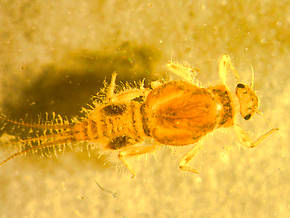
Female Tricorythodes (Tricos) Mayfly Spinner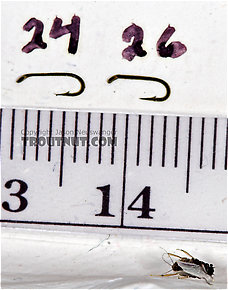 View 9 PicturesI photographed this Trico alive, although it didn't have much time left. These things die very quickly after they mate and it's hard to rush them back to the studio.
View 9 PicturesI photographed this Trico alive, although it didn't have much time left. These things die very quickly after they mate and it's hard to rush them back to the studio.See 7 more specimens...
Mayfly Species Ephemerella excrucians
These are very rarely called Blue-Winged Olives.
For trout (if not anglers), this single species is arguably the most important mayfly in North America. In terms of sheer numbers, breadth of distribution and hatch duration, it has a good argument.
Ephemerella excrucians or Pale Morning Dun usually follows its larger sibling Ephemerella dorothea infrequens with which it shares the same common name. What it often lacks in size by comparison is made up for with it's duration, often lasting for months with intermittent peaks. This close relationship with infrequens has led many anglers to confuse Pale Morning Dun biology with that of the multivoltine (Multivoltine: Having more than one generation per year.) Baetidae species, having disparate broods that decrease in size as the season advances. Sharing the same common name has not helped to alleviate this misconception.
Until recently, Ephemerella excrucians was considered primarily an upper MidWestern species of some regional importance commonly called Little Red Quill among other names. Recent work by entomologists determined that it is actually the same species as the important Western Pale Morning Dun (prev.Ephemerella inermis), and the lake dwelling Sulphur Dun of the Yellowstone area, (prev.Ephemerella lacustris). Since all three are considered variations of the same species, they have been combined into excrucians, being the original name for the type species reported as far back as the Civil War. Angler speculation had simmered for some time that the stillwater loving Ephemerella lacustris was much more widespread, inhabiting more water types then previously thought and could account for many large sulfurish ephemerellids found in still to very slow water locations throughout the West. With the revisions, this discussion is now moot.
Ephemerella excrucians variability in appearance, habitat preferences, and wide geographical distribution are cause for angler confusion with the changes in classification. They can be pale yellow 18's on a large Oregon river, creamy orange 14's on western lakes and feeder streams, large olive green on CA spring creeks as well as tiny sulfur ones in many Western watersheds. Then there's the little Red Quill on small streams in Wisconsin. Yet, all are the same species.
Ephemerella excrucians or Pale Morning Dun usually follows its larger sibling Ephemerella dorothea infrequens with which it shares the same common name. What it often lacks in size by comparison is made up for with it's duration, often lasting for months with intermittent peaks. This close relationship with infrequens has led many anglers to confuse Pale Morning Dun biology with that of the multivoltine (Multivoltine: Having more than one generation per year.) Baetidae species, having disparate broods that decrease in size as the season advances. Sharing the same common name has not helped to alleviate this misconception.
Until recently, Ephemerella excrucians was considered primarily an upper MidWestern species of some regional importance commonly called Little Red Quill among other names. Recent work by entomologists determined that it is actually the same species as the important Western Pale Morning Dun (prev.Ephemerella inermis), and the lake dwelling Sulphur Dun of the Yellowstone area, (prev.Ephemerella lacustris). Since all three are considered variations of the same species, they have been combined into excrucians, being the original name for the type species reported as far back as the Civil War. Angler speculation had simmered for some time that the stillwater loving Ephemerella lacustris was much more widespread, inhabiting more water types then previously thought and could account for many large sulfurish ephemerellids found in still to very slow water locations throughout the West. With the revisions, this discussion is now moot.
Ephemerella excrucians variability in appearance, habitat preferences, and wide geographical distribution are cause for angler confusion with the changes in classification. They can be pale yellow 18's on a large Oregon river, creamy orange 14's on western lakes and feeder streams, large olive green on CA spring creeks as well as tiny sulfur ones in many Western watersheds. Then there's the little Red Quill on small streams in Wisconsin. Yet, all are the same species.
Ephemerella excrucians (Pale Morning Dun) Mayfly Nymph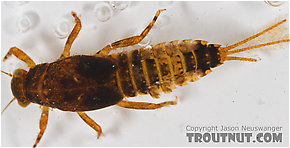 View 5 PicturesI spent (Spent: The wing position of many aquatic insects when they fall on the water after mating. The wings of both sides lay flat on the water. The word may be used to describe insects with their wings in that position, as well as the position itself.) a while with a microscope to fairly positively identify this specimen as Ephemerella excrucians.
View 5 PicturesI spent (Spent: The wing position of many aquatic insects when they fall on the water after mating. The wings of both sides lay flat on the water. The word may be used to describe insects with their wings in that position, as well as the position itself.) a while with a microscope to fairly positively identify this specimen as Ephemerella excrucians.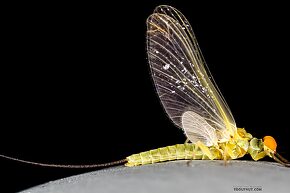
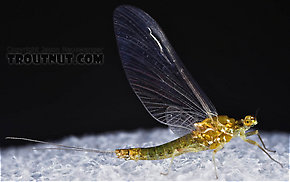
See 19 more specimens...
Mayfly Species Drunella flavilinea
These are very rarely called Blue-Winged Olives.
The Flavs pick up about a week after the closely related but larger Western Green Drakes (Drunella grandis and Drunella doddsii) finish hatching on most Western waters.
Their hatches may be complemented by simultaneous hatches of two less prolific species, Drunella coloradensis and Drunella spinifera.
Their hatches may be complemented by simultaneous hatches of two less prolific species, Drunella coloradensis and Drunella spinifera.
Drunella flavilinea (Flav) Mayfly Nymph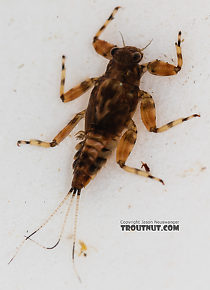 View 6 PicturesAlthough the identification is not certain because the nymph is not yet mature, the configuration of tubercles (
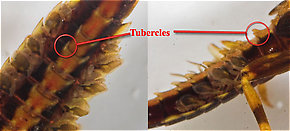 Tubercle: Various peculiar little bumps or projections on an insect. Their character is important for the identification of many kinds of insects, such as the nymphs of Ephemerellidae mayflies.) on this one--particularly the forefemora--seems to best match Drunella flavilinea.
View 6 PicturesAlthough the identification is not certain because the nymph is not yet mature, the configuration of tubercles (
A few (not all) of the abdominal tubercles on this Ephemerella needhami nymph are circled. They are especially large in this species.
Female Drunella flavilinea (Flav) Mayfly Dun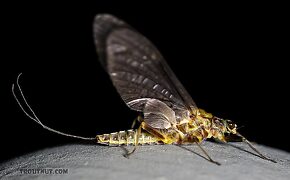 View 6 PicturesI can't be certain of the ID of this female dun, but I'm calling it Drunella flavilinea for three reasons: 1) the known abundance of "flavs" on the Henry's Fork, 2) clear differences in coloration from my confirmed specimens of Drunella coloradensis, which is the main lookalike, and 3) the habitat (a sizable river in a wide mountain valley, rather than a small, high-altitude stream) suggests it's not coloradensis.
View 6 PicturesI can't be certain of the ID of this female dun, but I'm calling it Drunella flavilinea for three reasons: 1) the known abundance of "flavs" on the Henry's Fork, 2) clear differences in coloration from my confirmed specimens of Drunella coloradensis, which is the main lookalike, and 3) the habitat (a sizable river in a wide mountain valley, rather than a small, high-altitude stream) suggests it's not coloradensis.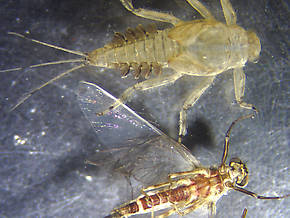
Jargon Defined:
Basal: close to the base; root or beginning
Broods: When a species produces more than one generation per year, each one is called a brood.
Caudal: Toward the posterior tip of the body.
Dun: Mayflies have two adult stages. They first emerge from the water as duns (scientifically known as the subimago stage). They then molt into the spinner (imago) stage, in which they mate and die. Sometimes the word "dun" is confusingly used to refer to a brownish gray color in fly tying materials.
Emergence: The transformation of a nymph or pupa into the adult winged stage of an insect. The term may refer to the emergence of an individual, or the daily or yearly event in which all individuals of a species emerge.
The femur of this Isonychia bicolor mayfly spinner is highlighted in red.
Instar: Many invertebrates molt through dozens of progressively larger and better-developed stages as they grow. Each of these stages is known as an instar. Hard-bodied nymphs typically molt through more instars than soft-bodied larvae.
Larvae: Many classes of aquatic insects, such as caddisflies, midges, craneflies, dobsonflies, alderflies, and many more, are known as "larvae" rather than "nymphs" in their juvenile stages. They have mostly soft bodies rather than hard exoskeletons. These insects also advance through a "pupa" stage before reaching adulthood.
Morphology: The form and structure of an organism, or the study of the form and structure of organisms.
Multibrooded: Producing more than one generation in a single year. Baetis mayflies are a classic example. Insects which produce a single generation with two distinct peaks (like the June and September hatches of Isonychia bicolor mayflies) are not multibrooded, because the fall insects are offspring from the previous fall instead of the current year's spring.
Multivoltine: Having more than one generation per year.
Nymph: The juvenile, underwater stages of mayflies, stoneflies, dragonflies, and damselflies and other aquatic insects whose juvenile stages are covered by hard exoskeletons. The word can also refer to the fishing flies which imitate these creatures, in which case it is used as a blanket term for flies imitating any underwater stage of an invertebrate (except for crayfish and leeches).
Pronotum: The top of the insect prothorax.
Setae: Little hairs on insects.
Spent: The wing position of many aquatic insects when they fall on the water after mating. The wings of both sides lay flat on the water. The word may be used to describe insects with their wings in that position, as well as the position itself.
Spinner: There are two winged stages of adult mayflies. They emerge from the water as duns, molt on land (usually) into their fully mature stage, spinners. As spinners, they mate, lay eggs, and die.
One sternite of this Isonychia bicolor mayfly spinner is highlighted in red.
Subspecies: Entomologists sometimes further divide a species into distinct groups called subspecies, which have two lower-case words on the end of their scientific name instead of one. The latter is the sub-species name. For example, Maccaffertium mexicanum mexicanum and Maccaffertium mexicanum integrum are two different subspecies of Maccaffertium mexicanum.
One tergite of this Isonychia bicolor mayfly spinner is highlighted in red.
Tergum: the dorsal part of an abdominal segment or segments (terga). Also used to describe the entire abdominal dorsum or the thoracic dorsal segments of Odonata.
A few (not all) of the abdominal tubercles on this Ephemerella needhami nymph are circled. They are especially large in this species.
This male Baetidae dun has slightly turbinate eyes.
The wing pads on this final instar Baetidae mayfly nymph are extremely dark.
Useful References:
Arbona, Fred Jr. 1989. Mayflies, the Angler, and the Trout. Nick Lyons Books.
Schwiebert, Ernest G. 1955. Matching the Hatch. MacMillan Publishing Company.
Swisher, Doug and Carl Richards. 2000. Selective Trout. The Lyons Press.
Top 10 Fly Hatches
 Baetis
 Baetidae
 Ephemerellidae
 Hexagenia limbata
 Chironomidae
 Ephemerella subvaria
 Heptageniidae
 Ephemerella
 Isonychia
 Hydropsychidae
Top Gift Shop Designs
 I outfish my daddy!
 Electric blue Hendrickson dun.
 I love buggers. Big, green, wooly ones.
 I outfish my husband!
 Be the trout.
 Eat mayflies.
Top Insect Specimens
 Baetisca obesa Mayfly Nymph
 Neophylax Caddisfly Adult
 Corydalus Hellgrammite Larva
 Isonychia bicolor Mayfly SpinnerBaetis Mayfly Dun
Miscellaneous Sites
Troutnut.com is copyright © 2004-2024 Jason
Neuswanger (email Jason). See my FAQ for information about use of my images.
 privacy policy
privacy policy