
Blog & Latest Updates
Fly Fishing Articles
Insects by Common Name


Tiny Winter Blacks


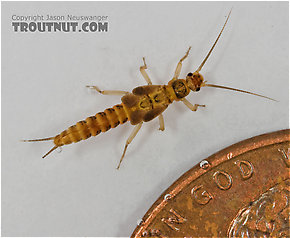
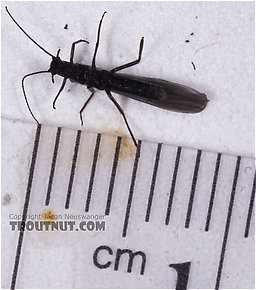
Like most common names, "Tiny Winter Black" can refer to more than one taxon. They're previewed below, along with 5 specimens. For more detail click through to the scientific names.
Stonefly Family Capniidae
These are sometimes called Tiny Winter Blacks.
These are the first stoneflies of the year to appear in most parts of the country, and often the first aquatic insects noticed by the angler. Their dark brown or black bodies are easy to spot against the snowbanks where they crawl around.
Capnia in the West and Allocapnia in the East are probably the most common genera of this prolific family.
Capnia in the West and Allocapnia in the East are probably the most common genera of this prolific family.
See 8 more specimens...
Stonefly Family Leuctridae
These are sometimes called Tiny Winter Blacks.
Leuctra is the only genus of any known importance to trout anglers. Their wings are rolled to a needle-like point; hence the common name, needle flies.
Megaleuctra stigmata (Little Black Needlefly) Stonefly Adult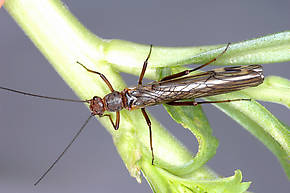 View 3 PicturesThis is one of rarest stoneflies in western Montana. It is a bit unusual that it is fairly abundant in a handful of streams that empty into the east side of Flathead Lake. A very beautiful bug.
View 3 PicturesThis is one of rarest stoneflies in western Montana. It is a bit unusual that it is fairly abundant in a handful of streams that empty into the east side of Flathead Lake. A very beautiful bug.See 3 more specimens...
Stonefly Family Nemouridae
These are sometimes called Tiny Winter Blacks.
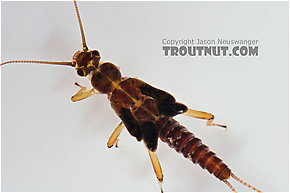
Female Amphinemura (Tiny Winter Blacks) Stonefly Adult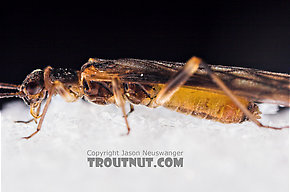 View 5 PicturesA few of these tiny stoneflies were among the only species of aquatic insect adults in the air on this particular afternoon, with most of the action coming from a species of Epeorus mayfly. I somehow forgot to photograph this one on the usual ruler, but I recall it was very, very small, with an abdomen no more than 1mm in girth and the body, not counting the wings, probably just 5-7mm long.
View 5 PicturesA few of these tiny stoneflies were among the only species of aquatic insect adults in the air on this particular afternoon, with most of the action coming from a species of Epeorus mayfly. I somehow forgot to photograph this one on the usual ruler, but I recall it was very, very small, with an abdomen no more than 1mm in girth and the body, not counting the wings, probably just 5-7mm long.See 4 more specimens...
Top 10 Fly Hatches
 Baetis
 Baetidae
 Ephemerellidae
 Hexagenia limbata
 Chironomidae
 Ephemerella subvaria
 Heptageniidae
 Ephemerella
 Isonychia
 Hydropsychidae
Top Gift Shop Designs
 I outfish my daddy!
 Electric blue Hendrickson dun.
 I love buggers. Big, green, wooly ones.
 I outfish my husband!
 Be the trout.
 Eat mayflies.
Top Insect Specimens
 Baetisca obesa Mayfly Nymph
 Neophylax Caddisfly Adult
 Corydalus Hellgrammite Larva
 Isonychia bicolor Mayfly Spinner
 Ephemerella aurivillii Mayfly Spinner
Miscellaneous Sites
Troutnut.com is copyright © 2004-2024 Jason
Neuswanger (email Jason). See my FAQ for information about use of my images.
 privacy policy
privacy policy