
Blog & Latest Updates
Fly Fishing Articles
Insects by Common Name

Willowflies


Scientific Names
| Match | Scientific Name |
 | Taeniopterygidae |
| Hesperoperla pacifica |
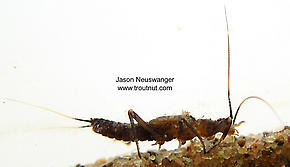
Like most common names, "Willowfly" can refer to more than one taxon. They're previewed below, along with 4 specimens. For more detail click through to the scientific names.
Stonefly Family Taeniopterygidae
These are very rarely called Willowflies.
The Early Brown and Early Black Willowflies of this family are some of the first relevant insects of the very early season. The egg-laying adults produce good dry fly fishing on lucky days when the river warms enough for the trout to rise. On cooler days their nymphs produce well.
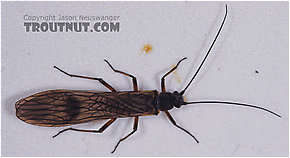
See 14 more specimens...
Stonefly Species Hesperoperla pacifica
These are very rarely called Willowflies.
This species is perhaps better known by anglers under its former scientific name, Acroneuria pacifica. On many rivers they share the same hatching cycle with the famous Pteronarcys californica (Salmonfly) that often overshadows them. Both can be found on the water at the same time in tremendous numbers. Anglers can become so mesmerized by the size and legend of the famous Salmonflies that they fail to pay attention to the smaller and more somber Perlidae. Rest assured the trout don't make that mistake. It pays to keep an eye out for which species the fish are most interested in on a particular stretch or run. Many boulders streamside can be covered with the empty husks of both species intermixed. See the Perlidae Hatch Page for more information.
Older anglers with an extensive background fishing in the Rockies often refer to them as Brown Willowflies or simply "Willows". Historically, Golden Stonefly was a name used on the West Coast to describe members of the family Perlidae (it seems everything from California was gold back then). While in the Rockies, Willow fly was the common name settlers and ranchers used. Over time, the most prominent species on the coast, Calineuria californica became universally accepted in angling literature as the Golden Stone, while Hesperoperla pacifica as the most prominent species in the Rockies was usually listed as Brown Willowfly. In 1955 in Matching the Hatch, Ernest Schwiebert wrote that this species is partially responsible for the "willowfly" hatches of the West, and he described some Colorado mating flights as "really a spectacle to see." Even late into the '80's popular angler entomologies such as Rick Hafele's "Western Hatches" made this distinction. The name Willowfly has largely been dropped from the lexicon of the latest generation of anglers, at least when referring to this species. In an interesting twist of irony, it is Hesperoperla pacifica that now bears the scientific common name Golden Stonefly - not Calineuria californica.
The nymphs have prominent anal gills making them easy to tell apart from Calineuria. They are also often less dramatically marked and have an hour glass or similar shaped mark running vertically on the front of their heads. The more somber appearance holds true for the adults as well. The male adults of Calineuria and Hesperoperla are easier to tell apart by looking at their hammers (Hammer: A smooth clearly defined chitinous area on the ventral surface of the ninth abdominal segment of some male stoneflies used for drumming up mates.). Both are quadrangular but Hesperoperla is wider than long.
Older anglers with an extensive background fishing in the Rockies often refer to them as Brown Willowflies or simply "Willows". Historically, Golden Stonefly was a name used on the West Coast to describe members of the family Perlidae (it seems everything from California was gold back then). While in the Rockies, Willow fly was the common name settlers and ranchers used. Over time, the most prominent species on the coast, Calineuria californica became universally accepted in angling literature as the Golden Stone, while Hesperoperla pacifica as the most prominent species in the Rockies was usually listed as Brown Willowfly. In 1955 in Matching the Hatch, Ernest Schwiebert wrote that this species is partially responsible for the "willowfly" hatches of the West, and he described some Colorado mating flights as "really a spectacle to see." Even late into the '80's popular angler entomologies such as Rick Hafele's "Western Hatches" made this distinction. The name Willowfly has largely been dropped from the lexicon of the latest generation of anglers, at least when referring to this species. In an interesting twist of irony, it is Hesperoperla pacifica that now bears the scientific common name Golden Stonefly - not Calineuria californica.
The nymphs have prominent anal gills making them easy to tell apart from Calineuria. They are also often less dramatically marked and have an hour glass or similar shaped mark running vertically on the front of their heads. The more somber appearance holds true for the adults as well. The male adults of Calineuria and Hesperoperla are easier to tell apart by looking at their hammers (Hammer: A smooth clearly defined chitinous area on the ventral surface of the ninth abdominal segment of some male stoneflies used for drumming up mates.). Both are quadrangular but Hesperoperla is wider than long.
Hesperoperla pacifica (Golden Stone) Stonefly Nymph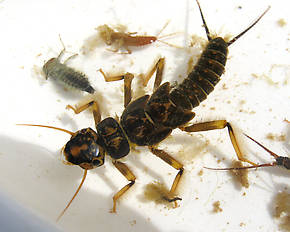 View 1 PicturesThis monster started to feed within a few minutes of sharing the inspection tray with its victims. This nymph is a voracious predator of small invertebrates and has even been noted for feeding on small fish and salmonid alevins. The niche it fills in fast water is equivalent to the Dragonfly nymphs that inhabit slower water.
Hesperoperla pacifica nymphs are easily distinguished from other western perlids by the presence of anal gills (obfuscated by algae in the tray) in combination with an hour glass shaped pale mark on the front of their heads.
View 1 PicturesThis monster started to feed within a few minutes of sharing the inspection tray with its victims. This nymph is a voracious predator of small invertebrates and has even been noted for feeding on small fish and salmonid alevins. The niche it fills in fast water is equivalent to the Dragonfly nymphs that inhabit slower water.Hesperoperla pacifica nymphs are easily distinguished from other western perlids by the presence of anal gills (obfuscated by algae in the tray) in combination with an hour glass shaped pale mark on the front of their heads.
Female Hesperoperla pacifica (Golden Stone) Stonefly Adult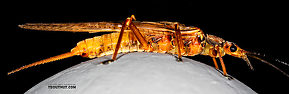 View 13 PicturesMy blurry photo at first makes it look like there might be a distinct notch in the subgenital plate of this specimen, but that's not the case -- just a poor photo. That's important to the ID.
View 13 PicturesMy blurry photo at first makes it look like there might be a distinct notch in the subgenital plate of this specimen, but that's not the case -- just a poor photo. That's important to the ID.See 6 more specimens...
Top 10 Fly Hatches
 Baetis
 Baetidae
 Ephemerellidae
 Hexagenia limbata
 Chironomidae
 Ephemerella subvaria
 Heptageniidae
 Ephemerella
 Isonychia
 Hydropsychidae
Top Gift Shop Designs
 I outfish my daddy!
 Electric blue Hendrickson dun.
 I love buggers. Big, green, wooly ones.
 I outfish my husband!
 Be the trout.
 Eat mayflies.
Top Insect Specimens
 Baetisca obesa Mayfly Nymph
 Corydalus Hellgrammite Larva
 Neophylax Caddisfly Adult
 Pteronarcys biloba Stonefly Nymph
 Hydropsyche aenigma Caddisfly Adult
Miscellaneous Sites
Troutnut.com is copyright © 2004-2024 Jason
Neuswanger (email Jason). See my FAQ for information about use of my images.
 privacy policy
privacy policy