
Blog & Latest Updates
Fly Fishing Articles
Insects by Common Name


Insect Order Odonata-Zygoptera (Damselflies)


Taxonomic Navigation -?-
Kingdom
Animalia (Animals)
» Phylum
Arthropoda (Arthropods)
» Class
Insecta (Insects)
» Order Odonata-Zygoptera (Damselflies)
| Family in Odonata-Zygoptera |  |  |
| Calopterygidae | 0 | 0 |
| Coenagrionidae | 0 | 0 |
2 families aren't included.
Common Name
| Match | Common Name |
 | Damselflies |
Damselflies and dragonflies are in the same order, Odonata, but they are taxonomically separated on an obscure level not built into this site, the suborder. Damselflies are in the suborder Zygoptera, the scientific name by which they're most known. None of that will help you catch trout, but it explains what the hyphen in this page's title is all about.
Biologically, damselflies are similar to dragonflies (Odonata-Anisoptera) in most of the ways that matter to the angler.
Juvenile Biology
Like the adults, the nymphs are fierce predators. They differ from dragonflies in that they are very slender with long, spindly legs, and they swim by awkwardly wiggling rather than using the dragonfly's natural jet propulsion.
Pictures of 8 Damselfly Specimens:
Argia Damselfly Nymph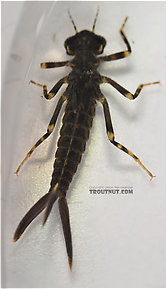 View 3 PicturesMy friend Willy captured this early instar (Instar: Many invertebrates molt through dozens of progressively larger and better-developed stages as they grow. Each of these stages is known as an instar. Hard-bodied nymphs typically molt through more instars than soft-bodied larvae.) damselfly nymph and brought it to me for identification. It is more robust and stocky at this early stage than the spindly appearance of the later instars (Instar: Many invertebrates molt through dozens of progressively larger and better-developed stages as they grow. Each of these stages is known as an instar. Hard-bodied nymphs typically molt through more instars than soft-bodied larvae.), and its appearance is less familiar.
View 3 PicturesMy friend Willy captured this early instar (Instar: Many invertebrates molt through dozens of progressively larger and better-developed stages as they grow. Each of these stages is known as an instar. Hard-bodied nymphs typically molt through more instars than soft-bodied larvae.) damselfly nymph and brought it to me for identification. It is more robust and stocky at this early stage than the spindly appearance of the later instars (Instar: Many invertebrates molt through dozens of progressively larger and better-developed stages as they grow. Each of these stages is known as an instar. Hard-bodied nymphs typically molt through more instars than soft-bodied larvae.), and its appearance is less familiar.Collected August 28, 2005 from Fall Creek in New York
Added to Troutnut.com by Troutnut on April 14, 2006
Added to Troutnut.com by Troutnut on April 14, 2006
Calopteryx Damselfly Nymph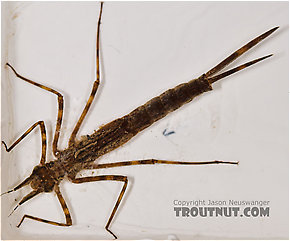 View 7 Pictures
View 7 PicturesCollected March 29, 2005 from Fall Creek in New York
Added to Troutnut.com by Troutnut on April 6, 2006
Added to Troutnut.com by Troutnut on April 6, 2006
Calopteryx Damselfly Nymph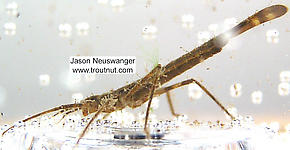 View 4 Pictures
View 4 PicturesCollected January 31, 2004 from unknown in Wisconsin
Added to Troutnut.com by Troutnut on January 25, 2006
Added to Troutnut.com by Troutnut on January 25, 2006
Recent Discussions of Odonata-Zygoptera
Damsefly Nymphs: Odonata Zygoptera 3 Replies »
Posted by WildcatRob on Dec 9, 2007
Last reply on Aug 29, 2011 by Sayfu
While Damselflies are not of great interest to the stream fisher, they are of great interest to the lake fisher.
Creatures of shallow, non fluctuating, weed filled trout lakes, Damsel nymphs migrate in mass to shore for their final molt. As the reach shore the climb out on emergent foliage, lock their claws into and wait while the exoskelton splits to reveal the most graceful of acquatic insects (I'm ducking the brickbats.)
The migration is relatively slow and close to surface with zigzags and pauses.
Mature damsels fold their wings parallel to the body, while hatched dragons hold their wings perpendicular to the body. Mature Damsels are of little interest to trout.
A damsel hatch will put all the really big trout in a lake in motion. These hogs like to get right up against the emergent vegetation picking the nymphs off as they start to climb out.
Anyone who has fished a damsel emergence will never forget the experience. Having experienced one, I am most fortunate. Because you would count me amongst the great liars of our sport, I won't tell the whole story.. The brief facts are: In less than 90 minutes 3 cutthroat - 7+ pounds total, one lost and one over 6 pounds scared away. The lake is Lenice. It's public. It's reknown for huge cutthroat. It's a challenge.
For a compact Odonta/damsel reference, I recommend 'The Gilly' A Flyfisher's Guide, Edited by Alfred G. Davy 1985 IBSN 0-88925-638-1 pp 69-74 as one of many compact references.
WildcatRob
ReplyStupid damselfly! 4 Replies »Creatures of shallow, non fluctuating, weed filled trout lakes, Damsel nymphs migrate in mass to shore for their final molt. As the reach shore the climb out on emergent foliage, lock their claws into and wait while the exoskelton splits to reveal the most graceful of acquatic insects (I'm ducking the brickbats.)
The migration is relatively slow and close to surface with zigzags and pauses.
Mature damsels fold their wings parallel to the body, while hatched dragons hold their wings perpendicular to the body. Mature Damsels are of little interest to trout.
A damsel hatch will put all the really big trout in a lake in motion. These hogs like to get right up against the emergent vegetation picking the nymphs off as they start to climb out.
Anyone who has fished a damsel emergence will never forget the experience. Having experienced one, I am most fortunate. Because you would count me amongst the great liars of our sport, I won't tell the whole story.. The brief facts are: In less than 90 minutes 3 cutthroat - 7+ pounds total, one lost and one over 6 pounds scared away. The lake is Lenice. It's public. It's reknown for huge cutthroat. It's a challenge.
For a compact Odonta/damsel reference, I recommend 'The Gilly' A Flyfisher's Guide, Edited by Alfred G. Davy 1985 IBSN 0-88925-638-1 pp 69-74 as one of many compact references.
WildcatRob
Posted by Troutnut on May 29, 2007
Last reply on Jul 1, 2007 by Litobrancha
Today I was collecting nymphs in the Poconos with Gonzo when I spotted an interesting-looking spinner in the air and it landed next to us on a piece of grass. I grabbed it and tossed it in my bug box, and we both took a closer look.
It was a male spinner, perfect for identification, and it seemed to belong to a species of Ephemerella that neither of us recognized. The form was similar to invaria, more sleek than subvaria or Drunella. It was long, a big size 12 probably, but very thin. It had three long, elegant tails, and would generally have been a very photogenic mayfly.
I was looking forward to getting it under the camera and microscope to figure out what it was. But when I got home a little while ago and was looking through my bugs, it had disappeared!
Mostly.
I found a detached spinner wing of about the right size, dangling out of the mouth of a big damselfly I had added to the container. D'oh! Despite the stress of restriction to my container, and the fact that its wings were messed up, my crippled damselfly apparently hobbled its way over to my prized spinner and ate all but one wing.
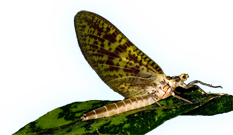
ReplyAdult damselIt was a male spinner, perfect for identification, and it seemed to belong to a species of Ephemerella that neither of us recognized. The form was similar to invaria, more sleek than subvaria or Drunella. It was long, a big size 12 probably, but very thin. It had three long, elegant tails, and would generally have been a very photogenic mayfly.
I was looking forward to getting it under the camera and microscope to figure out what it was. But when I got home a little while ago and was looking through my bugs, it had disappeared!
Mostly.
I found a detached spinner wing of about the right size, dangling out of the mouth of a big damselfly I had added to the container. D'oh! Despite the stress of restriction to my container, and the fact that its wings were messed up, my crippled damselfly apparently hobbled its way over to my prized spinner and ate all but one wing.
Posted by DMM on Feb 22, 2007
I didn't notice this Calopteryx adult before...it's beautiful.
ReplyYour Thoughts On Odonata-Zygoptera:
Top 10 Fly Hatches
 Baetis
 Baetidae
 Ephemerellidae
 Hexagenia limbata
 Chironomidae
 Ephemerella subvaria
 Heptageniidae
 Ephemerella
 Isonychia
 Hydropsychidae
Top Gift Shop Designs
 I outfish my daddy!
 Electric blue Hendrickson dun.
 I love buggers. Big, green, wooly ones.
 I outfish my husband!
 Be the trout.
 Eat mayflies.
Top Insect Specimens
 Baetisca obesa Mayfly Nymph
 Neophylax Caddisfly Adult
 Corydalus Hellgrammite Larva
 Isonychia bicolor Mayfly Spinner
 Ephemerella aurivillii Mayfly Spinner
Miscellaneous Sites
Troutnut.com is copyright © 2004-2024 Jason
Neuswanger (email Jason). See my FAQ for information about use of my images.
 privacy policy
privacy policy