
Blog & Latest Updates
Fly Fishing Articles
Insects by Common Name

Mayfly Species Heptagenia culacantha


Taxonomic Navigation -?-
Kingdom
Animalia (Animals)
» Phylum
Arthropoda (Arthropods)
» Class
Insecta (Insects)
» Order
Ephemeroptera (Mayflies)
» Genus
Heptagenia
» Species culacantha
This is the largest species of Heptagenia on the continent, and it's also one of the largest in the entire Heptageniidae family. Nymphs and adult females have been collected with bodies up to a size of 19.5mm, a little over 3/4" long.
Where & When
In the paper announcing its discovery, this mayfly was reported only from two very large rivers in New York and Pennsylvania, the Delaware and the Susquehanna. The authors first discovered the nymphs and duns in the Susquehanna near Three Mile Island, PA in 1980, and in 1982 they found more nymphs which they raised into eight spinners. They later figured out that several specimens collected from the Delaware and Susquehanna in 1974 belonged to this new species.
This mayfly is very hard to find, even for experts who know where to look. The discovering scientists wrote, "rarely was more than one nymph found on the underside of the same rock." Their attempt to find more specimens in 1981 was unsuccessful. However, the species seems to still be around. The Mayflies of the United States geographic database shows additional records from far northeastern New York and south-central Pennsylvania.
Delaware River fishing guide Paul Weamer of Border Water Outfitters found and photographed a female Heptagenia culacantha dun in 2005, and his photos are posted and discussed in a "name that mayfly" contest on the Fly Fisherman magazine forum. Heptagenia flavescens was incorrectly suggested, but it wasn't far off the mark: Evans (1985) mentions that it is Heptagenia culacantha's closest relative.
Nymph Biology
Substrate: Underside of large rubble and boulders
Environmental Tolerance: Known mainly from a fairly warm trout river and a warmwater river
The nymphs are supposed to be strikingly colored yellow with brown markings. The scientific description brings to mind a color pattern similar to the Perlidae (golden stoneflies).Environmental Tolerance: Known mainly from a fairly warm trout river and a warmwater river
Pictures of 2 Mayfly Specimens in the Species Heptagenia culacantha:
Male Heptagenia culacantha Mayfly Spinner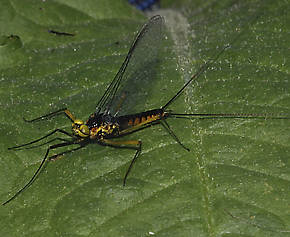 View 1 PicturesThis photo was provided by guide Eric Naguski along with the following comments, "I took this photo just upstream of Three Mile Island on the east shore of the Susquehanna River just below where the Swatara Creek enters. The Susquehanna is not an easy river to sample for bugs in my opinion. It is very large and pushes a lot of water. Especially in the spring when you would collect mature culacantha nymphs. And I don't believe that there are a ton of these Heptageniids around. Also the people who are doing most of the sampling like myself are doing so for water quality monitoring work so they only take the specimens down to genus-level taxonomy".
View 1 PicturesThis photo was provided by guide Eric Naguski along with the following comments, "I took this photo just upstream of Three Mile Island on the east shore of the Susquehanna River just below where the Swatara Creek enters. The Susquehanna is not an easy river to sample for bugs in my opinion. It is very large and pushes a lot of water. Especially in the spring when you would collect mature culacantha nymphs. And I don't believe that there are a ton of these Heptageniids around. Also the people who are doing most of the sampling like myself are doing so for water quality monitoring work so they only take the specimens down to genus-level taxonomy".Collected October 22, 2011 from the Susquehanna River in Pennsylvania
Added to Troutnut.com by Entoman on February 10, 2012
Added to Troutnut.com by Entoman on February 10, 2012
Male Heptagenia culacantha Mayfly Dun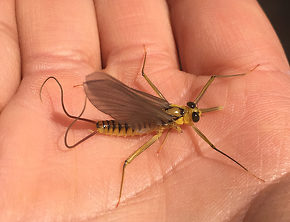 View 3 PicturesHyun Kounne generously provided photos of the striking, hard-to-find Heptagenia culacantha from the mainstem Delaware River. She mentioned it was one of maybe half a dozen she saw on the water that day.
View 3 PicturesHyun Kounne generously provided photos of the striking, hard-to-find Heptagenia culacantha from the mainstem Delaware River. She mentioned it was one of maybe half a dozen she saw on the water that day.Collected June 3, 2017 from the Delaware River in New York
Added to Troutnut.com by Troutnut on December 5, 2019
Added to Troutnut.com by Troutnut on December 5, 2019
Recent Discussions of Heptagenia culacantha
Added more Heptagenia culacantha info 12 Replies »
I went to the entomology library today and photocopied the 1985 paper that first described this curious species. I've updated the culacantha page with this information.
ReplyLink to pictures of H. culacantha 2 Replies »Many thanks to user Softhackle for digging up this link. I knew about the thread from back when it started, but I wasn't able to find it when I went back to look last night. Good work!
Fly Fisherman Magazine forum topic with two pictures of a H. culacantha dun.
I've added the species to the "live" part of the database and put up a rudimentary page where I can compile any more information we find.
ReplyDoes anyone know anything about Heptagenia culacantha? 8 Replies »Fly Fisherman Magazine forum topic with two pictures of a H. culacantha dun.
I've added the species to the "live" part of the database and put up a rudimentary page where I can compile any more information we find.
This is a shot in the dark, but I'm trying to track down descriptive information about a rather rare "mystery mayfly." Heptagenia culacantha was identified in 1985 (Evans, Botts, & Flowers). About all I have right now is a tease from the Journal of the New York Entomological Society--"This infrequently taken species, one of the largest and most striking North American heptageniids, is known only from Pennsylvania and New York."
The reason I'm so interested is that I believe I encounter a fishable hatch of these mayflies every season on one of my favorite PA brook trout headwaters. If that conjures a picture of fishing to 6-7" dinks, you'll need to double those numbers to appreciate how special this stream really is. Add to that an image of the fish rising to these beautiful "mystery mayflies" that hatch in the evening, following a day-long emergence of Dark Green Drakes (Litobrancha recurvata)!
It is such a special event that it is one of the very few things that can pull me away from fishing my favorite Olive Morning Dun hatch (Drunella lata, nee cornuta). Help!
ReplyThe reason I'm so interested is that I believe I encounter a fishable hatch of these mayflies every season on one of my favorite PA brook trout headwaters. If that conjures a picture of fishing to 6-7" dinks, you'll need to double those numbers to appreciate how special this stream really is. Add to that an image of the fish rising to these beautiful "mystery mayflies" that hatch in the evening, following a day-long emergence of Dark Green Drakes (Litobrancha recurvata)!
It is such a special event that it is one of the very few things that can pull me away from fishing my favorite Olive Morning Dun hatch (Drunella lata, nee cornuta). Help!
Your Thoughts On Heptagenia culacantha:
Top 10 Fly Hatches
 Baetis
 Baetidae
 Ephemerellidae
 Hexagenia limbata
 Chironomidae
 Ephemerella subvaria
 Heptageniidae
 Ephemerella
 Isonychia
 Hydropsychidae
Top Gift Shop Designs
 I outfish my daddy!
 Electric blue Hendrickson dun.
 I love buggers. Big, green, wooly ones.
 I outfish my husband!
 Be the trout.
 Eat mayflies.
Top Insect Specimens
 Baetisca obesa Mayfly Nymph
 Corydalus Hellgrammite Larva
 Neophylax Caddisfly Adult
 Pteronarcys biloba Stonefly Nymph
 Hydropsyche aenigma Caddisfly Adult
Miscellaneous Sites
Troutnut.com is copyright © 2004-2024 Jason
Neuswanger (email Jason). See my FAQ for information about use of my images.
 privacy policy
privacy policy