
Blog & Latest Updates
Fly Fishing Articles
Insects by Common Name


Caddisfly Genus Psychoglypha (Snow Sedges)


Taxonomic Navigation -?-
Kingdom
Animalia (Animals)
» Phylum
Arthropoda (Arthropods)
» Class
Insecta (Insects)
» Order
Trichoptera (Caddisflies)
» Family
Limnephilidae (Northern Caddisflies)
» Genus Psychoglypha (Snow Sedges)
| Species in Psychoglypha |  |  |
| Psychoglypha alascensisSnow Sedge | 1 | 3 |
| Psychoglypha subborealisSnow Sedge | 0 | 0 |
12 species aren't included.
Common Names
| Match | Common Name |
 | Snow Sedges |
 | Northern Caddisflies |
Dr. George Roemhild explained to me how he finds these winter caddisflies in February and March: "They crawl up on the snowbanks, but when the sun hits their dark wings they melt down out of sight. That's how I collect them, by walking along looking for holes in the snow."
I will keep an eye out this winter and hopefully collect some specimens to photograph.
Hatching Behavior
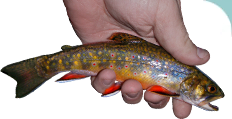
On bright winter days when the trout move into the shallows to sun themselves, these caddisflies may pick the same destination to emerge and the trout will feed.
Larva & Pupa Biology
Diet: Leaf matter, algae, dead animals
The larvae are the most important stage of Psychoglypha. They are especially prone to behavioral drift (Behavioral drift: The nymphs and larvae of many aquatic insects sometimes release their grip on the bottom and drift downstream for a while with synchronized timing. This phenomenon increases their vulnerability to trout just like emergence, but it is invisible to the angler above the surface. In many species it occurs daily, most often just after dusk or just before dawn.) and, unlike most species, they do it during the daytime.Pictures of 2 Caddisfly Specimens in the Genus Psychoglypha:
Female Psychoglypha alascensis (Snow Sedge) Caddisfly Adult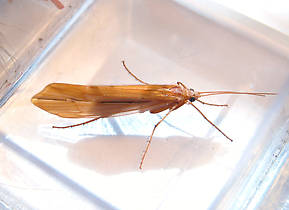 View 3 PicturesThis specimen was 22 mm.
View 3 PicturesThis specimen was 22 mm.Collected September 15, 2013 from Mystery Creek #178 in Idaho
Added to Troutnut.com by Entoman on September 23, 2013
Added to Troutnut.com by Entoman on September 23, 2013
Male Psychoglypha (Snow Sedges) Caddisfly Adult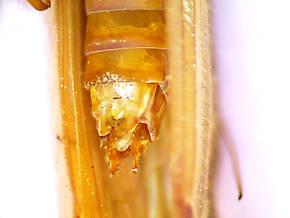 View 2 PicturesThis Psychoglypha adult was found clinging to my garage door in the evening on April 9, 2013. It measures 21 mm in length, from the front of head to the end of wings. It is my hope that Creno will be able to identify it to species based on the image of its genitalia. However, if other images are required for a species ID, the specimen is available, so they can be easily taken. Thanks, Roger Rohrbeck, Mercer Island, WA.
View 2 PicturesThis Psychoglypha adult was found clinging to my garage door in the evening on April 9, 2013. It measures 21 mm in length, from the front of head to the end of wings. It is my hope that Creno will be able to identify it to species based on the image of its genitalia. However, if other images are required for a species ID, the specimen is available, so they can be easily taken. Thanks, Roger Rohrbeck, Mercer Island, WA.Your Thoughts On Psychoglypha:
Top 10 Fly Hatches
 Baetis
 Baetidae
 Ephemerellidae
 Hexagenia limbata
 Chironomidae
 Ephemerella subvaria
 Heptageniidae
 Ephemerella
 Isonychia
 Hydropsychidae
Top Gift Shop Designs
 I outfish my daddy!
 Electric blue Hendrickson dun.
 I love buggers. Big, green, wooly ones.
 I outfish my husband!
 Be the trout.
 Eat mayflies.
Top Insect Specimens
 Baetisca obesa Mayfly Nymph
 Neophylax Caddisfly Adult
 Corydalus Hellgrammite Larva
 Isonychia bicolor Mayfly Spinner
 Ephemerella aurivillii Mayfly Spinner
Miscellaneous Sites
Troutnut.com is copyright © 2004-2024 Jason
Neuswanger (email Jason). See my FAQ for information about use of my images.
 privacy policy
privacy policy