
Blog & Latest Updates
Fly Fishing Articles
Insects by Common Name


Caddisfly Genus Arctopsyche (Great Gray Spotted Sedges)


Taxonomic Navigation -?-
Kingdom
Animalia (Animals)
» Phylum
Arthropoda (Arthropods)
» Class
Insecta (Insects)
» Order
Trichoptera (Caddisflies)
» Family
Hydropsychidae
» Genus Arctopsyche (Great Gray Spotted Sedges)
| Species in Arctopsyche |  |  |
| Arctopsyche grandisGreat Gray Spotted Sedge | 1 | 14 |
| Arctopsyche irrorataGreat Gray Spotted Sedge | 0 | 0 |
2 species aren't included.
Common Name
| Match | Common Name |
 | Great Gray Spotted Sedges |
Larva & Pupa Biology
Diet: Smaller insects
Shelter Type: They spin and tend their nets instead of building a case.
The larvae live for two years before emerging and are especially prone to behavioral drift (Behavioral drift: The nymphs and larvae of many aquatic insects sometimes release their grip on the bottom and drift downstream for a while with synchronized timing. This phenomenon increases their vulnerability to trout just like emergence, but it is invisible to the angler above the surface. In many species it occurs daily, most often just after dusk or just before dawn.) at dawn and dusk.Shelter Type: They spin and tend their nets instead of building a case.
Pictures of 1 Caddisfly Specimen in the Genus Arctopsyche:
Arctopsyche grandis (Great Gray Spotted Sedge) Caddisfly Larva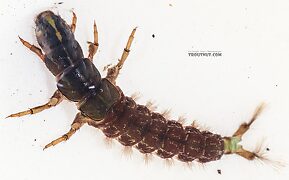 View 14 PicturesAt first I had trouble believing this giant Hydropsychidae larva was actually a member of its family, because of the size. I had never seen such a thing. It turned out to be a member of this exceptionally large species with a fitting name, grandis.
View 14 PicturesAt first I had trouble believing this giant Hydropsychidae larva was actually a member of its family, because of the size. I had never seen such a thing. It turned out to be a member of this exceptionally large species with a fitting name, grandis.Collected August 3, 2020 from the East Fork Big Lost River in Idaho
Added to Troutnut.com by Troutnut on August 19, 2020
Added to Troutnut.com by Troutnut on August 19, 2020
Recent Discussions of Arctopsyche
Arctopsyche grandis in waterton canyon 1 Reply »
Posted by Krikut on May 16, 2016 in the species Arctopsyche grandis
Last reply on May 17, 2016 by Bnorikane
Discovered one of these guys or (gals?) back on March 20 of this year up in Waterton Canyon. He was so chunky I first thought it was a small hellgrammite (I grew up in Virginia, where the hellgrammite was the bug of choice in most smallmouth rivers). This particular one measured about half an inch and had a bright green tail/foot segment. I'm curious if you guys have a favorite immitation? Thanks!
ReplyArctopsyche Grandis 6 Replies »A while ago there was some discussion of this bug in Colorado. I first came across this beast in early July 2011 on the Eagle River, just downstream of Edwards, Co. Met him again this week on the Eagle. It's quite the blast - big bugs and big trout. Especially the ones rising with abandon in the fast water in the middle of the day.
Funny thing is we don't seem to see these guys most years. The commonality between 2011 and this year is an extended runoff leading to cold and high - though clear water in early July. I wonder if they normally hatch during the peak of the runoff when no one is on the water.
I remember people commenting about these caddis allegedly being in parts of Colorado. The hatches the last two days on the Eagle and what I saw in 2011 would add some level of credence to that belief.
A size 10 (on a Partridge L3A) sponge body caddis with a dark gray body, and a size 10 Lafontaine sparkle emerger with a gray body and a clear shroud were the ticket.
ReplyArctopsyche grandis 6 Replies »Funny thing is we don't seem to see these guys most years. The commonality between 2011 and this year is an extended runoff leading to cold and high - though clear water in early July. I wonder if they normally hatch during the peak of the runoff when no one is on the water.
I remember people commenting about these caddis allegedly being in parts of Colorado. The hatches the last two days on the Eagle and what I saw in 2011 would add some level of credence to that belief.
A size 10 (on a Partridge L3A) sponge body caddis with a dark gray body, and a size 10 Lafontaine sparkle emerger with a gray body and a clear shroud were the ticket.
Posted by Flymonster on Sep 8, 2011 in the species Arctopsyche grandis
Last reply on May 20, 2013 by Flymonster
Here in the Willamette Valley the McKenzie Caddis (as Arctopsyche grandis is known locally) usually begins its emergence sometime around mid-May and can continue into mid-June. The most emergence activity will be noted on warm days once the water temperature reaches @ 52f. Most hatches occur on warm sunny days from 4pm-7pm. Arlen Thomason goes into great detail about the life-cycle and behaviors of a. grandis in his book "Bug Water".
At least for me, the McKenzie Caddis, marks the beginning of summer and excellent fly fishing for trout on the McKenzie, Middle Fork Willamette, North Fork of the Middle Fork Willamette, and our other local rivers and streams.
ReplyAt least for me, the McKenzie Caddis, marks the beginning of summer and excellent fly fishing for trout on the McKenzie, Middle Fork Willamette, North Fork of the Middle Fork Willamette, and our other local rivers and streams.
Your Thoughts On Arctopsyche:
Top 10 Fly Hatches
 Baetis
 Baetidae
 Ephemerellidae
 Hexagenia limbata
 Chironomidae
 Ephemerella subvaria
 Heptageniidae
 Ephemerella
 Isonychia
 Hydropsychidae
Top Gift Shop Designs
 I outfish my daddy!
 Electric blue Hendrickson dun.
 I love buggers. Big, green, wooly ones.
 I outfish my husband!
 Be the trout.
 Eat mayflies.
Top Insect Specimens
 Baetisca obesa Mayfly Nymph
 Neophylax Caddisfly Adult
 Corydalus Hellgrammite Larva
 Isonychia bicolor Mayfly Spinner
 Ephemerella aurivillii Mayfly Spinner
Miscellaneous Sites
Troutnut.com is copyright © 2004-2024 Jason
Neuswanger (email Jason). See my FAQ for information about use of my images.
 privacy policy
privacy policy