
Blog & Latest Updates
Fly Fishing Articles
Insects by Common Name


Big Golden Stones


This common name refers to only one family.
Stonefly Family Perlidae
These are sometimes called Big Golden Stones.
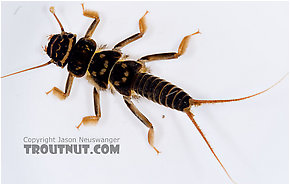
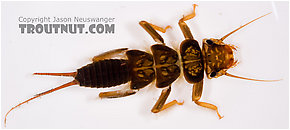
Every angler who turns over a rock now and then is familiar with the stout bodied and hastily scurrying examples of the family Perlidae. They are very active and predaceous. This family contains most of the large stonefly species common to freestone streams across the continent. There are fifteen genera of this large and abundant family currently recognized in North America. They are easy to tell from Pteronarcyidae species (Eastern Giant Black Stonefly, Western Salmonfly) by their lighter, patterned coloration. They are also much more ovoid in cross section. Their longer tails/antennae and large triangular heads are other 'easy to spot' differences. The males are substantially smaller than the females and some have very short wings.
Perlidae species are very similar in conformation and habits. With some exceptions, telling them apart can be very difficult East of the Rockies where ten of the genera reside and more than 50 species are involved. With nymphs, differentiating them by subfamily is a good place to start. There are only two: Perlinae - those with an occipital (Occiput: The back of the head.) ridge and row of spinules (often making the back of their heads look concave); Acroneuriinae - those without an occipital (Occiput: The back of the head.) ridge or row of spinules. See the genus and species pages for more information.
Angling literature can be confusing as species of this family were historically referred to as Golden Stoneflies on the West Coast, Brown Willowflies in the Rockies, and in the East they went by a plethora of names. Stone Creeper, American Stonefly, and Common Stonefly were used for the more abundant and usually more somber hued subfamily Acroneuriinae; also present are many often colorful species of the subfamily Perlinae that go by equally colorful names like Yellow Legged Stonefly, Embossed Stonefly, and Beautiful Stonefly. Over time these regional names are going by the wayside as more and more anglers (and the latest angling literature) refer to all of them collectively as Golden Stoneflies.
The nymphs range in coloration from dark brown, delicately patterned gold and amber, to a brilliant yellow and black striped pattern reminiscent of Bengal tigers. The latter description befits them in recognition of their predator status. Their rarely abundant populations and nocturnal habits make them limited in importance back East, but out West, the story is quite different.
In the Rocky Mountain and Pacific Coast States, perlids exist in tremendous numbers and perhaps more importantly, they are very active during daylight hours. Ironically, in spite of the large populations the entire family is represented by only eight species in six genera and of those, by far the largest populations involve only two, Calineuria californica and the equally common Hesperoperla pacifica. Certain characteristics allow the angler to easily tell these western species apart in the hand by comparing head markings and the presence or absence of anal gills on the nymphs. The adults are easily sorted as well by knowing the different hammer (Hammer: A smooth clearly defined chitinous area on the ventral surface of the ninth abdominal segment of some male stoneflies used for drumming up mates.) shapes of the males and dorsal (Dorsal: Top.) markings of both sexes.
Taxonomic revisions have moved four of the five western species formerly classified under Acroneuria to new genera, though like the two already mentioned, they are easily recognized in the taxa lists by their retained species names. All remaining Acroneuria species are now east of the Rockies.
Perlidae species are very similar in conformation and habits. With some exceptions, telling them apart can be very difficult East of the Rockies where ten of the genera reside and more than 50 species are involved. With nymphs, differentiating them by subfamily is a good place to start. There are only two: Perlinae - those with an occipital (Occiput: The back of the head.) ridge and row of spinules (often making the back of their heads look concave); Acroneuriinae - those without an occipital (Occiput: The back of the head.) ridge or row of spinules. See the genus and species pages for more information.
Angling literature can be confusing as species of this family were historically referred to as Golden Stoneflies on the West Coast, Brown Willowflies in the Rockies, and in the East they went by a plethora of names. Stone Creeper, American Stonefly, and Common Stonefly were used for the more abundant and usually more somber hued subfamily Acroneuriinae; also present are many often colorful species of the subfamily Perlinae that go by equally colorful names like Yellow Legged Stonefly, Embossed Stonefly, and Beautiful Stonefly. Over time these regional names are going by the wayside as more and more anglers (and the latest angling literature) refer to all of them collectively as Golden Stoneflies.
The nymphs range in coloration from dark brown, delicately patterned gold and amber, to a brilliant yellow and black striped pattern reminiscent of Bengal tigers. The latter description befits them in recognition of their predator status. Their rarely abundant populations and nocturnal habits make them limited in importance back East, but out West, the story is quite different.
In the Rocky Mountain and Pacific Coast States, perlids exist in tremendous numbers and perhaps more importantly, they are very active during daylight hours. Ironically, in spite of the large populations the entire family is represented by only eight species in six genera and of those, by far the largest populations involve only two, Calineuria californica and the equally common Hesperoperla pacifica. Certain characteristics allow the angler to easily tell these western species apart in the hand by comparing head markings and the presence or absence of anal gills on the nymphs. The adults are easily sorted as well by knowing the different hammer (Hammer: A smooth clearly defined chitinous area on the ventral surface of the ninth abdominal segment of some male stoneflies used for drumming up mates.) shapes of the males and dorsal (Dorsal: Top.) markings of both sexes.
Taxonomic revisions have moved four of the five western species formerly classified under Acroneuria to new genera, though like the two already mentioned, they are easily recognized in the taxa lists by their retained species names. All remaining Acroneuria species are now east of the Rockies.
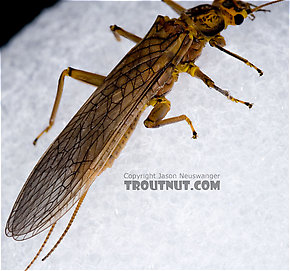
See 38 more specimens...
Top 10 Fly Hatches
 Baetis
 Baetidae
 Ephemerellidae
 Hexagenia limbata
 Chironomidae
 Ephemerella subvaria
 Heptageniidae
 Ephemerella
 Isonychia
 Hydropsychidae
Top Gift Shop Designs
 I outfish my daddy!
 Electric blue Hendrickson dun.
 I love buggers. Big, green, wooly ones.
 I outfish my husband!
 Be the trout.
 Eat mayflies.
Top Insect Specimens
 Baetisca obesa Mayfly Nymph
 Corydalus Hellgrammite Larva
 Neophylax Caddisfly Adult
 Pteronarcys biloba Stonefly Nymph
 Hydropsyche aenigma Caddisfly Adult
Miscellaneous Sites
Troutnut.com is copyright © 2004-2024 Jason
Neuswanger (email Jason). See my FAQ for information about use of my images.
 privacy policy
privacy policy