
Blog & Latest Updates
Fly Fishing Articles
Insects by Common Name

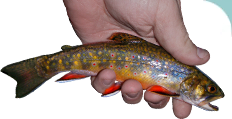

Great Brown Spinners


Scientific Names
| Match | Scientific Name |
 | Litobrancha recurvata |
 | Timpanoga hecuba |
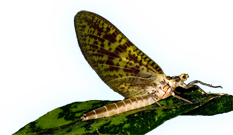
Like most common names, "Great Brown Spinner" can refer to more than one taxon. They're previewed below, along with 4 specimens. For more detail click through to the scientific names.
Mayfly Species Litobrancha recurvata
These are sometimes called Great Brown Spinners.
Litobrancha recurvata is generally reported to be the largest North American species of mayfly in angler entomologies, though this understanding is being challenged by reports of Hexagenia limbata that may exceed 40mm in some locales. Regardless, it is certainly the largest mayfly in the region of its distribution. Sometimes it appears together with species of Hexagenia or Ephemera, but in other places it creates excellent action on its own.
Female Litobrancha recurvata (Dark Green Drake) Mayfly Dun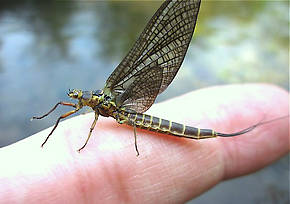 View 2 PicturesThese photos were contributed by Spencer Vanderhoof.
View 2 PicturesThese photos were contributed by Spencer Vanderhoof.Male Litobrancha recurvata (Dark Green Drake) Mayfly Spinner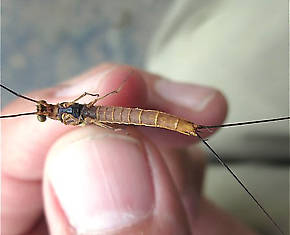 View 1 PicturesThese photos were contributed by Spencer Vanderhoof.
View 1 PicturesThese photos were contributed by Spencer Vanderhoof.See 1 more specimens...
Mayfly Species Timpanoga hecuba
These are very rarely called Great Brown Spinners.
Timpanoga hecuba is not abundant enough, and its emergence not concentrated enough to provide great hatches, but where it is locally abundant it creates fishable action because of its large size. This species seems subject to substantial fluctuations in population densities, possibly in relation to the amount of silted habitat they prefer. When silt builds up in drought years, their numbers appear to increase. It is the largest species in the Ephemerellidae family, often rivaling Drunella grandis (Western Green Drake) in length but appearing even stouter due to its dramatic lateral (Lateral: To the side.) abdominal spines. It contains two subspecies (Subspecies: Entomologists sometimes further divide a species into distinct groups called subspecies, which have two lower-case words on the end of their scientific name instead of one. The latter is the sub-species name. For example, Maccaffertium mexicanum mexicanum and Maccaffertium mexicanum integrum are two different subspecies of Maccaffertium mexicanum.). See the Timpanoga genus hatch page for details.
There seems to be no preferred common name and anglers call them many things. Great Red Quill and Western Red Drake seem to fit best, though many refer to them as Giant Dark Hendricksons. Many fly shop reports have recently started to refer to them by their Latin species name. A fly shop serving Yellowstone out of Gardiner, Montana calls them Drake Mackerels in their hatch chart.
There seems to be no preferred common name and anglers call them many things. Great Red Quill and Western Red Drake seem to fit best, though many refer to them as Giant Dark Hendricksons. Many fly shop reports have recently started to refer to them by their Latin species name. A fly shop serving Yellowstone out of Gardiner, Montana calls them Drake Mackerels in their hatch chart.
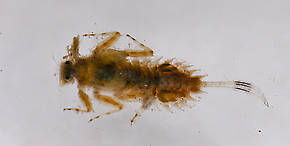
Female Timpanoga hecuba (Great Red Quill) Mayfly Dun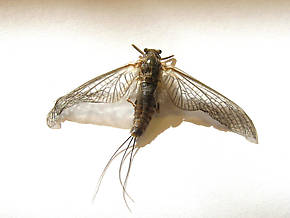 View 3 PicturesThis specimen is 14 mm. Technically this is the subspecies (Subspecies: Entomologists sometimes further divide a species into distinct groups called subspecies, which have two lower-case words on the end of their scientific name instead of one. The latter is the sub-species name. For example, Maccaffertium mexicanum mexicanum and Maccaffertium mexicanum integrum are two different subspecies of Maccaffertium mexicanum.) T. h. hecuba. The Cascades, Sierras and further West is where the other subspecies (Subspecies: Entomologists sometimes further divide a species into distinct groups called subspecies, which have two lower-case words on the end of their scientific name instead of one. The latter is the sub-species name. For example, Maccaffertium mexicanum mexicanum and Maccaffertium mexicanum integrum are two different subspecies of Maccaffertium mexicanum.), T. h. pacifica is found. The Great Basin seems to have formed a barrier preventing any overlap in their distribution.
View 3 PicturesThis specimen is 14 mm. Technically this is the subspecies (Subspecies: Entomologists sometimes further divide a species into distinct groups called subspecies, which have two lower-case words on the end of their scientific name instead of one. The latter is the sub-species name. For example, Maccaffertium mexicanum mexicanum and Maccaffertium mexicanum integrum are two different subspecies of Maccaffertium mexicanum.) T. h. hecuba. The Cascades, Sierras and further West is where the other subspecies (Subspecies: Entomologists sometimes further divide a species into distinct groups called subspecies, which have two lower-case words on the end of their scientific name instead of one. The latter is the sub-species name. For example, Maccaffertium mexicanum mexicanum and Maccaffertium mexicanum integrum are two different subspecies of Maccaffertium mexicanum.), T. h. pacifica is found. The Great Basin seems to have formed a barrier preventing any overlap in their distribution.See 1 more specimens...
Top 10 Fly Hatches
 Baetis
 Baetidae
 Ephemerellidae
 Hexagenia limbata
 Chironomidae
 Ephemerella subvaria
 Heptageniidae
 Ephemerella
 Isonychia
 Hydropsychidae
Top Gift Shop Designs
 I outfish my daddy!
 Electric blue Hendrickson dun.
 I love buggers. Big, green, wooly ones.
 I outfish my husband!
 Be the trout.
 Eat mayflies.
Top Insect Specimens
 Baetisca obesa Mayfly Nymph
 Corydalus Hellgrammite Larva
 Neophylax Caddisfly Adult
 Pteronarcys biloba Stonefly Nymph
 Hydropsyche aenigma Caddisfly Adult
Miscellaneous Sites
Troutnut.com is copyright © 2004-2024 Jason
Neuswanger (email Jason). See my FAQ for information about use of my images.
 privacy policy
privacy policy