
Blog & Latest Updates
Fly Fishing Articles
Insects by Common Name

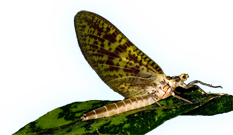
Western Black Quills


Scientific Names
| Match | Scientific Name |
 | Rhithrogena hageni |
 | Leptophlebia |
| Rhithrogena morrisoni |
Like most common names, "Western Black Quill" can refer to more than one taxon. They're previewed below, along with 9 specimens. For more detail click through to the scientific names.
Mayfly Species Rhithrogena hageni
These are pretty much always called Western Black Quills.
According to Fred Arbona in Mayflies, the Angler, and the Trout, this is an excellent hatch and one of the most common fast-water mayflies in the West.
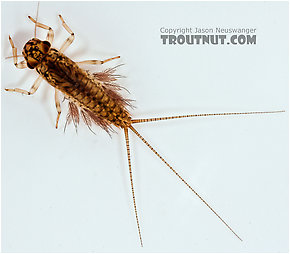
Rhithrogena hageni (Western Black Quill) Mayfly Nymph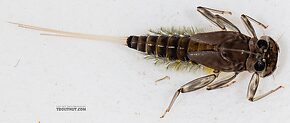 View 9 PicturesI'm basing the ID of this near-mature nymph on a male spinner with similar size and markings, collected on the same trip. There isn't a key to reliably identify the nymphs of most Rhithrogena species otherwise.
View 9 PicturesI'm basing the ID of this near-mature nymph on a male spinner with similar size and markings, collected on the same trip. There isn't a key to reliably identify the nymphs of most Rhithrogena species otherwise.Female Rhithrogena hageni (Western Black Quill) Mayfly Dun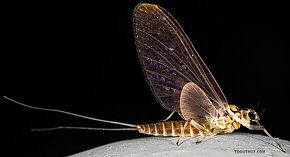 View 7 PicturesI was surprised by the olive cast on the body of this female Rhithrogena dun, which led me to mistake it for a western green drake (Drunella) in the field. I was pleasantly surprised to get a closer look and find something I hadn't collected yet. Its species ID is based on proximity to male spinner collected on the same trip, as well as physical similarity (size, tergite (
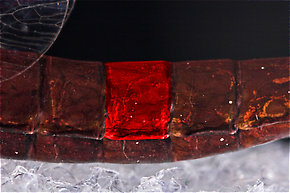 Tergite: The top (dorsal) part of a single segment on an insect's abdomen when it consists of a single chitinous plate (sclerite), or an individual sclerite if the segment has more than one.) coloration, dark streaks on the femora (
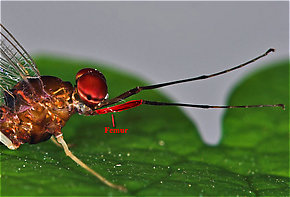 Femur: The main segment of an insect's leg close to the body, in between the tibia and the trochanter.)) to that specimen.
View 7 PicturesI was surprised by the olive cast on the body of this female Rhithrogena dun, which led me to mistake it for a western green drake (Drunella) in the field. I was pleasantly surprised to get a closer look and find something I hadn't collected yet. Its species ID is based on proximity to male spinner collected on the same trip, as well as physical similarity (size, tergite (
One tergite of this Isonychia bicolor mayfly spinner is highlighted in red.
The femur of this Isonychia bicolor mayfly spinner is highlighted in red.
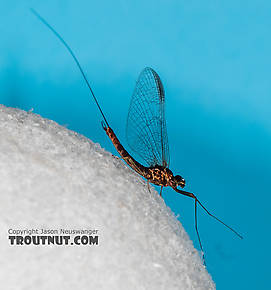
Male Rhithrogena hageni (Western Black Quill) Mayfly Spinner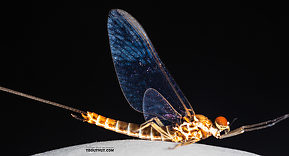 View 14 PicturesAlthough I could not find the preserved specimen to examine under my good new microscope, I'm tentatively calling it one Rhithrogena hageni, based on apparent similarity to this specimen, which I was able to positively ID.
The relative angle of the penes (Penes: The paired genital structures of most male insects, which vary widely in form and are one of the main characteristics used for species identification.) is a bit shallower in this specimen, but I photographed another specimen from the same collecting trip (and I think even the same swarm, although I don't recall for sure) as the other one, and it had the shallower angle seen on this specimen. I'm guessing it's just variation within the species.
View 14 PicturesAlthough I could not find the preserved specimen to examine under my good new microscope, I'm tentatively calling it one Rhithrogena hageni, based on apparent similarity to this specimen, which I was able to positively ID. The relative angle of the penes (Penes: The paired genital structures of most male insects, which vary widely in form and are one of the main characteristics used for species identification.) is a bit shallower in this specimen, but I photographed another specimen from the same collecting trip (and I think even the same swarm, although I don't recall for sure) as the other one, and it had the shallower angle seen on this specimen. I'm guessing it's just variation within the species.
See 1 more specimens...
Mayfly Genus Leptophlebia
These are sometimes called Western Black Quills.
Leptophlebia mayflies do not generate superhatches, but their medium-large size and other properties make them a relevant part of the early season.
The information below was mostly discovered in Leptophlebia cupida, the most important species, but it is not known to differ in the others.
The information below was mostly discovered in Leptophlebia cupida, the most important species, but it is not known to differ in the others.
Male Leptophlebia cupida (Borcher Drake) Mayfly Dun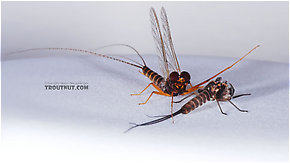 View 6 PicturesThis Leptophlebia cupida dun was extremely cooperative, and it molted into a spinner for me in front of the camera. Here I have a few dun pictures and one spinner picture, and I've put the entire molting sequence in an article.
View 6 PicturesThis Leptophlebia cupida dun was extremely cooperative, and it molted into a spinner for me in front of the camera. Here I have a few dun pictures and one spinner picture, and I've put the entire molting sequence in an article.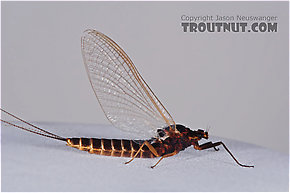
See 17 more specimens...
Mayfly Species Rhithrogena morrisoni
These are sometimes called Western Black Quills.
Despite the reputation of Rhithrogena as being the most tenacious of clingers, Rhithrogena morrisoni or Western March Brown has the greatest populations in moderate runs over cobble. It can reach amazing densities in this water type on rivers like the Rogue in Oregon, Lower Yuba In California, and the Henry's Fork in Idaho.
These large flies range between 9mm and 12mm and are the first important hatch of the year. Generally speaking, they have two distinct color phases and hatching periods, with the Coastal states having the lighter version emerging late February through April in lower elevation tailwaters and the darker version in the Rocky mountain states emerging a month or two later. This has led to much confusion as these significant regional differences are seldom pointed out in angling literature.
They offer the western angler some of the finest fishing of the year during moderate precipitation cycles. It's biggest spoiler is high water or early runoff. On many rivers, there is also a fine hatch of a large late Winter stonefly (Skwala spc.) that usually precedes it that helps to get the fish "looking up". It is the West's equivalent of the East's mottle winged Macaffertium vicarium (American March Brown), both in terms of appearance and importance. Primarily due to western fishing seasons of the past that excluded this mayfly's activity, reporting on this species in angling literature is a relatively recent phenomenon. Thus, it lags in tradition compared to the blotchy winged Heptageniidae of the East and Midwest. But given time...
These large flies range between 9mm and 12mm and are the first important hatch of the year. Generally speaking, they have two distinct color phases and hatching periods, with the Coastal states having the lighter version emerging late February through April in lower elevation tailwaters and the darker version in the Rocky mountain states emerging a month or two later. This has led to much confusion as these significant regional differences are seldom pointed out in angling literature.
They offer the western angler some of the finest fishing of the year during moderate precipitation cycles. It's biggest spoiler is high water or early runoff. On many rivers, there is also a fine hatch of a large late Winter stonefly (Skwala spc.) that usually precedes it that helps to get the fish "looking up". It is the West's equivalent of the East's mottle winged Macaffertium vicarium (American March Brown), both in terms of appearance and importance. Primarily due to western fishing seasons of the past that excluded this mayfly's activity, reporting on this species in angling literature is a relatively recent phenomenon. Thus, it lags in tradition compared to the blotchy winged Heptageniidae of the East and Midwest. But given time...
Rhithrogena morrisoni (Western March Brown) Mayfly Nymph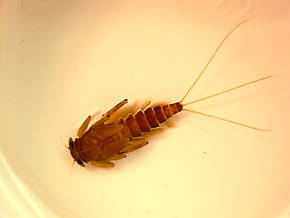 View 4 PicturesSize - (excluding tails) - 12 mm
Status at time of photo - preserved, but photographed within days of capture.
W. C. Day, Aquatic Insects of California differentiates morrisoni nymphs by submedian pale dots on tergites (
Tergite: The top (dorsal) part of a single segment on an insect's abdomen when it consists of a single chitinous plate (sclerite), or an individual sclerite if the segment has more than one.) 8 & 9, which look to be in evidence. This is one of the "super-hatches" on this river that can be prolific March through April.
Entoman
View 4 PicturesSize - (excluding tails) - 12 mmStatus at time of photo - preserved, but photographed within days of capture.
W. C. Day, Aquatic Insects of California differentiates morrisoni nymphs by submedian pale dots on tergites (
One tergite of this Isonychia bicolor mayfly spinner is highlighted in red.
Entoman

See 1 more specimens...
Jargon Defined:
Dun: Mayflies have two adult stages. They first emerge from the water as duns (scientifically known as the subimago stage). They then molt into the spinner (imago) stage, in which they mate and die. Sometimes the word "dun" is confusingly used to refer to a brownish gray color in fly tying materials.
The femur of this Isonychia bicolor mayfly spinner is highlighted in red.
Molting: When aquatic insects with hard exoskeletons (like mayfly and stonefly nymphs) grow bigger, their exoskeleton does not grow with them. Instead they grow a new, larger one underneath and shed the old one when it's too small. This process is called molting.
Nymph: The juvenile, underwater stages of mayflies, stoneflies, dragonflies, and damselflies and other aquatic insects whose juvenile stages are covered by hard exoskeletons. The word can also refer to the fishing flies which imitate these creatures, in which case it is used as a blanket term for flies imitating any underwater stage of an invertebrate (except for crayfish and leeches).
Penes: The paired genital structures of most male insects, which vary widely in form and are one of the main characteristics used for species identification.
Spinner: There are two winged stages of adult mayflies. They emerge from the water as duns, molt on land (usually) into their fully mature stage, spinners. As spinners, they mate, lay eggs, and die.
One tergite of this Isonychia bicolor mayfly spinner is highlighted in red.
Useful References:
Arbona, Fred Jr. 1989. Mayflies, the Angler, and the Trout. Nick Lyons Books.
Top 10 Fly Hatches
 Baetis
 Baetidae
 Ephemerellidae
 Hexagenia limbata
 Chironomidae
 Ephemerella subvaria
 Heptageniidae
 Ephemerella
 Isonychia
 Hydropsychidae
Top Gift Shop Designs
 I outfish my daddy!
 Electric blue Hendrickson dun.
 I love buggers. Big, green, wooly ones.
 I outfish my husband!
 Be the trout.
 Eat mayflies.
Top Insect Specimens
 Baetisca obesa Mayfly Nymph
 Corydalus Hellgrammite Larva
 Neophylax Caddisfly Adult
 Pteronarcys biloba Stonefly Nymph
 Hydropsyche aenigma Caddisfly Adult
Miscellaneous Sites
Troutnut.com is copyright © 2004-2024 Jason
Neuswanger (email Jason). See my FAQ for information about use of my images.
 privacy policy
privacy policy