
Blog & Latest Updates
Fly Fishing Articles
Insects by Common Name


Pale Evening Duns


Scientific Names


Anglers usually shorten the Pale Evening Dun hatch to the PED hatch.
Like most common names, "Pale Evening Dun" can refer to more than one taxon. They're previewed below, along with 12 specimens. For more detail click through to the scientific names.
Mayfly Species Ephemerella dorothea dorothea
These are pretty much always called Pale Evening Duns.
Ephemerella dorothea consists of two subspecies (Subspecies: Entomologists sometimes further divide a species into distinct groups called subspecies, which have two lower-case words on the end of their scientific name instead of one. The latter is the sub-species name. For example, Maccaffertium mexicanum mexicanum and Maccaffertium mexicanum integrum are two different subspecies of Maccaffertium mexicanum.), which both produce excellent action. Ephemerella dorothea dorothea is a small species of Sulphur in the East, and Ephemerella dorothea infrequens (formerly Ephemerella infrequens) is one of the two main Pale Morning Dun hatches of the West. The remainder of this page focuses on the dorothea dorothea subspecies (Subspecies: Entomologists sometimes further divide a species into distinct groups called subspecies, which have two lower-case words on the end of their scientific name instead of one. The latter is the sub-species name. For example, Maccaffertium mexicanum mexicanum and Maccaffertium mexicanum integrum are two different subspecies of Maccaffertium mexicanum.), and Ephemerella dorothea infrequens is discussed separately on its own page.
This is one of the most challenging mayfly hatches on Eastern waters. On many streams, it follows or overlaps hatches of the larger, lingering Ephemerella invaria.
This is one of the most challenging mayfly hatches on Eastern waters. On many streams, it follows or overlaps hatches of the larger, lingering Ephemerella invaria.
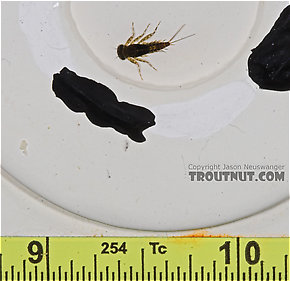
Ephemerella dorothea dorothea (Pale Evening Dun) Mayfly Nymph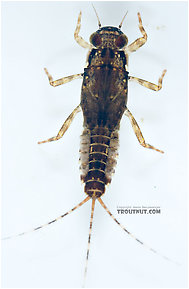 View 6 PicturesI keyed this nymph carefully under a microscope to check that it's Ephemerella dorothea.
View 6 PicturesI keyed this nymph carefully under a microscope to check that it's Ephemerella dorothea.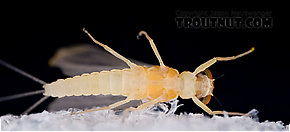
Mayfly Species Heptagenia elegantula
These are often called Pale Evening Duns.
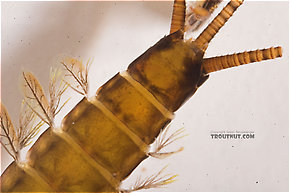
The spinner falls of this elegant species can be quite important to anglers across the West. Recent revisions have synonymized the Midwestern species Heptagenia diabasia that may be of some local importance.
Mayfly Species Ephemerella invaria
These are often called Pale Evening Duns.
This species, the primary "Sulphur" hatch, stirs many feelings in the angler. There is nostalgia for days when everything clicked and large, selective trout were brought to hand. There is the bewildering memory of towering clouds of spinners which promise great fishing and then vanish back into the aspens as night falls. There is frustration from the maddening selectivity with which trout approach the emerging duns--a vexing challenge that, for some of us, is the source of our excitement when Sulphur time rolls around.
Ephemerella invaria is one of the two species frequently known as Sulphurs (the other is Ephemerella dorothea). There used to be a third, Ephemerella rotunda, but entomologists recently discovered that invaria and rotunda are a single species with an incredible range of individual variation. This variation and the similarity to the also variable dorothea make telling them apart exceptionally tricky.
As the combination of two already prolific species, this has become the most abundant of all mayfly species in Eastern and Midwestern trout streams.
Ephemerella invaria is one of the two species frequently known as Sulphurs (the other is Ephemerella dorothea). There used to be a third, Ephemerella rotunda, but entomologists recently discovered that invaria and rotunda are a single species with an incredible range of individual variation. This variation and the similarity to the also variable dorothea make telling them apart exceptionally tricky.
As the combination of two already prolific species, this has become the most abundant of all mayfly species in Eastern and Midwestern trout streams.
Ephemerella invaria (Sulphur Dun) Mayfly Nymph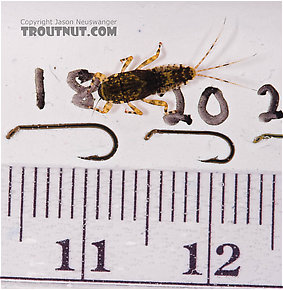 View 8 PicturesThis small Ephemerella invaria nymph was at least a month away from emergence.
View 8 PicturesThis small Ephemerella invaria nymph was at least a month away from emergence.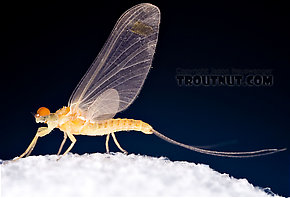
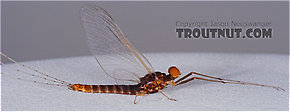
See 42 more specimens...
Mayfly Species Leucrocuta aphrodite
These are sometimes called Pale Evening Duns.
This is one of the few Eastern species of the Heptagenia complex to produce fishable hatches.
Mayfly Species Leucrocuta hebe
These are sometimes called Pale Evening Duns.
This widespread species produces more fishable hatches in the East and Midwest than any other species in the Heptagenia genus complex.
Female Leucrocuta hebe (Little Yellow Quill) Mayfly Dun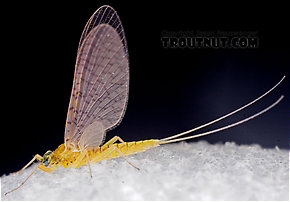 View 9 PicturesI found this dun on the same piece of stream as a similar spinner, probably of the same species.
View 9 PicturesI found this dun on the same piece of stream as a similar spinner, probably of the same species.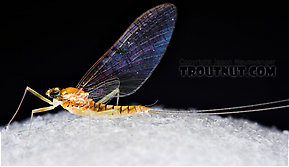
See 8 more specimens...
Mayfly Species Epeorus vitreus
These are sometimes called Pale Evening Duns.
This is the second most common Epeorus species in the East and Midwest. Most anglers will encounter sporadic hatches of Epeorus vitreus once in a while, and sometimes a more concentrated emergence causes a good rise of fish.
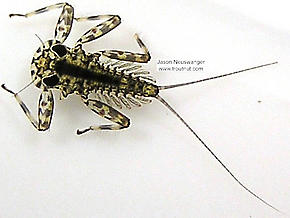
Male Epeorus vitreus (Sulphur) Mayfly Dun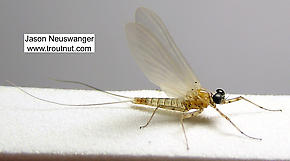 View 4 PicturesThis is my favorite mayfly from 2004, and it appears on my popular Be the Trout: Eat Mayflies products. Check them out!
Its identification is really up in the air. It might be a late-season vitreus dun but it may very well be one of the more obscure species in that genus.
View 4 PicturesThis is my favorite mayfly from 2004, and it appears on my popular Be the Trout: Eat Mayflies products. Check them out!Its identification is really up in the air. It might be a late-season vitreus dun but it may very well be one of the more obscure species in that genus.
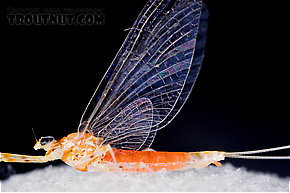
See 12 more specimens...
Top 10 Fly Hatches
 Baetis
 Baetidae
 Ephemerellidae
 Hexagenia limbata
 Chironomidae
 Ephemerella subvaria
 Heptageniidae
 Ephemerella
 Isonychia
 Hydropsychidae
Top Gift Shop Designs
 I outfish my daddy!
 Electric blue Hendrickson dun.
 I love buggers. Big, green, wooly ones.
 I outfish my husband!
 Be the trout.
 Eat mayflies.
Top Insect Specimens
 Baetisca obesa Mayfly Nymph
 Neophylax Caddisfly Adult
 Corydalus Hellgrammite Larva
 Isonychia bicolor Mayfly Spinner
 Ephemerella aurivillii Mayfly Spinner
Miscellaneous Sites
Troutnut.com is copyright © 2004-2024 Jason
Neuswanger (email Jason). See my FAQ for information about use of my images.
 privacy policy
privacy policy