
Blog & Latest Updates
Fly Fishing Articles
Insects by Common Name


> > How to catagorize 2 and 3 tailed mayflies?
This topic is about the Insect Order Ephemeroptera
Mayflies may be the most important insects for trout anglers to understand. They are an ancient order of insects, famous outside the fly-fishing world for their fragile beauty and short adult lifespan, often a single day to mate and die. The mayfly's poignant drama attracts poets and anglers alike, but anglers make the most of it.
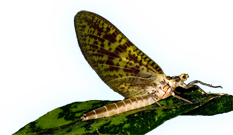
Mayflies live more than 99% of their lives as nymphs on the river or lake bottom, filling many crucial roles in freshwater ecosystems as they feed and grow. They eventually emerge from the water as winged sub-adults called "subimagos" by scientists and "duns" by anglers. Duns evolved to be good at escaping the water, with a hydrophobic surface and hardy build, but they are clumsy fliers. Within a day or two they molt one last time into "imagos" or "spinners," the mature adults, a transformation captured in this photo series of a dun molting into a spinner. They have longer legs and tails, and sleeker, more lightweight bodies, giving them the airborne speed, agility, and long grasp they need for their midair mating rituals. They are usually darker than the duns and have shinier, more transparent wings. They die within minutes or hours after mating. Read more...


There are 823 more specimens...
The Discussion
| Riverratben | April 21st, 2007, 1:51 pm | |
| Pueblo Colorado Posts: 7 | Of the 4 main categories of mayflies (clingers, crawlers, swimmers, and burrowers) are there 2 tailed and 3 tailed mayflies in more than one category? Or are their some categories with both 2 and 3 tailed mayflies in them? For example: Do burrowers all have only 2 tails? | |
| SEVERELY ADDICTED! | ||
| Taxon | April 21st, 2007, 6:54 pm | |
 Site Editor Royse City, TXPosts: 1350 | Ben-Of the 4 main categories of mayflies (clingers, crawlers, swimmers, and burrowers) are there 2 tailed and 3 tailed mayflies in more than one category? Yes, both clinger and swimmer mayflies have both 2-tailed and 3-tailed nymphal mayflies. For example: Do burrowers all have only 2 tails? No, all burrower mayflies are 3-tailed in their nymphal stage. Perhaps the following table will better illustrate this: Habit – Family – Genus (Nymphal Tails) Burrower - Ephemeridae - Ephemera (3) Burrower - Ephemeridae - Hexagenia (3) Burrower - Ephemeridae - Litobrancha (3) Burrower - Polymitarcyidae - Ephoron (3) Burrower - Potamanthidae - Anthopotamus (3) Clinger - Heptageniidae - Cinygma (3) Clinger - Heptageniidae - Cinygmula (3) Clinger - Heptageniidae - Ecdyonurus (3) Clinger - Heptageniidae - Epeorus (2) Clinger - Heptageniidae - Heptagenia (3) Clinger - Heptageniidae - Ironodes (2) Clinger - Heptageniidae - Leucrocuta (3) Clinger - Heptageniidae - Maccaffertium (3) Clinger - Heptageniidae - Rhithrogena (3) Clinger - Heptageniidae - Stenacron (3) Clinger - Heptageniidae - Stenonema (3) Crawler - Baetiscidae - Baetisca (3) Crawler - Caenidae - Brachycercus (3) Crawler - Caenidae - Caenis (3) Crawler - Ephemerellidae - Attenella (3) Crawler - Ephemerellidae – Caudatella (3) Crawler - Ephemerellidae - Dannella (3) Crawler - Ephemerellidae - Drunella (3) Crawler - Ephemerellidae - Ephemerella (3) Crawler - Ephemerellidae - Eurylophella (3) Crawler - Ephemerellidae - Serratella (3) Crawler - Ephemerellidae - Timpanoga (3) Crawler - Leptohyphidae - Tricorythodes (3) Crawler - Leptophlebiidae - Leptophlebia (3) Crawler - Leptophlebiidae - Paraleptophlebia (3) Swimmer - Ameletidae - Ameletus (3) Swimmer - Baetidae - Acentrella (2) Swimmer - Baetidae - Acerpenna (3) Swimmer - Baetidae - Baetis (2) Swimmer - Baetidae - Baetis (3) Swimmer - Baetidae - Callibaetis (3) Swimmer - Baetidae - Centroptilum (3) Swimmer - Baetidae - Diphetor (3) Swimmer - Baetidae - Heterocloeon (2) Swimmer - Baetidae - Plauditus (2) Swimmer - Baetidae - Procloeon (3) Swimmer - Baetidae - Pseudocloeon (2) Swimmer - Isonychiidae - Isonychia (3) Swimmer - Metretopodidae - Metretopus (2) Swimmer - Metretopodidae - Siphloplecton (3) Swimmer - Siphlonuridae - Siphlonurus (3) | |
| Best regards, Roger Rohrbeck www.FlyfishingEntomology.com | ||
| Troutnut | April 21st, 2007, 7:28 pm | |
 Administrator Bellevue, WAPosts: 2737 | Good table, Roger! | |
| Jason Neuswanger, Ph.D. Troutnut and salmonid ecologist | ||
| Riverratben | April 22nd, 2007, 9:06 pm | |
| Pueblo Colorado Posts: 7 | Wow thanks for the info. I love dealing with people who know their stuff. Thanks again, Ben | |
| SEVERELY ADDICTED! | ||
| Albafly | May 5th, 2010, 4:56 pm | |
| Posts: 1 | Thats a great table. I'd like to ask what may be a stupid question- do all mayfly nymphs with 2 tails have two as an adult, and all nymphs with 3 tails have 3 as adults? Thanks, Alba | |
| Dryfly | May 5th, 2010, 7:06 pm | |
| rochester mn Posts: 133 | If it has two tails as a nymph it will have two tails as an adult (Adults alway have at least two tails, therefore if it has two tails as a nymph it has to have to as an adult, it can't lose one). If it has three tails then it can lose one. Baetis and Maccafertium have 3 tails as a nymph and two as adults. Other mayflies like Ephemerella keep all three tails. | |
| Entoman | February 6th, 2011, 1:49 pm | |
 Posts: 2604 | Hi Riverratben, Your questions don't differentiate between nymph and adult stages so I hope my answers don't confuse. But if they do, please feel free to ask for further explanation. Of the 4 main categories of mayflies (clingers, crawlers, swimmers, and burrowers) are there 2 tailed and 3 tailed mayflies in more than one category? Yes, There are three tailed species in all four categories in the nymph stage and two categories in the adult stage (all crawlers and many burrowers). Two tailed mayflies are spread among two categories as nymphs (some clingers and some swimmers) and three categories as adults (clingers, swimmers, and some burrowers). Or are their some categories with both 2 and 3 tailed mayflies in them? Yes, but the answer may seem confusing because there are several ways this is true. First, there is differentiation between nymph and adult which occurs in three groups (most clingers, most swimmers, and some burrowers). Second, their is differentiation between Genera that occur in those same three groups (some clingers, some swimmers, and some burrowers). Finally, there's even a difference between sexes in a Genus of one group (burrowers) Do burrowers all have only 2 tails? No. You would have been closer to the mark if you had said three tails because all of them do in the nymph stage and many species do as adults. Hi Albafly - do all mayfly nymphs with 2 tails have two as an adult, and all nymphs with 3 tails have 3 as adults? As covered indirectly above: Yes about the two tailed nymphs (some swimmers and some clingers), No about the three tailed nymphs (most swimmers, most clingers, and some burrowers). With the exception of a few obscure examples of no importance to fly fishers, the crawlers are the only ones that universally stay three to three. Riverratben & Albafly - It seems there's a hope implied in your questions that there might be an easy way to identify mayflies at least to the level of the groups you described. There is (kind of), but (unfortunately) not by counting tails alone. What follows is a "fishermans rule of thumb" that will help you to easily identify mayfly nymphs and adults down to the groups you mentioned: Nymphs (See duns for habitat and population density) - Abdomens substantially longer than head and thorax combined, slender legs, streamlined bodies, tails shorter than body length, tiny to large size... Swimmer - Abdomens substantially longer than head and thorax combined, pincher or tusk like appendages on the front of their heads, feathery gills on their abdomens, short stout legs, short often fuzzy tails, very large size... Burrower - Abdomens same length or shorter than head and thorax combined with medium to stout legs. Tails same as or shorter than body, tiny to large size... Crawler - Abdomens same length to substantially shorter than head and thorax, medium to stout legs that are often very long, tails as long as or often much longer than body and usually very strongly splayed, blunt rounded heads as wide or wider than body, flattened shape... Clinger Duns (here come the tails!) - Two tails, very tiny or absent hind wings (hard to make out with the naked eye in smaller specimens), slender bodies, tiny to medium size, all water types, common and very abundant... Swimmer - Two tails, large hind wings, small to medium size, freestone habitat, common and abundant... Clinger - Two tails, large hind wings, medium to large size, contrasting legs (cream rear and middle legs, dark front legs), freestone habitat, uncommon and rarely abundant in the West... Swimmer - Two tails, very large hind wings (almost half of fore wing length), usually dark colored, medium to large size, still and slow waters, uncommon but can be very abundant where found... Swimmer - Two tails, large hind wings, fore wings exhibiting a "window screen" pattern, bodies appear longer than their wings with little increase in width from the middle of the abdomen through the thorax when viewed from below, usually light colored, very large size, still and slow water, uncommon but can be very abundant where found... Burrower - Three tails, large hind wings, often blotchy fore wings, bodies appear longer than their wings with little increase in width from the middle of the abdomen through the thorax when viewed from below, large size, slow water, uncommon in the west but can be fairly abundant where found... Burrower - Three tails, medium to small rear wings or absent, tiny to large size, all water types, common and very abundant... Crawler Spinners - Same rules apply as for subimagos (duns) except wings are clearer to very translucent, The bodies are generally darker, most often a shade of brown. Also very common to see a difference in coloration between abdomen and thorax. It may be helpful for you to condense this as best you can & put it on card stock to fit in the lids of your fly boxes (one for nymphs and one for dries). I think it will prove helpful for a quick ID aid. Even though the critters share substantial physical and behavioral characteristics within the groups, there are also substantial variations. These variations are often important in terms of fly selection and presentation techniques. Each group (with the exception of the clingers) actually contains several different Families. Eventually, you will probably want to be able to identify them at least down to Family and even Genus. As your skill and confidence grows in identification, so will your enjoyment and fishing success. Surgeon General's Warning! This product can be addictive and advantageous to your health. Hope this helps guys... Best regards, Kurt | |
| "It's not that I find fishing so important, it's just that I find all other endeavors of Man equally unimportant... And not nearly as much fun!" Robert Traver, Anatomy of a Fisherman | ||
| Oldredbarn | February 7th, 2011, 8:44 am | |
 Posts: 2608 | I was told by some very old Au Sable wise guys that trout can't count...;) Spence | |
| "Even when my best efforts fail it's a satisfying challenge, and that, after all, is the essence of fly fishing." -Chauncy Lively "Envy not the man who lives beside the river, but the man the river flows through." Joseph T Heywood | ||
| TNEAL | February 7th, 2011, 10:11 am | |
| GRAYLING. MICHIGAN Posts: 278 | I learned early on that one of the greatest things about fly fishing is we can get as involved as we want. Another of the greatest things is that trout don't care how involved we are. | |
| Entoman | February 7th, 2011, 11:31 am | |
Posts: 2604 | Spence - I was told by some very old Au Sable wise guys that trout can't count...;) I think those MI philosophers made it out west! TNEAL - Another of the greatest things is that trout don't care how involved we are. You got that right! The trout point that out to me all the time... | |
| "It's not that I find fishing so important, it's just that I find all other endeavors of Man equally unimportant... And not nearly as much fun!" Robert Traver, Anatomy of a Fisherman | ||
| Martinlf | June 12th, 2012, 10:50 am | |
 Moderator Palmyra PAPosts: 3233 | Bumping this up for Shawn as well. | |
| "He spread them a yard and a half. 'And every one that got away is this big.'" --Fred Chappell | ||
| Taxon | June 13th, 2012, 4:33 am | |
Site Editor Royse City, TXPosts: 1350 | Mack, Thanks, I think. :-) | |
| Best regards, Roger Rohrbeck www.FlyfishingEntomology.com | ||
Quick Reply
You have to be logged in to post on the forum. It's this easy:
Related Discussions
| Title | Replies | Last Reply |
| Re: Differences I'm dying to know about In the Mayfly Genus Tricorythodes by Reify | 2 | Jul 9, 2018 by Martinlf |
| Re: New Mexico ??? In Beginner Help by Hankaye | 3 | Apr 19, 2013 by Sayfu |
| Re: White Mayfly ---- Euphron leukon? In the Identify This! Board by JumpNotZero | 1 | Sep 9, 2008 by GONZO |
| Re: 2 tails or 3 In the Mayfly Species Maccaffertium vicarium by Snagy | 1 | Feb 6, 2010 by Taxon |
Re: Paralep adoptiva vs. E. pluralis In the Identify This! Board by Adirman | 13 | May 16, 2013 by Adirman |
Re: Unidentified Baetidae     (2 more) In the Identify This! Board by Benthosfan | 8 | May 5, 2021 by Benthosfan |
| Re: Something to be aware of. In General Discussion by Softhackle | 2 | Aug 29, 2011 by Jesse |
Paracloeodes minutus    In the Photography Board by Millcreek | 0 | |
| Re: Bald-Tailed Baetidae In General Discussion by Dickybird | 6 | Sep 7, 2021 by Konchu |
| Re: Found it on the Jeep In the Identify This! Board by Grannom | 3 | Jun 26, 2008 by Grannom |
Troutnut.com is copyright © 2004-2024 Jason
Neuswanger (email Jason). See my FAQ for information about use of my images.
 privacy policy
privacy policy