
Blog & Latest Updates
Fly Fishing Articles
Insects by Common Name


> > Arcynopteryx
The Specimen
Isogenoides hansoni (Appalachian Springfly) Stonefly Nymph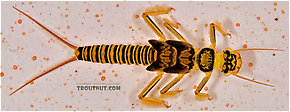 View 11 PicturesThis large Perlodidae stonefly was a strikingly bright yellow color, more so than any other insect I've seen. I didn't enhance it much. See the discussion threads to follow how we identified this specimen, which was listed incorrectly for several years.
View 11 PicturesThis large Perlodidae stonefly was a strikingly bright yellow color, more so than any other insect I've seen. I didn't enhance it much. See the discussion threads to follow how we identified this specimen, which was listed incorrectly for several years.The Discussion
| Taxon | July 7th, 2006, 11:49 am | |
 Site Editor Royse City, TXPosts: 1350 | Jason- Not to despair; this is what American Stoneflies: A Photographic Guide to the Plecoptera by Bill P. Stark, Stanley W. Szezytko, and C. Ridley Nelson has to say about genus Arcynopteryx: "This genus is represented in North America by A. compacta (McLachlan). This species ranges from Alaska to Maine and has been reported as far south as Colorado. Males usually have shortened wings and are easily recognized by the long, lash-like epiproct tip. Females and nymphs are quite similar to Skwala. A. compacta has been collected around alpine lakes in the northern Rocky Mountains. No photographs are available for this group." Also, Arcynopteryx compacta is listed by Stark/Baumann as residing in New York. | |
| Best regards, Roger Rohrbeck www.FlyfishingEntomology.com | ||
| Troutnut | July 7th, 2006, 12:08 pm | |
 Administrator Bellevue, WAPosts: 2737 | Thanks! It's probably A. compacta then. I like the genus name. | |
| Jason Neuswanger, Ph.D. Troutnut and salmonid ecologist | ||
| Myersl | April 8th, 2010, 7:26 am | |
| Plattsburgh, NY Posts: 5 | Jason, This appears to be Cultus verticalis, although without examining the actual specimen or seeing adults, I can’t be sure. The color pattern is very striking in comparison to nymphs preserved in ethanol. I have collected adults of Cultus verticalis and Cultus decisus decisus from several streams in the Catskills. There are two species of Cultus in New York, Cultus decisus decisus (in large rivers) and Cultus verticalis (in small to medium sized streams). Arcynopteryx compacta is very uncommon in NY. | |
| myersl | ||
| Entoman | November 9th, 2011, 5:02 am | |
 Posts: 2604 | Great photos, Jason. There seems to have been a lot of back and forth on this determination over the years. I stumbled across these conversations while researching something else and quickly became interested. Trying to tie three different threads together back into one conversation is probably impossible, but worth a try. How they got separated in the first place, I have no idea. Anyway, the fortunate thing is that your quality photos teamed up with a good specimen (that shows some key characters unambiguously) makes this fun and worth revisiting. It's my understanding that one of the most important set of characters helpful in separating out the various genera of the Perlodidae can be found on the mesosternum and somehow they weren't discussed much regarding this specimen. The third photo shows these characters in great detail and I think that's where you went wrong in the M & C keys. In one of the couplets you were given a choice between whether the Y-arms met the anterior or posterior corners of the furcal pits. I think you chose anterior which led you to Arcynopterx and away from Isogenoides. You missed by only one couplet!:) I think Loyd is right about Isogenoides - the terga and head markings match to a tee. The size is right too. Isogenoides has a median longitudinal suture running from the stem to the transverse suture between the Y-arms creating a three point contact. Your specimen also has this character. The other genera mentioned as possibilities have issues with this and other Y-arm characters as well as the gill character Lloyd mentioned. Regards, Kurt | |
| "It's not that I find fishing so important, it's just that I find all other endeavors of Man equally unimportant... And not nearly as much fun!" Robert Traver, Anatomy of a Fisherman | ||
Quick Reply
You have to be logged in to post on the forum. It's this easy:
Related Discussions
| Title | Replies | Last Reply |
| I. hansoni In Isogenoides hansoni Stonefly Nymph by GONZO | 0 | |
| Re: Anybody know the genus and species? In Isogenoides hansoni Stonefly Nymph by Troutnut | 8 | Feb 12, 2009 by Troutnut |
| Re: Cultus verticalis? In the Stonefly Species Agnetina capitata by DOS | 8 | Apr 1, 2009 by Troutnut |
| Distance between the eyes of male Epeorus In the Mayfly Genus Epeorus by Troutnut | 0 | |
| Re: Cool Perlid In Female Helopicus subvarians Stonefly Adult by Troutnut | 3 | Apr 7, 2010 by GONZO |
Re: some northcentral penna. stoneflies  In the Identify This! Board by Gutcutter | 4 | May 2, 2010 by SlateDrake9 |
Re: Interesting clinger species  In the Identify This! Board by CalebBoyle | 7 | Mar 31, 2007 by GONZO |
| Name basis..... In Maccaffertium ithaca Mayfly Nymph by Quillgordon | 0 | |
| Re: Water Penny (ventral image) In Psephenus Beetle Larva by LowBudget | 2 | Jan 18, 2014 by LowBudget |
Re: Mayfly hatch in aquarium - Leptophlebiidae?   In the Identify This! Board by LowBudget | 4 | Apr 12, 2014 by Brookyman |
Troutnut.com is copyright © 2004-2024 Jason
Neuswanger (email Jason). See my FAQ for information about use of my images.
 privacy policy
privacy policy