

Blog & Latest Updates
Fly Fishing Articles
Insects by Common Name


> > Bug Bellies II
 View Full Size (1.2X larger)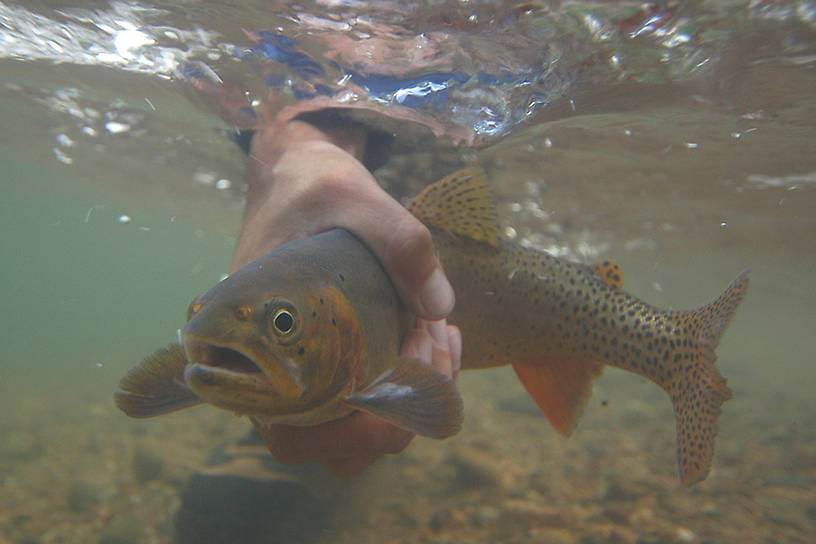
©2004 Mike Speer
Underwater Cutthroat caught at Boxwood Gulch Ranch, on the north fork of the South Platte river near Bailey, Colorado. An Ex-streamly clear tail water, great for sub-surface photography.
.
Underwater Cutthroat caught at Boxwood Gulch Ranch, on the north fork of the South Platte river near Bailey, Colorado. An Ex-streamly clear tail water, great for sub-surface photography.
.
| Gripngrin | December 4th, 2006, 6:11 pm | |
| Front Range - Colorado Posts: 17 | Somewhat related to Bug Bellies, the topic started by Louis prompted a thought concerning trout vision. I once heard that trout have slight telephoto vision, allowing them to scrutinize bugs (bellies). Also wondering if they can see in color, low light (nocturnal), approximate field of vision, etc? After years of guiding and observing trout feed, take flies, etc, it seems that they may have a telephoto vision at times allowing them to see an upcoming bug at more than ten feet, as well as a macro vision able to distinguish between real bugs and the best tied imitations. Can anyone verify or comment on this. If you have any information it would be good reading for us trout nerds, uh, nuts. Mike | |
| Grip'n Grin Mike | ||
| GONZO | December 4th, 2006, 8:38 pm | |
Site Editor "Bear Swamp," PAPosts: 1681 | Hi Mike, There are some excellent discussions of trout vision in recent literature, though I'm at a loss to remember specific references off the top of my head. (Marinaro's In the Ring of the Rise and Goddard and Clarke's The Trout and the Fly are two classics on this topic, but there are more recent discussions. Perhaps someone else can help with those). The telephoto aspect is not one I can confirm (although the lens of the trout's eye is more spherical than ours), but I'll take a stab at your other questions. Because they possess both rods and cones, trout can see color and have low-light vision. It is sometimes assumed that the transition from one to the other (normal daylight vision to black-and-white "rod" vision) may produce a temporary visual handicap for the trout. I have even read some speculation that this might be a reason that many trout stream insects have evolved periods of regular behavioral drift that peak at dusk and again at dawn (to take advantage of the trout's temporary visual adjustment). Because trout eyes have more rods and human eyes have more cones, it is assumed that our perception of color and detail is superior (cone-enhanced qualities) and the trout has superior sensitivity to movement, contrast, and low light (rod-enhanced qualities). Trout have about 180 degrees of monocular vision with each eye and an approximately 30 degree overlapping field of binocular vision directly in front and a bit ahead of their nose (this also extends upward, but the calculations are more complex). When viewing through the water's surface, they have a 96-97 degree "cone of vision" which permits above-water objects to be seen through the trout's "window." Due to the refraction of light as it enters the water a larger above-water field is captured, but objects close to the edge of the circle (Snell's circle, where the effect of bending is the greatest) are subject to distortion. Outside of this cone, the underside of the water's surface appears as a mirror reflecting the underwater scene. Hope this basic info is helpful, but I'm sure someone here can add to it. (David, I'm counting on you, pal.) PS--Sorry, David, I guess we were in Louis's famous IM mode! Please feel free to correct any mistakes or misconceptions I may have offered. PPS--Very cool photo, Mike! | |
| Konchu | December 4th, 2006, 9:42 pm | |
 Site Editor IndianaPosts: 505 | What about UV-light and the ability to see polarized light? | |
| GONZO | December 4th, 2006, 10:17 pm | |
Site Editor "Bear Swamp," PAPosts: 1681 | Thanks for the additional info, David--also very cool! As I understand it, the trout's focus would also come into play when considering the situation you describe. If it was close to the surface and focused on a bug, the surrounding images captured (say, of an angler on the bank) would be quite blurry. If it was deeper and the lentis muscle was retracted, the focus could extend to infinity and the image of the angler would now be clear. Am I correct in this understanding? If so, it may be another reason that trout can often be more closely approached when surface feeding on a hatch. | |
| Martinlf | December 5th, 2006, 5:36 pm | |
 Moderator Palmyra PAPosts: 3233 | What a great series of posts, at least the parts I could understand. Much food for thought. Thanks, David, and Gonzo. | |
| "He spread them a yard and a half. 'And every one that got away is this big.'" --Fred Chappell | ||
| Gripngrin | December 5th, 2006, 8:11 pm | |
| Front Range - Colorado Posts: 17 | Great feedback Dave & Lloyd. Once on the Green River, just past the lower put-in at Little Hole, my boat mates & I witnessed a large brown trout move a huge distance for a imitation cicada. From downstream ahead of the boat, this brown started from from about eight feet deep water, at least twenty feet away from my fly. This slow motion rise was in in slower water below a long tongue just before the bend going into the canyon. After seeing this I was convinced that trout had telescopic vision. Of course, a # 6 Crystal Cicada could probably been seen from the moon in the right light. Never the less, seeing this long distance rise was awesome. Oh yeah, landed him! He was shaped more like a largemouth bass than a trout. Measured 22 inch's at about 2.5 pounds. Do larger trout have bigger eyes, cones / rods, hence better vision? Would love to learn more about the lateral lines. Also, what state region do you work in? Mike | |
| Grip'n Grin Mike | ||
| Troutnut | December 5th, 2006, 9:24 pm | |
 Administrator Bellevue, WAPosts: 2737 | Once on the Green River, just past the lower put-in at Little Hole, my boat mates & I witnessed a large brown trout move a huge distance for a imitation cicada. From downstream ahead of the boat, this brown started from from about eight feet deep water, at least twenty feet away from my fly. This slow motion rise was in in slower water below a long tongue just before the bend going into the canyon. I've had a very similar experience on the Brule. I watched an 18-inch brown turn around and shoot about 20 feet downstream to slam an Ausable Wulff as soon as it hit the water. At the time (it was my first summer learning to fly fish) I thought it was impressive vision, but in hindsight it's obvious the fish just picked up on the vibrations. One other important point is that we tend to overestimate how far it's possible to see underwater based on water clarity. What seems "crystal clear" to us in a shallow stream might not really be even close. We stand in a foot of water and can clearly see the bottom 20 feet away from us, and we just kind of subconsciously assume something underwater at our feet could see that far too. When you think about it, it's obvious that that doesn't make sense, but many people don't stop to think about it. Something underwater can only see as far to the side as we can see when looking straight down into the water. So if you can see the bottom below you pretty well in 6 feet of water but not 7 (that's fairly clear), then you or a fish could only see that far to the side, too. I've only been on one or two streams, both small, where the clarity let details show up pretty well at 15+ feet. Even think about lakes; in how many can you see bottom detail well in 15 feet of water? | |
| Jason Neuswanger, Ph.D. Troutnut and salmonid ecologist | ||
| Troutnut | December 5th, 2006, 9:25 pm | |
Administrator Bellevue, WAPosts: 2737 | By the way Mike, great trout photo! | |
| Jason Neuswanger, Ph.D. Troutnut and salmonid ecologist | ||
| Martinlf | December 6th, 2006, 8:34 am | |
Moderator Palmyra PAPosts: 3233 | Jason's comment is intriguing, and reminds me of David's observation that trout are extraordinarily sensitive to vibrations, even to those caused by insects. I'll try to keep this in mind when tying streamers and wet flies, and when wading. Also, though spiked boots give added confidence, especially in big water, I believe I'm going to use my spikeless boots more, expecially when spikes are not needed. The spikes certainly create more grinding and scraping vibrations, and most likely often suggest the presence of a predator more strongly than simple felts. | |
| "He spread them a yard and a half. 'And every one that got away is this big.'" --Fred Chappell | ||
| GONZO | December 6th, 2006, 10:36 am | |
Site Editor "Bear Swamp," PAPosts: 1681 | Louis, I usually try to avoid using spikes or chains unless serious safety issues are involved. It can be a bit of a trade-off though. Even a fairly tame wading situation (in terms of current and depth) can be complicated by snot-covered rocks or slick ledges. If leaving the spiked boots behind means more slipping and stumbling, the stealthy advantage of a quieter bootsole disappears pretty quickly. Artful wading is an underestimated skill. Keep in mind, however, that fast water hides a multitude of sins. Vibrations, whether attractive or alarming, are masked by the turbulence and white noise of fast water, and the directional influence of the current comes into play. As David points out, the physical laws governing vision through mixed media (water/air) can be a little complicated to explain. But, they are easy enough to experience. While we may not be able to view the underwater world through a trout's eyes, seeing it with our own is an invaluable experience. I've had the opportunity to do a fair amount of scuba diving in trout streams (and I'd love to do more). Jason's observations about clarity, David's explanation of the function of Snell's Law, the qualities of sound (vibration) underwater, and the responses of fish to all of these things become much easier to understand when you can experience them firsthand. That experience is something I would recommend to any angler. | |
| GONZO | December 6th, 2006, 7:17 pm | |
Site Editor "Bear Swamp," PAPosts: 1681 | I notice my name has been in a number of posts of late. This isn't some secret code or something, is it? Are my pets going to start vanishing? I see I'm not the only one who suffers from occasional "posting paranoia." I think you're pretty safe here, David (or should I use DMM?). From one paranoid to another, however, I'd still keep an eye on those pets--you never know who's watching on the Internet! :) | |
| Troutnut | December 6th, 2006, 9:13 pm | |
Administrator Bellevue, WAPosts: 2737 | Hope the walleye reference doesn't offend any of you salmonophiles, but get used to it because there are more non-salmon examples to come. It's okay. There are plenty of things we can learn about salmonids by studying lesser fishes. ;) Great explanation of the lateral line sense! | |
| Jason Neuswanger, Ph.D. Troutnut and salmonid ecologist | ||
| Gripngrin | December 8th, 2006, 8:31 pm | |
| Front Range - Colorado Posts: 17 | Thanks for the LL info David. Will use that info to catch larger trout. Sneak up, hands & knees. Bo & arrow cast. Flouro tippet. Then, WHAM - The next state record cutthtoat! (See new thread for visual) | |
| Grip'n Grin Mike | ||
| IEatimago | July 23rd, 2007 | |
| Spring Mills, PA Posts: 97 | great information, it makes me wonder how i ever catch any fish with my sloppy casting hittng the water so hard and my body movments even when im on my knees or trying to be stealth i allways seem to wiggle some how. thanks dmm and gonzo this thread should be a sticky. | |
Quick Reply
You have to be logged in to post on the forum. It's this easy:
Related Discussions
| Title | Replies | Last Reply |
Re: Underwater Trout Pics In the Photography Board by Freepow | 2 | Apr 13, 2009 by Trtklr |
| Re: Fishing photography In the Photography Board by Carver | 4 | Apr 6, 2007 by Troutnut |
| Re: Now to tie a Baetis Dun Imitation In Female Baetis Mayfly Dun by DarkDun | 3 | Jan 16, 2007 by Martinlf |
| Re: Fishing emergers In General Discussion by Adirman | 1 | Aug 29, 2018 by Martinlf |
Re: Beautiful West!    In the Photography Board by Jesse | 1 | Apr 18, 2010 by Jmd123 |
| neversink river 7/4/2007 In Fishing Reports by Mcjames | 0 | |
| Umbrella hook Western March Brown Dun pattern In Fly Tying by Rgiffin | 0 | |
| Re: A video series you will enjoy! In General Discussion by Jlh42581 | 1 | Jan 17, 2007 by Brett |
| Re: Simms Jackets In General Discussion by WestCO | 3 | Nov 8, 2013 by Entoman |
| Cicada experiences In General Discussion by Martinlf | 0 |
Troutnut.com is copyright © 2004-2024 Jason
Neuswanger (email Jason). See my FAQ for information about use of my images.
 privacy policy
privacy policy