
Blog & Latest Updates
Fly Fishing Articles
Insects by Common Name


> > Anyone know more about Ephemerella septentrionalis?
This topic is about the Mayfly Species Penelomax septentrionalis
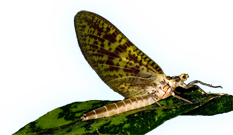
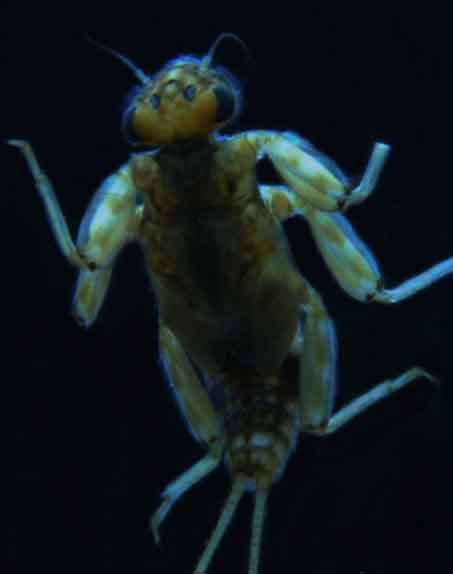
This fascinating mayfly is among the most distinctive in the Ephemerellidae family, because it has unusually long legs in both the nymphal and adult stages. The nymphs have a strikingly rugged, spindly appearance, and the adults are a strikingly deeper, amber-yellow color than other Ephemerellidae duns.
This species was overlooked in the fly-fishing literature for many years. The first details appear in Fly-Fishing Pressured Water, which states that this species (formerly called Ephemerella septentrionalis) sometimes supports hatches of Ephemerella invaria. Ernest Schwiebert's Nymphs Volume I: The Mayflies: The Major Species seconds that claim, suggesting that it generates fishable hatches which may go unnoticed due to confusion with both Ephemerella invaria and Ephemerella dorothea. However, the long legs, thin dorsal (Dorsal: Top.) stripe, and more vivid color make it easy to tell them apart upon close inspection. Read more...


There are 1 more specimens...
The Discussion
| Troutnut | May 18th, 2007, 6:37 pm | |
 Administrator Bellevue, WAPosts: 2737 | I found about one sentence on these in Gonzo's book, and haven't seen them mentioned anywhere else in fly fishing literature. Nor is any of the scientific literature I have on them particularly interesting (just descriptions). Now that I've collected a few and see what unique-looking nymphs they've got, I'm really curious about them. | |
| Jason Neuswanger, Ph.D. Troutnut and salmonid ecologist | ||
| GONZO | June 17th, 2007, 9:45 am | |
Site Editor "Bear Swamp," PAPosts: 1681 | Jason, I had a chance to talk with Penn State entomologist Greg Hoover yesterday. He said that he collects most of his septentrionalis nymphs by sweeping his net through mossy breaks on 1st and 2nd order streams. He also said that when he hears accounts of unusually large (three-tailed) "sulphurs," he suspects they may be this species. Apparently they are about a hook size larger than invaria on average. He confirmed that emergence timing is about the same as the early part of the invaria hatch. (I say "early part" because invaria can extend for quite a lengthy period on streams with heavy populations. The later, smaller component is even confused for dorothea on some streams that have no dorothea population.) As you have noted, the easy field ID trait is the long spindly legs in both nymph and adult. | |
| Troutnut | June 17th, 2007, 10:15 am | |
Administrator Bellevue, WAPosts: 2737 | Thanks for getting that information. :) Too bad I couldn't get a really intact dun. Still, given their rarity, I count myself lucky to have found this one. | |
| Jason Neuswanger, Ph.D. Troutnut and salmonid ecologist | ||
| GONZO | June 17th, 2007, 6:17 pm | |
Site Editor "Bear Swamp," PAPosts: 1681 | Despite the very slight reference in fly-fishing literature, I'm not sure how rare they really are. They are rather widespread in the East, being found at least from Tennessee to Maine. The name implies they are "of the nothern regions," so I wouldn't be surprised if they spread well into Canada. Even though Greg said he finds the highest populations in low order streams, the fact that your specimens came from much higher order streams indicates that at least token populations can be found in larger waters. Greg ran off quite a list of PA trout streams where he finds them, but their lesser significance compared to the overwhelming invaria populations is the reason I suggested they sometimes "support" those hatches. And even fairly bug-conscious fly fishers who encounter the hatch may not notice the differences between septentrionalis and invaria unless they collect specimens for comparison. It may just be that they are more significant on smaller streams where matching the hatch is not very important, or that their habitat requirements are narrower than the very adaptable invaria. They are a very cool and interesting mayfly, and your photos of the nymph and dun are the only ones I've ever seen. And that does make your photos rare, indeed. | |
| Konchu | June 18th, 2007, 6:22 am | |
 Site Editor IndianaPosts: 505 | I'd suggest that the habitat requirements of septentrionalis may be narrower than those of invaria. | |
| Troutnut | July 16th, 2011, 6:35 pm | |
Administrator Bellevue, WAPosts: 2737 | I just looked in Ernest Schwiebert's mega-volume Nymphs to see if he had anything about Ephemerella aurivillii (oddly, there's no mention of it), and I noticed he had some good info on septentrionalis, so I updated that hatch page with his information and some from this discussion. It's such a cool mayfly I figured I'd bump the topic. | |
| Jason Neuswanger, Ph.D. Troutnut and salmonid ecologist | ||
| GONZO | July 16th, 2011, 6:52 pm | |
Site Editor "Bear Swamp," PAPosts: 1681 | Based on current taxonomy, Jason, my "sister sulphur" comment is inaccurate. Although some taxonomists included it in the "invaria group" in the past (Burks 1958), the only sense in which that comment applies today is that they may go to the same streamside dance together and look enough alike on the water that they might be mistaken by anglers. :) Oh, and whether or not my book was the first mention of this species in the fly-fishing lit. might depend on what you mean by "mention." Charles Meck included this species in his hatch listing in Pennsylvania Trout Streams and Their Hatches (Backcountry Publications 1989), but I don't think he mentions anything about them in the main text. I believe that Charlie and I both learned to identify this species through discussions with Greg Hoover. | |
| Troutnut | July 16th, 2011, 7:06 pm | |
Administrator Bellevue, WAPosts: 2737 | Okay, I took the "sister sulphur" part out. I still think it could be justified by the similarity in timing and appearance, with a caveat that it's not a taxonomical kinship, but I suppose it's better to avoid the confusion altogether. | |
| Jason Neuswanger, Ph.D. Troutnut and salmonid ecologist | ||
| GONZO | July 16th, 2011, 7:12 pm | |
Site Editor "Bear Swamp," PAPosts: 1681 | See post-post edit above. | |
| Oldredbarn | July 18th, 2011, 1:01 pm | |
 Posts: 2608 | Jason, This is a technical aside, but as I view this your actual comments and photos of the bug appear in a straight line down with only one word per line...Has anyone else had this problem or just me? All the posts seem ok just your original text and photos of the bug are all in one long line down. Spence | |
| "Even when my best efforts fail it's a satisfying challenge, and that, after all, is the essence of fly fishing." -Chauncy Lively "Envy not the man who lives beside the river, but the man the river flows through." Joseph T Heywood | ||
| Troutnut | July 18th, 2011, 2:52 pm | |
Administrator Bellevue, WAPosts: 2737 | Spence, I recall a similar bug on the front page for certain web browsers when I put this new update to the site online. Now I just have to remember how I fixed it. | |
| Jason Neuswanger, Ph.D. Troutnut and salmonid ecologist | ||
| Oldredbarn | July 18th, 2011, 3:21 pm | |
Posts: 2608 | I just thought you were showing us TroutNuts some examples of "Concrete Poetry"! ;) | |
| "Even when my best efforts fail it's a satisfying challenge, and that, after all, is the essence of fly fishing." -Chauncy Lively "Envy not the man who lives beside the river, but the man the river flows through." Joseph T Heywood | ||
Quick Reply
You have to be logged in to post on the forum. It's this easy:
Related Discussions
| Title | Replies | Last Reply |
| Re: Little J In General Discussion by Wbranch | 3 | May 17, 2009 by GONZO |
Re: maccafertium? In the Identify This! Board by Dryfly | 17 | Jun 2, 2007 by Dryfly |
| Re: Ephemera In the Photography Board by Crepuscular | 11 | May 31, 2013 by Oldredbarn |
| Re: S. basale on Clarks Creek, PA In the Mayfly Species Siphloplecton basale by Wiconisco37 | 1 | Jun 10, 2009 by Martinlf |
Suwallia sp.     In the Photography Board by Millcreek | 0 | |
Re: Caddisfly8378h In the Identify This! Board by Nanz | 8 | Jun 14, 2007 by Nanz |
More Baetis nymphs     (2 more) In the Identify This! Board by Millcreek | 0 | |
Re: Near French Creek, PA In the Identify This! Board by Lyrae | 5 | May 13, 2007 by GONZO |
| Re: Butterflies!! In General Discussion by Adirman | 10 | Jun 27, 2011 by Entoman |
| Re: Possible upcoming trip to North Dakota - any good trout waters??? In General Discussion by Jmd123 | 5 | Sep 3, 2009 by Jmd123 |
Troutnut.com is copyright © 2004-2024 Jason
Neuswanger (email Jason). See my FAQ for information about use of my images.
 privacy policy
privacy policy