
Blog & Latest Updates
Fly Fishing Articles
Insects by Common Name


> > Today's Quill Gordon
The Specimen
The Discussion
| Beachvid | February 6th, 2007, 3:33 am | |
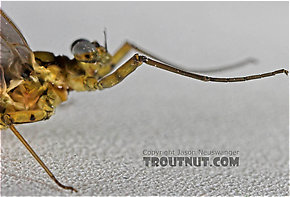
| Nationwide Posts: 14 | Great pictures of the Quill Gordon. I am aware that color means nothing but these pictures of the body are much more yellow than the normal mahogony body color. I also noted you took them in May and this seems late for them to be around for that area. Are you sure the species is correct? | |
| VideoNut | ||
| Troutnut | February 6th, 2007, 11:44 am | |
 Administrator Bellevue, WAPosts: 2737 | Yeah, pretty sure. The bodies are more of a subdued amber color under normal lighting; up close and fully illuminated in the pictures they seem more striking. | |
| Jason Neuswanger, Ph.D. Troutnut and salmonid ecologist | ||
| Konchu | February 7th, 2007, 1:19 pm | |
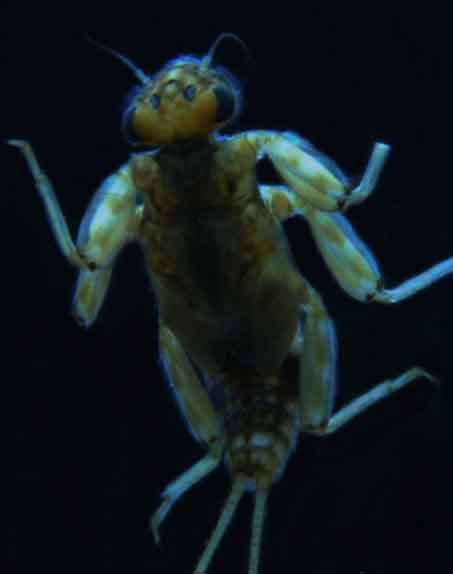 Site Editor IndianaPosts: 505 | I, too, would be curious about the true ID of the critter pictured. The NE Epeorus can present a few problems... | |
| Martinlf | February 7th, 2007, 4:26 pm | |
 Moderator Palmyra PAPosts: 3233 | In Trout Streams and Hatches of Pennsylvania Charlie Meck notes that he has fished Quill Gordon hatches on one stream in mid-June. | |
| "He spread them a yard and a half. 'And every one that got away is this big.'" --Fred Chappell | ||
| Beachvid | February 8th, 2007, 6:52 am | |
| Nationwide Posts: 14 | If someone will tell me how, I would like to post some pictures of what I know is a Quill Gordon or Epeorus pleuralis that are very different in color. As I said before I am aware the color makes no difference for proper identification . These mayflies hatch when the water reaches 50 degree F. and stays there a few days. That may be the case where you took the photos. Have you checked to see if it is a Epeorus vitreus? I don't have the information to check the keys. | |
| VideoNut | ||
| Konchu | February 8th, 2007, 2:16 pm | |
Site Editor IndianaPosts: 505 | What keys are you using to make IDs on Epeorus? | |
| Taxon | February 8th, 2007, 9:42 pm | |
 Site Editor Royse City, TXPosts: 1350 | Konchu- Using Merritt & Cummings, Jason’s photos key to Epeorus (Ironopsis). The following species of Epeorus reside in New York: E. fragilis (Morgan), 1911 E. frison (Burks), 1946 E. pleuralis (Banks), 1910 E. punctatus (McDunnough), 1925 E. suffusus (McDunnough), 1925 E. vitreus (Walker), 1853 Arbona illustrates penis lobes for all of them except E. frison, which has no mention in flyfishing entomology literature, at least of which I am aware. The illustrations for E. pleuralis and E. fragilis both come close. However, I believe E. pleuralis to be a better match to the following blowup of the genitalia of Jason’s specimen: 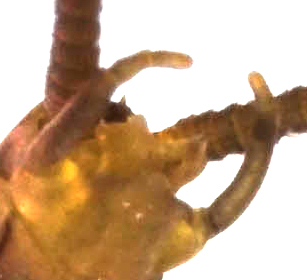 | |
| Best regards, Roger Rohrbeck www.FlyfishingEntomology.com | ||
| Konchu | February 9th, 2007, 6:32 am | |
Site Editor IndianaPosts: 505 | I'm most curious about how others in the flyfishing community are sorting out and identifying the species of Northeastern Epeorus. Keys? Experience? | |
| Martinlf | February 9th, 2007, 1:44 pm | |
Moderator Palmyra PAPosts: 3233 | Taxon, I am stunned and taken aback. It never occurred to me that you, of all people, would bring pornography to this innocent site. Epeorus pleuralis penises indeed! Shocking. | |
| "He spread them a yard and a half. 'And every one that got away is this big.'" --Fred Chappell | ||
| GONZO | February 12th, 2007, 10:11 am | |
Site Editor "Bear Swamp," PAPosts: 1681 | Konchu- Definitively distinguishing Eastern Epeorus to the species level can be challenging (as is finding reliable species-level keys), and an examination of the penes of male specimens under a microscope is probably required (at least for the less common species). From a practical fly-fishing standpoint, however, the two most important species (pleuralis and vitreus) are pretty easy to recognize. The early season pleuralis hatches would be hard to mistake for anything else as long as one captures a specimen. The two tails distinguish it from most other early season "gray mays." The only early two-tailed hatches that might cause some confusion are B. tricaudatus and perhaps Ameletus spp. The hind wings and size would serve to distinguish it from lingering first-brood B. tricaudatus hatches, and the unmarked wings and less prominent costal projection on the hind wings separate it from early Ameletus spp. Peak E. vitreus hatches typically occur from the end of May through June in my region, though these hatches may linger into August where heavy populations exist (or even into September on tailwaters like the Delaware). This hatch is often mistaken for Stenacron, but the absence of the dark wing markings in or around the bulla region of the forewings is a good field identification trait. Some also mistake them for "sulphurs" (Ephemerella spp.), but the two tails are an easy way of separating vitreus from these overlapping hatches. (Provided, of course, that the specimen is undamaged.) I realize that you were probably asking about reliable ways of identifying other (lesser) species of Epeorus; but, other than inspecting male genitalia under magnification, I don't know of any. I have encountered a few Eastern Epeorus specimens that didn't seem to match either pleuralis or vitreus, but these have never constituted a significant hatch from a fly-fishing perspective. By the way, with regard to Beachvid's original questions, the yellowish coloration of pleuralis duns is not that unusual. Schwiebert mentions that old-timers on the Brodheads gave the name "yellow quill" to this hatch on my old homewater. Yellow quill is also a common name for the later vitreus hatch, and is generally more descriptive of that hatch in most watersheds. As for Meck's claim that he has fished pleuralis in mid-June (which Louis mentioned), I suppose that is possible on some very cold tributaries, but it is unusual. Finding pleuralis hatches lingering into the first week of May on Catskill or Pocono waters is not unusual, however, and such timing would be too early for vitreus. | |
| Troutnut | February 12th, 2007, 1:36 pm | |
Administrator Bellevue, WAPosts: 2737 | Taxon, I am stunned and taken aback. It never occurred to me that you, of all people, would bring pornography to this innocent site. Epeorus pleuralis penises indeed! Shocking. Maybe I should put one of those warnings upon entering the site, "You must be 18 years or older to enter. If you are a mayfly." Konchu, have you got any good ideas for Epeorus keys? I've had to resort to ancient books to identify adults, like Needham & Traver's "The Biology of Mayflies." If anyone can cite a more recent key to the adults I will happily rush to the entomology library and make a copy. Since this topic seems to have everyone's attention, I'd like to point out another recent Epeorus discussion in case anybody has fresh ideas about the identity of those four specimens. As for the mayfly in this topic, I don't remember how exactly I identified it. It was a while ago and I was still busy finishing up at Cornell. I remember that it was one of several similar-looking and fairly large mayflies emerging from the Beaverkill mixed with blue quills (presumably Paraleptophlebia adoptiva), and it was the time of year that everyone expected quill gordons so I think I just assumed that's what it was. It's too bad I didn't photograph this one next to a ruler, but it was quite large -- about the same size as the E. pleuralis spinner on this site, and I do remember confidently keying that one under a microscope. I'm still going to guess this one is E. pleuralis based on the size, time of year, their known significance on that river, and Gonzo's observation that they can take on a yellowish color. Also remember that my lighting setup really brings out the colors, and most of my mayflies do look more drab in normal situations. But I do want to make it clear that this one hasn't been rigorously identified. | |
| Jason Neuswanger, Ph.D. Troutnut and salmonid ecologist | ||
| Konchu | February 13th, 2007, 2:14 pm | |
Site Editor IndianaPosts: 505 | I'm not aware of any recent formal tools for IDing Epeorus adults, which is why I asked about how to do it. I know sometimes people use informal rules of thumb, etc. that can have some value and would be curious to learn about these from everybody out there. Out of fairness, I suppose I should divulge that I have more experience with mayflies than trout and my perspective may be a little different from most people posting. So, what we call the same things might be a little different in our minds. | |
| Taxon | February 13th, 2007, 3:12 pm | |
Site Editor Royse City, TXPosts: 1350 | Konchu- The only reliable adult Epeorus species identification method of which I'm aware is microscopic examination of the male genitalia. As I mentioned earler, Mayflies, The Angler and the Trout by Fred L. Arbona, Jr. has genitalia illustrations of most Epeorus species of interest to flyfishers. Notice how, once burned, I now cleverly avoid use of the "p" word, which seems to have potential for triggering unintended consequence. | |
| Best regards, Roger Rohrbeck www.FlyfishingEntomology.com | ||
| GONZO | February 14th, 2007, 11:36 am | |
Site Editor "Bear Swamp," PAPosts: 1681 | Konchu and Roger- As one who does not own a microscope, the accurate identification of some Eastern Epeorus species remains difficult for me. (My wife is quite tolerant of most of my fly-fishing purchases, but I suspect that buying a microscope in order to stare at a mayfly's penis--excuse me, genitalia--is where she'd draw the line!) :) In the absence of other, more definitive clues, the timing of the emergence and (sometimes) the collecting records for a region provide the only other means for me to try to make an educated guess. Based on this, species other than pleuralis and vitreus seem to be either rare or at least minor in my region, and the collecting record seems to bear out this observation for much of the East. Populations of pleuralis seem to be on the decline in many places in the East, while vitreus populations seem to be holding their own. I assume this is because of the different habitat requirements/sensitivities between these species, and this seems to have an interesting parallel in the Ephemerella species subvaria and invaria. I have seen subvaria populations dwindle in many streams where they used to be strong, while most invaria populations (often in the same streams) seem still to be quite good. Some local populations probably provide exceptions to these general observations, however, and unusual specimens like the ones Jason found emerging in September on a cold Catskill tributary (see the link in his post above) don't seem to conform to the species I am familiar with. I have fished emergences of what I assumed to be vitreus in mid-September on the West Branch of the Delaware, but, except for being slightly smaller than the earlier hatches of this species, these were quite consistent with that species in every way I could determine. (And cold tailwaters often have the effect of prolonging/altering hatch timing.) Jason's observation that his mystery species was the only significant hatch on that day is intriguing because most of the non-conforming, "oddball" Epeorus I have encountered were pretty insignificant, hardly ever constituting a "fishable" hatch. By the way, Roger, does Arbona cite a source for the drawings of the Epeorus "private parts" depicted in his book? | |
| Taxon | February 14th, 2007, 1:14 pm | |
Site Editor Royse City, TXPosts: 1350 | By the way, Roger, does Arbona cite a source for the drawings of the Epeorus "private parts" depicted in his book? Gonzo- He provides an extensive bibliography, but without citation in the text, due (he indicates) to space limitations. | |
| Best regards, Roger Rohrbeck www.FlyfishingEntomology.com | ||
| Troutnut | February 14th, 2007, 10:16 pm | |
Administrator Bellevue, WAPosts: 2737 | (My wife is quite tolerant of most of my fly-fishing purchases, but I suspect that buying a microscope in order to stare at a mayfly's penis--excuse me, genitalia--is where she'd draw the line!) :) It's penes. That spelling makes the whole endeavor seem a bit less ridiculous. Still, I wish mayfly species could be easily distinguished on the basis of their feet or something! You can get a respectable microscope for under $200, maybe even under $100 for our purposes. I've got two. My girlfriend is quite understanding about that -- then again, she is a microbiologist of sorts. :) | |
| Jason Neuswanger, Ph.D. Troutnut and salmonid ecologist | ||
| Martinlf | February 15th, 2007, 7:19 am | |
Moderator Palmyra PAPosts: 3233 | It's penes. That spelling makes the whole endeavor seem a bit less ridiculous. Aha, I've been waiting for this one. My expectation was that Taxon would make this correction, but he's far too clever a mayfly to fall into my web. Gonzo, quite innocently baited the snare again, I see. My original Anglicized pluralization of the third declension Latin noun "penis" in the complaint about "Epeorus pleuralis penises" was designed to sound ridiculous and to sow general mayhem and confusion. I can't believe it took seven posts and a rebaiting to get the correction. You guys are asleep at the switch. Oh, and Jason, I just can't resist this. Gonzo's nonpluralized use of penis is correct. He was referring to "a [singular] mayfly's" organ of generation. Taxon, how's that for euphemism? Obviously there's way too much snow on the ground. | |
| "He spread them a yard and a half. 'And every one that got away is this big.'" --Fred Chappell | ||
| GONZO | February 15th, 2007, 9:36 am | |
Site Editor "Bear Swamp," PAPosts: 1681 | Jason and Louis-Gonzo quite innocently baited the snare again I appreciate the presumption of innocence, but I have to plead guilty on all counts. As you can see from my first post on this topic, I was quite aware of the more acceptable plural form of the noun in question and chose the singular entirely for effect. So, I confess not only my guilt, but also my complicity in stirring this linguistic pot. Who knew Latin could be such an endless source of entertainment? And yes, I think we are all in desperate need of a piscatorial fix. :) | |
| Beachvid | February 15th, 2007, 11:12 am | |
| Nationwide Posts: 14 | Gonzo is on target about the importance of the species in this genus. preuralis and vitreus is all I have ever encountered of any hatch importance or intensity. Both are fairly easy to identify which is why I questioned the images to start with. As I said before, the Quill Gordons hatch when the water is 50 degrees F. and stays there a few days, starting in late February in the South to as late as May in the Northeast.The vitreus follows shortly thereafter usually not over a month in most places. Tailwaters can change this of course. I have found these two hatches vary a lot time wise in the Delaware from other streams but understandablely so. There are usually plenty of them and not difficult to identify. The nymphs are especially easy to identify early in the year - the only two tailed nymphs that size and/or shape you will find. The tricaudatus two tailed baetis are tiny compared to them and the Ameletus (rather rare) are swimming nymphs that look entirely different from the clinger Quill Gordons. These hatch below the surface or from the bottom to the surface - I'm not sure which but do not hatch in the skim. I am encourgaged with all of the response to this since this is my first forum activity. | |
| VideoNut | ||
| Taxon | February 15th, 2007, 12:29 pm | |
Site Editor Royse City, TXPosts: 1350 | Gonzo's nonpluralized use of penis is correct. He was referring to "a [singular} mayfly's" organ of generation. taxon, how's that for euphemism? Well Louis, euphemistically speaking of course, given that a singular adult male mayfly's “organ of generation” has evolved as a laterally opposed pair, use of the pluralized form would seem appropriate, unless one is referring to a single lobe. | |
| Best regards, Roger Rohrbeck www.FlyfishingEntomology.com | ||
Quick Reply
You have to be logged in to post on the forum. It's this easy:
Related Discussions
| Title | Replies | Last Reply |
| Up-to-date with the latest mayfly species In General Discussion by Troutnut | 0 | |
| Re: Thoughts on this Heptageniid's ID? In Male Epeorus vitreus Mayfly Dun by Troutnut | 1 | Oct 28, 2008 by GONZO |
| Re: confusing local names+ In Ephemerella needhami Mayfly Dun by Gutcutter | 4 | Dec 22, 2009 by Oldredbarn |
| Re: Epeorus In the Identify This! Board by Crepuscular | 6 | Feb 25, 2013 by Crepuscular |
| Re: Peculiar Heptageniid In Female Epeorus vitreus Mayfly Spinner by Troutnut | 2 | Oct 5, 2006 by GONZO |
Re: Caught a nymph on a Nymph?!  In the Identify This! Board by Btbo32 | 6 | Feb 19, 2020 by Wbranch |
| Re: White Mayfly ---- Euphron leukon? In the Identify This! Board by JumpNotZero | 1 | Sep 9, 2008 by GONZO |
| Re: Not Maccaffertium, E. vitreus female In Female Epeorus vitreus Mayfly Dun by GONZO | 1 | Oct 19, 2006 by Troutnut |
| Re: You Guys Hate Me Yet :) More pics In the Identify This! Board by DayTripper | 16 | May 20, 2008 by Shawnny3 |
| Re: Possible ID In the Mayfly Species Apobaetis futilis by Sreyadig | 2 | Apr 19, 2021 by Crepuscular |
Troutnut.com is copyright © 2004-2024 Jason
Neuswanger (email Jason). See my FAQ for information about use of my images.
 privacy policy
privacy policy