
Blog & Latest Updates
Fly Fishing Articles
Insects by Common Name


Mayfly Species Epeorus pleuralis (Quill Gordon)


Taxonomic Navigation -?-
Kingdom
Animalia (Animals)
» Phylum
Arthropoda (Arthropods)
» Class
Insecta (Insects)
» Order
Ephemeroptera (Mayflies)
» Genus
Epeorus (Little Maryatts)
» Species pleuralis (Quill Gordon)
Common Names


This is page 2 of specimens of Epeorus pleuralis. Visit the main Epeorus pleuralis page for:
- The behavior and habitat of Epeorus pleuralis.
Pictures of 5 Mayfly Specimens in the Species Epeorus pleuralis:
Epeorus pleuralis (Quill Gordon) Mayfly Nymph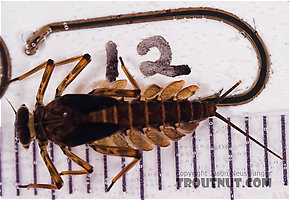 View 4 PicturesThis Epeorus pluralis dun is recently deceased in these photos. I decided not to photograph several lively, less mature nymphs. This one was ready to hatch, as indicated by the black wing pads (
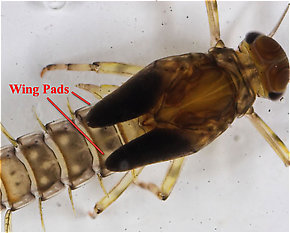 Wing pad: A protrusion from the thorax of an insect nymph which holds the developing wings. Black wing pads usually indicate that the nymph is nearly ready to emerge into an adult.). I believe it had not been dead long enough to lose its natural coloration.
View 4 PicturesThis Epeorus pluralis dun is recently deceased in these photos. I decided not to photograph several lively, less mature nymphs. This one was ready to hatch, as indicated by the black wing pads (
The wing pads on this final instar Baetidae mayfly nymph are extremely dark.
Collected April 19, 2006 from Mongaup Creek in New York
Added to Troutnut.com by Troutnut on April 21, 2006
Added to Troutnut.com by Troutnut on April 21, 2006
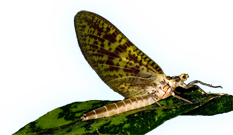
Male Epeorus pleuralis (Quill Gordon) Mayfly Dun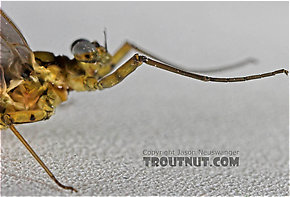 View 9 Pictures
View 9 PicturesCollected May 7, 2005 from the Beaverkill River in New York
Added to Troutnut.com by Troutnut on May 16, 2006
Added to Troutnut.com by Troutnut on May 16, 2006
Jargon Defined:
Dun: Mayflies have two adult stages. They first emerge from the water as duns (scientifically known as the subimago stage). They then molt into the spinner (imago) stage, in which they mate and die. Sometimes the word "dun" is confusingly used to refer to a brownish gray color in fly tying materials.
Natural: A natural is a real insect (or similar creature) a trout might eat. The term is used to specify the real thing as opposed to its artificial imitation.
Nymphs: The juvenile, underwater stages of mayflies, stoneflies, dragonflies, and damselflies and other aquatic insects whose juvenile stages are covered by hard exoskeletons. The word can also refer to the fishing flies which imitate these creatures, in which case it is used as a blanket term for flies imitating any underwater stage of an invertebrate (except for crayfish and leeches).
The wing pads on this final instar Baetidae mayfly nymph are extremely dark.
Useful References:
Arbona, Fred Jr. 1989. Mayflies, the Angler, and the Trout. Nick Lyons Books.
Caucci, Al and Nastasi, Bob. 2004. Hatches II. The Lyons Press.
Fauceglia, Ted. 2005. Mayflies . Stackpole Books.
Knopp, Malcolm and Robert Cormier. 1997. Mayflies: An Angler's Study of Trout Water Ephemeroptera . The Lyons Press.
Schwiebert, Ernest G. 1955. Matching the Hatch. MacMillan Publishing Company.
Swisher, Doug and Carl Richards. 2000. Selective Trout. The Lyons Press.
Top 10 Fly Hatches
 Baetis
 Baetidae
 Ephemerellidae
 Hexagenia limbata
 Chironomidae
 Heptageniidae
 Ephemerella subvaria
 Ephemerella
 Isonychia
 Hydropsychidae
Top Gift Shop Designs
 I outfish my daddy!
 Electric blue Hendrickson dun.
 I love buggers. Big, green, wooly ones.
 I outfish my husband!
 Be the trout.
 Eat mayflies.
Top Insect Specimens
 Baetisca obesa Mayfly Nymph
 Corydalus Hellgrammite Larva
 Neophylax Caddisfly Adult
 Pteronarcys biloba Stonefly Nymph
 Rhyacophila fuscula Caddisfly Larva
Miscellaneous Sites
Troutnut.com is copyright © 2004-2024 Jason
Neuswanger (email Jason). See my FAQ for information about use of my images.
 privacy policy
privacy policy