
Blog & Latest Updates
Fly Fishing Articles
Insects by Common Name

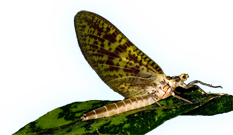
Mayfly Species Cinygmula reticulata (Western Ginger Quill)


Taxonomic Navigation -?-
Kingdom
Animalia (Animals)
» Phylum
Arthropoda (Arthropods)
» Class
Insecta (Insects)
» Order
Ephemeroptera (Mayflies)
» Genus
Cinygmula (Dark Red Quills)
» Species reticulata (Western Ginger Quill)
Common Names


Where & When
Region: West
Time Of Year (?): May through early September, location dependant
Preferred Waters: Cold moving water over shallow gravel or stones
Altitude: Variable
This taxon's preference for shallow cold water seems to be a limiting factor on distribution. Timing is dependant on elevation and seasonal weather. High country hatches often peak in late July.Time Of Year (?): May through early September, location dependant
Preferred Waters: Cold moving water over shallow gravel or stones
Altitude: Variable
Hatching Behavior
Time Of Day (?): Midday
Habitat: Smooth flowing water over shallow gravel or stones, meadow streams
Water Temperature: Seem to thrive best in water that remains cold even in mid Summer
There is scant reporting on this species in angling literature, so behavior that runs the gamut for Heptagenids is possible. Due to the environs where it is most often found, "selective" feeding is rarely at issue.Habitat: Smooth flowing water over shallow gravel or stones, meadow streams
Water Temperature: Seem to thrive best in water that remains cold even in mid Summer
Nymph Biology
Current Speed: Slow to medium
Substrate: Gravel to small cobble.
Pictures of 3 Mayfly Specimens in the Species Cinygmula reticulata:
Cinygmula reticulata (Western Ginger Quill) Mayfly Nymph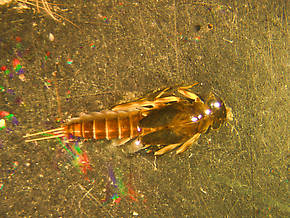 View 1 PicturesI collected several live specimens of nymphs and reared them to the imago (Imago: The sexually mature adult stage of the mayfly is called the imago by scientists and the spinner by anglers.) stage. They were C. reticulata. The interesting thing is they were collected in May and were emerging along with Rhithrogena (March Brown). This seems to be an overlooked hatch since in some rivers it emerges very early, before runoff.
View 1 PicturesI collected several live specimens of nymphs and reared them to the imago (Imago: The sexually mature adult stage of the mayfly is called the imago by scientists and the spinner by anglers.) stage. They were C. reticulata. The interesting thing is they were collected in May and were emerging along with Rhithrogena (March Brown). This seems to be an overlooked hatch since in some rivers it emerges very early, before runoff.Collected May 10, 2009 from the Big Thompson River in Montana
Added to Troutnut.com by Bnewell on June 26, 2011
Added to Troutnut.com by Bnewell on June 26, 2011
Female Cinygmula reticulata (Western Ginger Quill) Mayfly Dun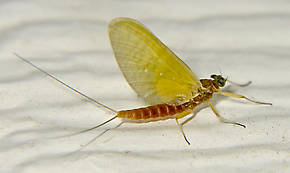 View 1 Pictures
View 1 PicturesCollected June 15, 2011 from the Touchet River in Washington
Added to Troutnut.com by Bnewell on June 24, 2011
Added to Troutnut.com by Bnewell on June 24, 2011
Male Cinygmula reticulata (Western Ginger Quill) Mayfly Spinner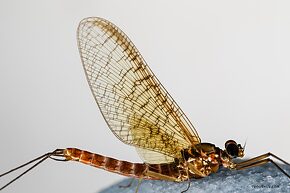 View 7 PicturesThe lengths of the wing and body, measured with a caliper, are both 8 mm.
Keys in Needham's 1935 Biology of Mayflies point to either Cinygmula reticulata or Cinygmula gartrelli. IT seems to have “cross veins in costal half of fore wing only, slightly margined with brown” and “wings tinged withamber at base and along costal margin of both wings” (gartrelli) as opposed to “all cross veins of both wings faintly but broadly margined with pale smoky” and “wings entirely amber-tinged” (although there is a slight amber tinge throughout, just more pronounced in places) as in reticulata. However, wing length reported for reticulata (9 mm) is closer to this specimen than gartrelli (10 mm). Ventral (Ventral: Toward or on the bottom.) median marks are supposed to be “traces” for reticulata and “present” for gartrelli. Descriptions for both species involve semi-hyaline (Hyaline: Highly transparent, or glassy; usually refers to insect wings, especially those of mayfly spinners.) anterior (Anterior: Toward the front of an organism's body. The phrase "anterior to" means "in front of.") abdominal segments not present on my specimens. Distribution records suggest reticulate lives nearby, so I'm going with that, but I can't confidently rule out gartrelli.
View 7 PicturesThe lengths of the wing and body, measured with a caliper, are both 8 mm.Keys in Needham's 1935 Biology of Mayflies point to either Cinygmula reticulata or Cinygmula gartrelli. IT seems to have “cross veins in costal half of fore wing only, slightly margined with brown” and “wings tinged withamber at base and along costal margin of both wings” (gartrelli) as opposed to “all cross veins of both wings faintly but broadly margined with pale smoky” and “wings entirely amber-tinged” (although there is a slight amber tinge throughout, just more pronounced in places) as in reticulata. However, wing length reported for reticulata (9 mm) is closer to this specimen than gartrelli (10 mm). Ventral (Ventral: Toward or on the bottom.) median marks are supposed to be “traces” for reticulata and “present” for gartrelli. Descriptions for both species involve semi-hyaline (Hyaline: Highly transparent, or glassy; usually refers to insect wings, especially those of mayfly spinners.) anterior (Anterior: Toward the front of an organism's body. The phrase "anterior to" means "in front of.") abdominal segments not present on my specimens. Distribution records suggest reticulate lives nearby, so I'm going with that, but I can't confidently rule out gartrelli.
Collected August 1, 2020 from Mystery Creek #237 in Montana
Added to Troutnut.com by Troutnut on August 18, 2020
Added to Troutnut.com by Troutnut on August 18, 2020
Your Thoughts On Cinygmula reticulata:
Top 10 Fly Hatches
 Baetis
 Baetidae
 Ephemerellidae
 Hexagenia limbata
 Chironomidae
 Heptageniidae
 Ephemerella subvaria
 Ephemerella
 Isonychia
 Hydropsychidae
Top Gift Shop Designs
 I outfish my daddy!
 Electric blue Hendrickson dun.
 I love buggers. Big, green, wooly ones.
 I outfish my husband!
 Be the trout.
 Eat mayflies.
Top Insect Specimens
 Baetisca obesa Mayfly Nymph
 Corydalus Hellgrammite Larva
 Neophylax Caddisfly Adult
 Rhyacophila fuscula Caddisfly Larva
 Pteronarcys biloba Stonefly Nymph
Miscellaneous Sites
Troutnut.com is copyright © 2004-2024 Jason
Neuswanger (email Jason). See my FAQ for information about use of my images.
 privacy policy
privacy policy