
Blog & Latest Updates
Fly Fishing Articles
Insects by Common Name


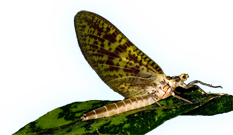
Mayfly Family Ephemerellidae (Hendricksons, Sulphurs, PMDs, BWOs)


Taxonomic Navigation -?-
Kingdom
Animalia (Animals)
» Phylum
Arthropoda (Arthropods)
» Class
Insecta (Insects)
» Order
Ephemeroptera (Mayflies)
» Family Ephemerellidae (Hendricksons, Sulphurs, PMDs, BWOs)


3 genera aren't included.
Common Name
| Match | Common Name |
 | Hendricksons, Sulphurs, PMDs, BWOs |
Where & When
Regions: East, Midwest, West
Time Of Year (?): Spring to Fall
Preferred Waters: Variable
Altitude: Variable
Ephemerellids can be found in virtually any cold water habitat across the continent. A curious fact about this family is that the males and females often inhabit different parts of the stream. In many species, the males and females are of different sizes and colors, and your fly may need to match the dominant gender emerging from your stretch of the river.Time Of Year (?): Spring to Fall
Preferred Waters: Variable
Altitude: Variable
Hatching Behavior
These are fantastic dry-fly insects. Behavior varies by species, but almost all have excellent qualities for the angler. Most eclode laboriously in the surface film, where emerger and floating nymph patterns are excellent. Others before reaching the surface, making them good wet-fly fare. Some species have been documented to engage in both forms thus opening debate over whether these two styles of emergence are driven by genetics or environmental influences. They can also take a very long time to prepare their wings for flight once they reach the surface. There they ride like miniature sailboats in the classic mayfly style, fluttering occasionally, and can be imitated by a plethora of upright winged dry fly patterns.
Many species are especially prone to being stillborn (Stillborn: In fly fishing, a stillborn insect is one which got stuck in its nymphal or pupal shuck during emergence and floats helplessly on the surface instead of flying away. It is a specific class of cripple, although it is sometimes used interchangeably with that term.) or crippled, and trout are especially fond of this wounded prey and can be fooled by our crafty imitations.
 View Full Size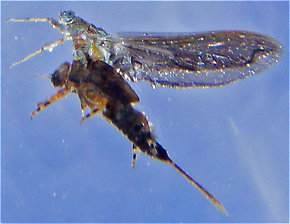
Spinner Behavior
Most species return to the stream as spinners one day after they emerge. Spinner falls are usually concentrated over the riffles, but occur over selected stretches on waters lacking this feature.
Nymph Biology
Nymphs of this family are a gift to the angler, because many have the peculiar habit of swimming up and down between the surface and the bottom several times before actually emerging. The actual biological purpose these seeming "practice runs" serve is open to debate, but they expose the slow-swimming nymphs to the trout. This behavior has been described by biologists as pulses of benthic drift, and they can do so in astounding numbers. They do the same near the surface as well.
Between their tendency to be in exposed places and behavioral drift (Behavioral drift: The nymphs and larvae of many aquatic insects sometimes release their grip on the bottom and drift downstream for a while with synchronized timing. This phenomenon increases their vulnerability to trout just like emergence, but it is invisible to the angler above the surface. In many species it occurs daily, most often just after dusk or just before dawn.), the nymphs of this family are important to trout year-round. Their imitations often prove successful anywhere in the water column.
Pictures of 271 Mayfly Specimens in the Family Ephemerellidae:
Male Ephemerella aurivillii Mayfly Spinner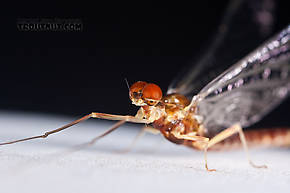 View 15 PicturesThis spinner molted from a dun after being photographed, and the dun form is listed here as a separate specimen. I've rarely found a more cooperative and photogenic mayfly.
View 15 PicturesThis spinner molted from a dun after being photographed, and the dun form is listed here as a separate specimen. I've rarely found a more cooperative and photogenic mayfly.Male Ephemerella subvaria (Hendrickson) Mayfly Dun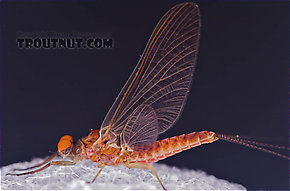 View 9 PicturesI collected this male Hendrickson dun and a female in the pool on the Beaverkill where the popular Hendrickson pattern was first created. He is descended from mayfly royalty.
View 9 PicturesI collected this male Hendrickson dun and a female in the pool on the Beaverkill where the popular Hendrickson pattern was first created. He is descended from mayfly royalty.Collected April 19, 2006 from the Beaverkill River in New York
Added to Troutnut.com by Troutnut on April 22, 2006
Added to Troutnut.com by Troutnut on April 22, 2006
Female Drunella tuberculata Mayfly Dun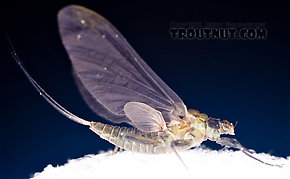 View 14 PicturesI don't know for sure that this is Drunella tuberculata, but that's my best guess for now.
It certainly has a different look and much more robust body shape from Drunella lata duns I photographed a couple weeks earlier, so I doubt it's that species. Using distribution records to eliminate other choices narrows this down to Drunella tuberculata or Drunella walkeri.
Markings described for the abdominal sternites (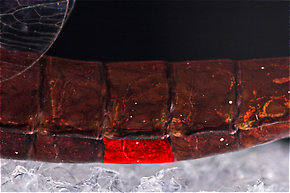 Sternite: The bottom (ventral) part of a single segment on an insect's abdomen.) of the male spinner of Drunella tuberculata are suspiciously similar to those on this female dun. Also, this dun is 9.5mm long (my ruler pic isn't very good, but I'm basing this on measuring the real thing). The size range given in the old Allen & Edmunds keys for walkeri females is 7-8mm, while tuberculata is 9-11mm. For these reasons I'm sticking it in tuberculata for now.
This is the only Drunella mayfly I saw all day. I scooped it off the water as it emerged at around 7pm from a big Catskill tailwater.
View 14 PicturesI don't know for sure that this is Drunella tuberculata, but that's my best guess for now. It certainly has a different look and much more robust body shape from Drunella lata duns I photographed a couple weeks earlier, so I doubt it's that species. Using distribution records to eliminate other choices narrows this down to Drunella tuberculata or Drunella walkeri.
Markings described for the abdominal sternites (
One sternite of this Isonychia bicolor mayfly spinner is highlighted in red.
This is the only Drunella mayfly I saw all day. I scooped it off the water as it emerged at around 7pm from a big Catskill tailwater.
Collected June 1, 2007 from the West Branch of the Delaware River in New York
Added to Troutnut.com by Troutnut on June 8, 2007
Added to Troutnut.com by Troutnut on June 8, 2007
37 Underwater Pictures of Ephemerellidae Mayflies:


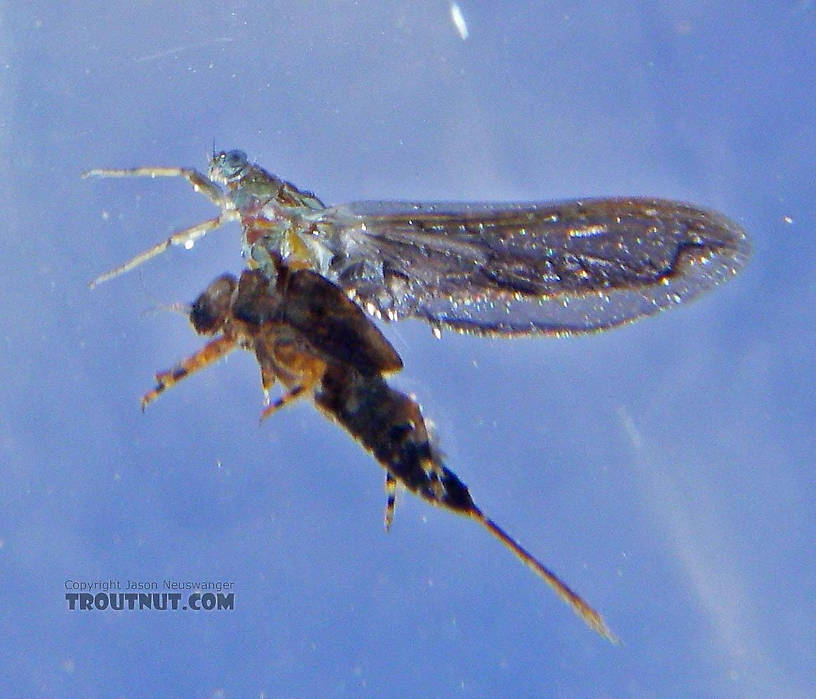
This is a close-up underwater view of a stillborn (Stillborn: In fly fishing, a stillborn insect is one which got stuck in its nymphal or pupal shuck during emergence and floats helplessly on the surface instead of flying away. It is a specific class of cripple, although it is sometimes used interchangeably with that term.) Ephemerella subvaria (Henrickson) female dun.
In this picture: Mayfly Species Ephemerella subvaria (Hendrickson).
In this picture: Mayfly Species Ephemerella subvaria (Hendrickson).
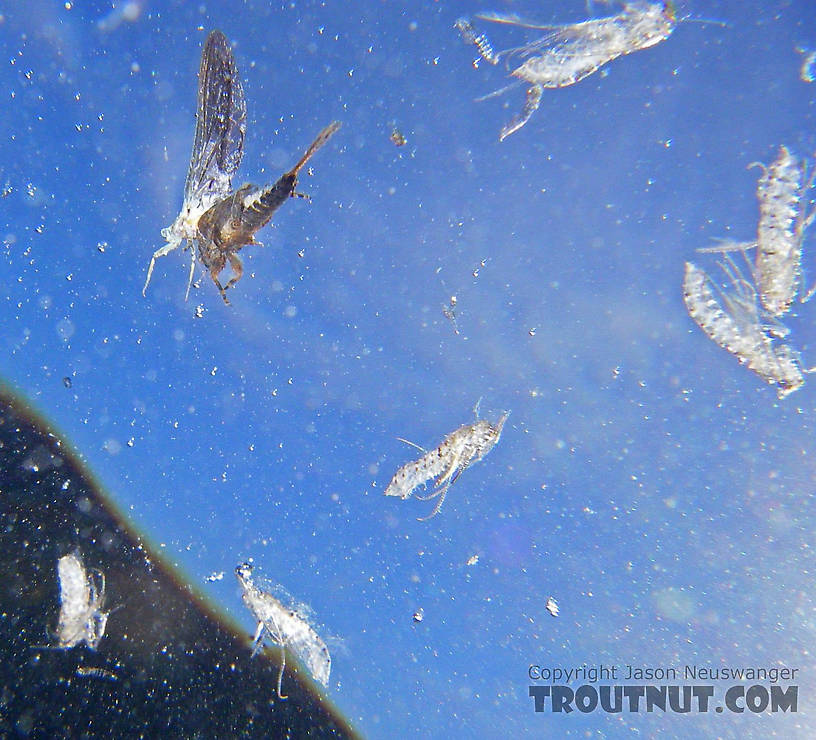
This picture from below shows a stillborn (Stillborn: In fly fishing, a stillborn insect is one which got stuck in its nymphal or pupal shuck during emergence and floats helplessly on the surface instead of flying away. It is a specific class of cripple, although it is sometimes used interchangeably with that term.) Ephemerella subvaria (Hendrickson) dun drifting on the surface amidst a number of shed pupal skins from Brachycentrus caddisflies which were heavily hatching that day.
In this picture: Mayfly Species Ephemerella subvaria (Hendrickson) and Caddisfly Species Brachycentrus appalachia (Apple Caddis).
In this picture: Mayfly Species Ephemerella subvaria (Hendrickson) and Caddisfly Species Brachycentrus appalachia (Apple Caddis).
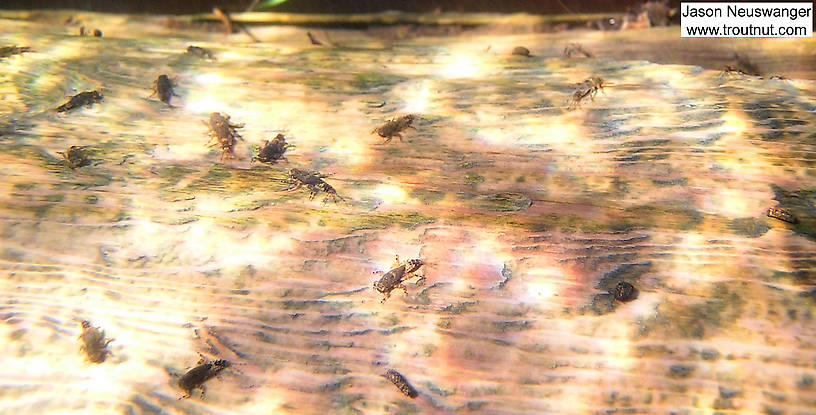
In this picture: Mayfly Species Ephemerella subvaria (Hendrickson) and Mayfly Species Ephemerella invaria (Sulphur Dun).
StateWisconsin
LocationNamekagon River
Date TakenApr 23, 2004
Date AddedJan 25, 2006
AuthorTroutnut
CameraOlympus C740UZ
Recent Discussions of Ephemerellidae
PMD Spinner - Egg sack color? 20 Replies »
Posted by Wbranch on Jan 26, 2010 in the species Ephemerella excrucians
Last reply on Aug 18, 2020 by Troutnut
Do any of you entomologist types know the true color of the PMD spinner? Dorothea or excrucians. Where I fish in MT there are huge spinner falls, many spents are on the water in the morning and others fall again at various periods during the day. I'd like to tie some with egg sacks as I saw many in July but forgot what color they were. Thanks.
Replyrotunda 8 Replies »Posted by CharlieBugs on Jan 26, 2015 in the species Ephemerella invaria
Last reply on Feb 1, 2015 by Gutcutter
Your post on Ephemerella subvaria brought back some memories that might be of interest to some readers.
I got my master’s degree under Ed Cooper at Penn State in 1966. I studied the impact of low oxygen from Penn State’s sewage plant on the mayflies of Spring Creek. The plant mostly removed BOD (organic matter which causes low oxygen) by oxidizing it in a bacteria rich environment. But at that time the plant did not remove phosphorus (and nitrogen) which fertilized the macrophytic algae and other plant growth. There were far more macrophytes (large plants) in Spring Creek below the sewage plant entrance than above, and essentially no mayflies. What was there in the effluent that killed the mayflies? Mayflies put directly in the effluent did not die over a 16 hour day. But oxygen samples taken over 24 hours in summer showed a much greater variation below the effluent (from 16 ppm (or mg/l), 160% of saturation in late afternoon) to 3 ppm (30 percent saturation just before dawn) (vs 14 to 10 ppm, +- 20 percent saturation above the effluent.
I built a Rube Goldberg machine in the lab that would control the oxygen levels and temperature of control and experimental cages that each held 25 mayflies. The control would keep oxygen near saturation and the experimental one would lower the oxygen over 8 hours (the length of night in summer). Mortality was dependent upon both oxygen level and temperature. Virtually no mayflies would die if the oxygen was above 2 PPM (or mg/l) at 8 C, or at 4.5 at 20 C. Seventy five percent of larvae would die at 1 ppm at 8 degrees and 2.5 ppm at 20 degrees. So the mortality was much more if the temperatures were high. Hence most of the mortality would presumably occur in August when the high temperatures (20C) would increase the larvae metabolism and hence need for oxygen, but the water would hold less oxygen even before the night-time respiration of the macrophytes would reduce it much further (to only 3 ppm). Thus the low nighttime oxygen caused by excessive plant growth was a sufficient cause or the near total absence of mayflies below the sewage plant. Recognizing the aquatic impact Penn State started to use land disposal of its effluent which as far as I knew alleviated, and even stopped, the negative impacts on the mayflies. Can anyone verify this ? The otherwise well done “The Fishery of Spring Creek; A Watershed Under Siege “
By Robert F. Carline, Rebecca L. Dunlap Jason E. Detar, Bruce A. Hollender Has nothing on dissolved oxygen or aquatic insects. In my opinion we need much more of an ecosystems approach for streams (Which we are doing for Little Sandy Creek in N.Y.).
Now back to Ephemeralla subvaria. The title of the paper I published on this project (my first of nearly 300 publications) was:
1. Hall, C.A.S. 1969. Mortality of the mayfly nymph, Ephemerella rotunda, at low dissolved oxygen concentrations. J. Elisha Mitchell Sci. Soc. 85(1): 34-39 (M.S. Thesis, Pennsylvania State University, 1966).
Whoa! Ephemeralla rotunda? This was by far the most abundant mayfly in Spring Creek where I sampled! But I could not even find the name in your list. Also I had my samples verified by Burke, author of the authoritative "Mayflies of Illinois", and he said Well that’s what it keyed out to in my book”. (Talk about scientific ass covering! ) Well to make matters worse (as of 24 hours ago) my next girlfriend, Molly, at the University of North Carolina, loved the name of “Ephemerella rotunda”, the rotund one, which comes to think of it described her as well. I liked it too. But n’exist plus: where had the most abundant mayfly gone? Fortunately upon reading the rest of the post I found “Ephemerella invaria is one of the two species frequently known as Sulphurs (the other is Ephemerella dorothea). There used to be a third, Ephemerella rotunda, but entomologists recently discovered that invaria and rotunda are a single species with an incredible range of individual variation." Ahh neither rotunda nor Molly stood the test of time. So I assume what I called rotunda is still alive and well in Spring Creek as invaria. Again, can anyone verify that?
If anyone wants to follow up on the distribution and abundance of mayfly (or any other species) may I recommend: Hall, C.A.S., J.A. Stanford and R. Hauer. 1992. The distribution and abundance of organisms as a consequence of energy balances along multiple environmental gradients. Oikos 65: 377-390. I can send it if you cannot get it from google, which I think you can. (chall@esf.edu)
ReplySo is Ep Infrequens now known as Ep Dorothea? 20 Replies »I got my master’s degree under Ed Cooper at Penn State in 1966. I studied the impact of low oxygen from Penn State’s sewage plant on the mayflies of Spring Creek. The plant mostly removed BOD (organic matter which causes low oxygen) by oxidizing it in a bacteria rich environment. But at that time the plant did not remove phosphorus (and nitrogen) which fertilized the macrophytic algae and other plant growth. There were far more macrophytes (large plants) in Spring Creek below the sewage plant entrance than above, and essentially no mayflies. What was there in the effluent that killed the mayflies? Mayflies put directly in the effluent did not die over a 16 hour day. But oxygen samples taken over 24 hours in summer showed a much greater variation below the effluent (from 16 ppm (or mg/l), 160% of saturation in late afternoon) to 3 ppm (30 percent saturation just before dawn) (vs 14 to 10 ppm, +- 20 percent saturation above the effluent.
I built a Rube Goldberg machine in the lab that would control the oxygen levels and temperature of control and experimental cages that each held 25 mayflies. The control would keep oxygen near saturation and the experimental one would lower the oxygen over 8 hours (the length of night in summer). Mortality was dependent upon both oxygen level and temperature. Virtually no mayflies would die if the oxygen was above 2 PPM (or mg/l) at 8 C, or at 4.5 at 20 C. Seventy five percent of larvae would die at 1 ppm at 8 degrees and 2.5 ppm at 20 degrees. So the mortality was much more if the temperatures were high. Hence most of the mortality would presumably occur in August when the high temperatures (20C) would increase the larvae metabolism and hence need for oxygen, but the water would hold less oxygen even before the night-time respiration of the macrophytes would reduce it much further (to only 3 ppm). Thus the low nighttime oxygen caused by excessive plant growth was a sufficient cause or the near total absence of mayflies below the sewage plant. Recognizing the aquatic impact Penn State started to use land disposal of its effluent which as far as I knew alleviated, and even stopped, the negative impacts on the mayflies. Can anyone verify this ? The otherwise well done “The Fishery of Spring Creek; A Watershed Under Siege “
By Robert F. Carline, Rebecca L. Dunlap Jason E. Detar, Bruce A. Hollender Has nothing on dissolved oxygen or aquatic insects. In my opinion we need much more of an ecosystems approach for streams (Which we are doing for Little Sandy Creek in N.Y.).
Now back to Ephemeralla subvaria. The title of the paper I published on this project (my first of nearly 300 publications) was:
1. Hall, C.A.S. 1969. Mortality of the mayfly nymph, Ephemerella rotunda, at low dissolved oxygen concentrations. J. Elisha Mitchell Sci. Soc. 85(1): 34-39 (M.S. Thesis, Pennsylvania State University, 1966).
Whoa! Ephemeralla rotunda? This was by far the most abundant mayfly in Spring Creek where I sampled! But I could not even find the name in your list. Also I had my samples verified by Burke, author of the authoritative "Mayflies of Illinois", and he said Well that’s what it keyed out to in my book”. (Talk about scientific ass covering! ) Well to make matters worse (as of 24 hours ago) my next girlfriend, Molly, at the University of North Carolina, loved the name of “Ephemerella rotunda”, the rotund one, which comes to think of it described her as well. I liked it too. But n’exist plus: where had the most abundant mayfly gone? Fortunately upon reading the rest of the post I found “Ephemerella invaria is one of the two species frequently known as Sulphurs (the other is Ephemerella dorothea). There used to be a third, Ephemerella rotunda, but entomologists recently discovered that invaria and rotunda are a single species with an incredible range of individual variation." Ahh neither rotunda nor Molly stood the test of time. So I assume what I called rotunda is still alive and well in Spring Creek as invaria. Again, can anyone verify that?
If anyone wants to follow up on the distribution and abundance of mayfly (or any other species) may I recommend: Hall, C.A.S., J.A. Stanford and R. Hauer. 1992. The distribution and abundance of organisms as a consequence of energy balances along multiple environmental gradients. Oikos 65: 377-390. I can send it if you cannot get it from google, which I think you can. (chall@esf.edu)
Posted by Wbranch on Feb 17, 2008 in the species Ephemerella dorothea infrequens
Last reply on Jul 1, 2014 by Crepuscular
These mayflies look more like the Sulfurs I see on the Delaware system than the PMD's I see in Montana. The Montana mayfly has a distinct yellow leading edge to an overall light dun gray wing and the abdomen and thorax have a more light greenish/yellow cloration so how is it that Infrequens is now known as Ep Dorothea Dorothea?
ReplyDrunella cornuta on the Brodhead at Stroudsburg PA 11 Replies »Posted by Reify on Apr 21, 2014 in the species Drunella cornuta
Last reply on Apr 24, 2014 by Brookyman
4/21/14 - Fished the Brodhead today at the last park before last bridge on PA 191 - downstream of huge riffle section so is a great tretch for this species. I didn't get there until around 1:00 PM, took a nap and started fishing at 2:00 and there were still cornuta coming off sparsely but steadliy - until 3:30 PM. Sparse rises, but I was entertained. Is that normal or could it be because the water is unusually cold this year. Are the males and females of the same size or is one larger - and of slightly more pale coloration at take-off from surface? It almost looked to me to be two different flies, but I'm sure they weren't.
Replyflorida mayfly nymph imitations 2 Replies »Posted by Homer47 on Sep 5, 2012 in the species Eurylophella temporalis
Last reply on Sep 6, 2012 by Sayfu
Looks like an imitation would be about a #10 or #8 dark brown nymph pattern. I'm down here in north Fla and trying to match the hatch in the far north central part of the state, mostly to fool the bream. Any ideas or help would be appreciated. I found two patterns so far that seem to work- a little brown nymph with a rusty brown/orange thorax(maybe this is a good representation of the E. Temporalis), and a size 12 buzzer nymph with black body, peacock thorax and white breathing filament. The bream seemed to agree with that choice. I would like to try and copy more local insects as I figure out what they are.There are dragonflies and damselflies and mosquitoes. I could start there.
ReplyThere are 24 more topics.
Your Thoughts On Ephemerellidae:
Jargon Defined:
Behavioral drift: The nymphs and larvae of many aquatic insects sometimes release their grip on the bottom and drift downstream for a while with synchronized timing. This phenomenon increases their vulnerability to trout just like emergence, but it is invisible to the angler above the surface. In many species it occurs daily, most often just after dusk or just before dawn.
Duns: Mayflies have two adult stages. They first emerge from the water as duns (scientifically known as the subimago stage). They then molt into the spinner (imago) stage, in which they mate and die. Sometimes the word "dun" is confusingly used to refer to a brownish gray color in fly tying materials.
Emergence: The transformation of a nymph or pupa into the adult winged stage of an insect. The term may refer to the emergence of an individual, or the daily or yearly event in which all individuals of a species emerge.
Nymph: The juvenile, underwater stages of mayflies, stoneflies, dragonflies, and damselflies and other aquatic insects whose juvenile stages are covered by hard exoskeletons. The word can also refer to the fishing flies which imitate these creatures, in which case it is used as a blanket term for flies imitating any underwater stage of an invertebrate (except for crayfish and leeches).
Spinner: There are two winged stages of adult mayflies. They emerge from the water as duns, molt on land (usually) into their fully mature stage, spinners. As spinners, they mate, lay eggs, and die.
One sternite of this Isonychia bicolor mayfly spinner is highlighted in red.
Stillborn: In fly fishing, a stillborn insect is one which got stuck in its nymphal or pupal shuck during emergence and floats helplessly on the surface instead of flying away. It is a specific class of cripple, although it is sometimes used interchangeably with that term.
Useful References:
Arbona, Fred Jr. 1989. Mayflies, the Angler, and the Trout. Nick Lyons Books.
Caucci, Al and Nastasi, Bob. 2004. Hatches II. The Lyons Press.
Leonard, Justin W. and Fannie A. Leonard. 1962. Mayflies of Michigan Trout Streams. Cranbrook Institute of Science.
Top 10 Fly Hatches
 Baetis
 Baetidae
 Ephemerellidae
 Hexagenia limbata
 Chironomidae
 Heptageniidae
 Ephemerella subvaria
 Ephemerella
 Isonychia
 Hydropsychidae
Top Gift Shop Designs
 I outfish my daddy!
 Electric blue Hendrickson dun.
 I love buggers. Big, green, wooly ones.
 I outfish my husband!
 Be the trout.
 Eat mayflies.
Top Insect Specimens
 Baetisca obesa Mayfly Nymph
 Corydalus Hellgrammite Larva
 Neophylax Caddisfly Adult
 Pteronarcys biloba Stonefly Nymph
 Hydropsyche aenigma Caddisfly Adult
Miscellaneous Sites
Troutnut.com is copyright © 2004-2024 Jason
Neuswanger (email Jason). See my FAQ for information about use of my images.
 privacy policy
privacy policy