
Blog & Latest Updates
Fly Fishing Articles
Insects by Common Name

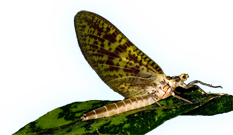
Mayfly Genus Leptophlebia (Black Quills and Blue Quills)


Taxonomic Navigation -?-
Kingdom
Animalia (Animals)
» Phylum
Arthropoda (Arthropods)
» Class
Insecta (Insects)
» Order
Ephemeroptera (Mayflies)
» Genus Leptophlebia (Black Quills and Blue Quills)
| Species in Leptophlebia |  |  |
| Leptophlebia cupidaBorcher Drake | 0 | 0 |
| Leptophlebia johnsoniBorcher Drake | 0 | 0 |
| Leptophlebia nebulosaBorcher Drake | 0 | 0 |
4 species aren't included.
Common Names


The information below was mostly discovered in Leptophlebia cupida, the most important species, but it is not known to differ in the others.
Where & When
Caucci and Nastasi in Hatches II tell an interesting story of their unsuccessful search for fishable populations of Leptophlebia nymphs. I have had better luck. They searched during the time when these nymphs are supposedly concentrated in schools in preparation for emergence; this may be exactly why they did not catch any. If the nymphs abandoned most of their habitat to gather in schools, they would be hard to find without some luck to stumble upon one of the schools. I have sampled good populations of Leptophlebia cupida from prime trout water during January and February, when they were more spread out.
Hatching Behavior
Time Of Day (?): Sporadic from midday through evening, usually peaking near midday
Water Temperature: 55°F and up
The duns usually emerge laboriously at the surface. Fred Arbona notes in Mayflies, the Angler, and the Trout that they swim to and from the surface for an hour before they emerge, a habit usually found in the Ephemerellidae family.Water Temperature: 55°F and up
Some authors report that they occasionally crawl out onto shore to emerge.
Spinner Behavior
Time Of Day: Afternoon and evening
Habitat: Medium to fast water
Most sources say the spinners lay their eggs over fast water, but I have watched them over smooth-water runs of medium current speed, too. The females rise and fall over the water to oviposit, dropping some eggs as they contact the surface at the bottom of each dive. As they fall they lock their wings in a V-shaped position and look like little airplanes dive-bombing the surface.Habitat: Medium to fast water
When they fall spent (Spent: The wing position of many aquatic insects when they fall on the water after mating. The wings of both sides lay flat on the water. The word may be used to describe insects with their wings in that position, as well as the position itself.) or get stuck on the surface during egg-laying, they are taken eagerly by trout. To my knowledge these spinner falls are never very intense, but they can get the trout rising. I have seen it on a little farmland brookie stream in Wisconsin.
Nymph Biology
Current Speed: Slow
Substrate: Silt, detritus (Detritus: Small, loose pieces of decaying organic matter underwater.), leaf drift (Leaf drift: The mass of dead leaves gathered on the bottom of the stream, sometimes stacked thick in still places like back eddies. Many aquatic invertebrates use the leaf drift for shelter and food. Most insects shred the leaves to digest the bacteria and plankton living on them, rather than digesting the leaves themselves.)
Although Leptophlebia cupida nymphs are universally described as slow-water dwellers, I have also found good concentrations in strong riffles. They probably reside in slow microhabitats near the bank and in pockets in these fast stretches of the river.Substrate: Silt, detritus (Detritus: Small, loose pieces of decaying organic matter underwater.), leaf drift (Leaf drift: The mass of dead leaves gathered on the bottom of the stream, sometimes stacked thick in still places like back eddies. Many aquatic invertebrates use the leaf drift for shelter and food. Most insects shred the leaves to digest the bacteria and plankton living on them, rather than digesting the leaves themselves.)
These nymphs are known for gathering in schools like little minnows and migrating for distances up to a mile through the slow shallows of a river before emerging. The word "migration" is overused in angling entomology books to describe the pre-emergence activities of many species, but this is one of the only mayflies for which the word is no exaggeration.
Some authors say that Leptophlebia nymphs are poor swimmers, but I have found the opposite. They are a notch slower than the true swimmer families, but they swim much faster and more gracefully than other crawlers or clingers like Ephemerellidae and Heptageniidae. If they were as slow as some suggest, their lengthy migrations would be difficult to believe.
Because the nymphs are especially tolerant of warm, slow-flowing water, they make excellent aquarium mayflies. They are good species to take to the science classroom, where they can survive in a goldfish bowl with a few leaves in it and are likely to emerge before the end of the spring term.
In the wild, the nymphs are mostly nocturnal.
Pictures of 20 Mayfly Specimens in the Genus Leptophlebia:
Male Leptophlebia cupida (Borcher Drake) Mayfly Dun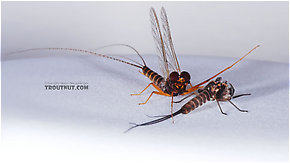 View 6 PicturesThis Leptophlebia cupida dun was extremely cooperative, and it molted into a spinner for me in front of the camera. Here I have a few dun pictures and one spinner picture, and I've put the entire molting sequence in an article.
View 6 PicturesThis Leptophlebia cupida dun was extremely cooperative, and it molted into a spinner for me in front of the camera. Here I have a few dun pictures and one spinner picture, and I've put the entire molting sequence in an article.Collected May 27, 2005 from the Teal River in Wisconsin
Added to Troutnut.com by Troutnut on May 16, 2006
Added to Troutnut.com by Troutnut on May 16, 2006
Leptophlebia cupida (Borcher Drake) Mayfly Nymph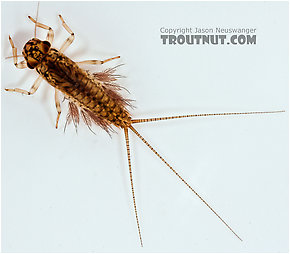 View 8 Pictures
View 8 PicturesCollected March 29, 2005 from Fall Creek in New York
Added to Troutnut.com by Troutnut on April 6, 2006
Added to Troutnut.com by Troutnut on April 6, 2006
Female Leptophlebia cupida (Borcher Drake) Mayfly Spinner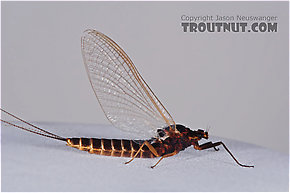 View 7 Pictures
View 7 PicturesCollected May 28, 2005 from the Namekagon River in Wisconsin
Added to Troutnut.com by Troutnut on May 24, 2006
Added to Troutnut.com by Troutnut on May 24, 2006
Recent Discussions of Leptophlebia
Steamntrout
Posted by Steamntrout on Jun 14, 2017 in the species Leptophlebia nebulosa
Looking at Purdue's May Fly Central it shows nebulosa being found in Canada's Far North, North East and North West as well as USA's North East, South East & Far West.
ReplySoutheast Mayflies 24 Replies »Posted by DarkDun on Nov 20, 2006 in the species Leptophlebia cupida
Last reply on Mar 4, 2007 by Taxon
This is one of the species that seem to be prevalent in our area of southwest NC. It emerges in March as I recall and again in October on certain streams. I would like to confirm that this next season.
ReplyYour Thoughts On Leptophlebia:
Top 10 Fly Hatches
 Baetis
 Baetidae
 Ephemerellidae
 Hexagenia limbata
 Chironomidae
 Heptageniidae
 Ephemerella subvaria
 Ephemerella
 Isonychia
 Hydropsychidae
Top Gift Shop Designs
 I outfish my daddy!
 Electric blue Hendrickson dun.
 I love buggers. Big, green, wooly ones.
 I outfish my husband!
 Be the trout.
 Eat mayflies.
Top Insect Specimens
 Baetisca obesa Mayfly Nymph
 Corydalus Hellgrammite Larva
 Neophylax Caddisfly Adult
 Pteronarcys biloba Stonefly Nymph
 Rhyacophila fuscula Caddisfly Larva
Miscellaneous Sites
Troutnut.com is copyright © 2004-2024 Jason
Neuswanger (email Jason). See my FAQ for information about use of my images.
 privacy policy
privacy policy