
Blog & Latest Updates
Fly Fishing Articles
Insects by Common Name


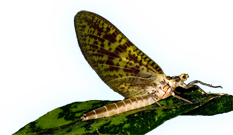
Mayfly Species Siphloplecton basale (Pseudo-Gray Drake)


Taxonomic Navigation -?-
Kingdom
Animalia (Animals)
» Phylum
Arthropoda (Arthropods)
» Class
Insecta (Insects)
» Order
Ephemeroptera (Mayflies)
» Family
Metretopodidae (Pseudo-Gray Drakes)
» Species basale (Pseudo-Gray Drake)
Common Names
| Match | Common Name |
 | Pseudo-Gray Drake |
 | Great Speckled Spinner |
| Great Speckled Olive Dun |
There are rumors of fishable Siphloplecton days, but I know none of the details. They might be locally important in places angler-entomologists have yet to visit in the prime months, an unsung local treasure like Baetisca laurentina.
Where & When
The Pseudo-Gray Drakes hatch around the time of the more important Hendricksons (Ephemeralla subvaria) in late April and early May. I've seen them in large and small streams in northwest Wisconsin. I've also seen some large drakes flying in the Delaware system of the Catskills which I suspect were of this species, but I could not collect a specimen in the deep water.
The Leonards write in Mayflies of Michigan Trout Streams that Siphloplecton basale inhabits strong currents in medium to large rivers, but I have found the nymphs in good numbers in a silty pool in the slow-flowing headwaters of a small stream.
The Leonards also say the species may emerge through mid-July, which conflicts with other authors and my own observations.
Hatching Behavior
This species emerges by crawling out onto shore, so the emerging duns are not important.
I once caught a dun drifting along on the surface, but it may have been blown in by the wind.
Spinner Behavior
Time Of Day: Evening
Habitat: Riffles
The females may drop their eggs from high above the water or land and rest of the surface to oviposit. They are a common sight in small numbers for a couple weeks on any given stretch.Habitat: Riffles
The spinners are unusualy elegant gray and black mayflies.
Nymph Biology
Current Speed: Slow
Substrate: Gravel, weeds
Siphloplecton nymphs are extremely fast swimmers, every bit the equals of Isonychia. They may be mistaken for Siphlonurus nymphs at first glance, but they are larger, slightly thicker, and they have two claws on the front tarsus (Substrate: Gravel, weeds
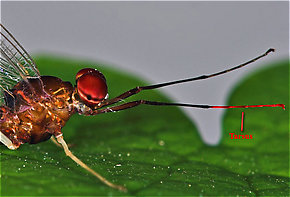
The tarsus of this Isonychia bicolor mayfly spinner is highlighted in red.
I have not found a reference regarding their environmental tolerance, but in my studio they were much more sensitive to warm water than any other species, dying almost instantly in little photo stage tanks warmed by incandescent lights. That's one of many reasons why I switched to using a flash.
Pictures of 9 Mayfly Specimens in the Species Siphloplecton basale:
Male Siphloplecton basale (Pseudo-Gray Drake) Mayfly Spinner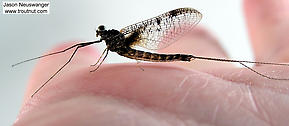 View 6 PicturesI went to great comical lengths to swipe this spinner from the air with a little aquarium net I carry with me while I'm fishing. Siphloplecton basale spinners fly fast and high over the riffles, and there are never very many of them, so they're difficult to catch.
View 6 PicturesI went to great comical lengths to swipe this spinner from the air with a little aquarium net I carry with me while I'm fishing. Siphloplecton basale spinners fly fast and high over the riffles, and there are never very many of them, so they're difficult to catch.Collected May 8, 2004 from the Namekagon River in Wisconsin
Added to Troutnut.com by Troutnut on January 25, 2006
Added to Troutnut.com by Troutnut on January 25, 2006
Male Siphloplecton basale (Pseudo-Gray Drake) Mayfly Dun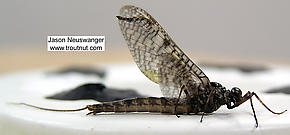 View 5 PicturesThis one hatched on the same April Saturday that I saw the first Hendricksons of the season.
View 5 PicturesThis one hatched on the same April Saturday that I saw the first Hendricksons of the season.Collected April 24, 2004 from the Namekagon River in Wisconsin
Added to Troutnut.com by Troutnut on January 25, 2006
Added to Troutnut.com by Troutnut on January 25, 2006
Siphloplecton basale (Pseudo-Gray Drake) Mayfly Nymph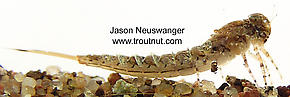 View 4 PicturesThis nymph has double front tarsal claws (Tarsal claw: The claws at the tip of the tarsus, on an insect's "foot.") and double gills on the first three abdominal segments.
View 4 PicturesThis nymph has double front tarsal claws (Tarsal claw: The claws at the tip of the tarsus, on an insect's "foot.") and double gills on the first three abdominal segments.Collected March 1, 2004 from unknown in Wisconsin
Added to Troutnut.com by Troutnut on January 25, 2006
Added to Troutnut.com by Troutnut on January 25, 2006
Recent Discussions of Siphloplecton basale
S. basale on Clarks Creek, PA 1 Reply »
Posted by Wiconisco37 on Feb 4, 2009
Last reply on Jun 10, 2009 by Martinlf
they were discovered on Clarks Creek by a man from halifax, PA
i dont know what their numbers were like thgough
Replyi dont know what their numbers were like thgough
Your Thoughts On Siphloplecton basale:
Jargon Defined:
Duns: Mayflies have two adult stages. They first emerge from the water as duns (scientifically known as the subimago stage). They then molt into the spinner (imago) stage, in which they mate and die. Sometimes the word "dun" is confusingly used to refer to a brownish gray color in fly tying materials.
Nymphs: The juvenile, underwater stages of mayflies, stoneflies, dragonflies, and damselflies and other aquatic insects whose juvenile stages are covered by hard exoskeletons. The word can also refer to the fishing flies which imitate these creatures, in which case it is used as a blanket term for flies imitating any underwater stage of an invertebrate (except for crayfish and leeches).
Oviposit: To lay eggs.
Spinner: There are two winged stages of adult mayflies. They emerge from the water as duns, molt on land (usually) into their fully mature stage, spinners. As spinners, they mate, lay eggs, and die.
Tarsal claws: The claws at the tip of the tarsus, on an insect's "foot."
The tarsus of this Isonychia bicolor mayfly spinner is highlighted in red.
Useful References:
Caucci, Al and Nastasi, Bob. 2004. Hatches II. The Lyons Press.
Knopp, Malcolm and Robert Cormier. 1997. Mayflies: An Angler's Study of Trout Water Ephemeroptera . The Lyons Press.
Leonard, Justin W. and Fannie A. Leonard. 1962. Mayflies of Michigan Trout Streams. Cranbrook Institute of Science.
Top 10 Fly Hatches
 Baetis
 Baetidae
 Ephemerellidae
 Hexagenia limbata
 Chironomidae
 Ephemerella subvaria
 Heptageniidae
 Ephemerella
 Isonychia
 Hydropsychidae
Top Gift Shop Designs
 I outfish my daddy!
 Electric blue Hendrickson dun.
 I love buggers. Big, green, wooly ones.
 I outfish my husband!
 Be the trout.
 Eat mayflies.
Top Insect Specimens
 Baetisca obesa Mayfly Nymph
 Corydalus Hellgrammite Larva
 Neophylax Caddisfly Adult
 Pteronarcys biloba Stonefly Nymph
 Hydropsyche aenigma Caddisfly Adult
Miscellaneous Sites
Troutnut.com is copyright © 2004-2024 Jason
Neuswanger (email Jason). See my FAQ for information about use of my images.
 privacy policy
privacy policy