
Blog & Latest Updates
Fly Fishing Articles
Insects by Common Name


Mayfly Family Heptageniidae (March Browns, Cahills, Quill Gordons)


Taxonomic Navigation -?-
Kingdom
Animalia (Animals)
» Phylum
Arthropoda (Arthropods)
» Class
Insecta (Insects)
» Order
Ephemeroptera (Mayflies)
» Family Heptageniidae (March Browns, Cahills, Quill Gordons)


4 genera aren't included.
Common Name
| Match | Common Name |
 | March Browns, Cahills, Quill Gordons |
This is page 4 of specimens of Heptageniidae. Visit the main Heptageniidae page for:
- The behavior and habitat of Heptageniidae.
- 11 underwater pictures of Heptageniidae.
Pictures of 215 Mayfly Specimens in the Family Heptageniidae:
Female Maccaffertium vicarium (March Brown) Mayfly Spinner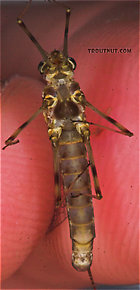 View 7 PicturesI collected this mayfly on the same trip as a male of the same species. They are Maccaffertium vicarium mayflies of the type formerly known as Stenonema fuscom, the "Gray Fox."
View 7 PicturesI collected this mayfly on the same trip as a male of the same species. They are Maccaffertium vicarium mayflies of the type formerly known as Stenonema fuscom, the "Gray Fox."Collected May 28, 2005 from the Namekagon River in Wisconsin
Added to Troutnut.com by Troutnut on May 24, 2006
Added to Troutnut.com by Troutnut on May 24, 2006
Heptagenia pulla (Golden Dun) Mayfly Nymph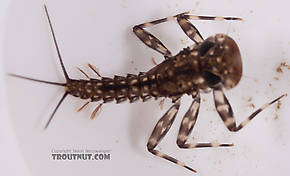 View 8 PicturesLike most Alaskan mayflies, this one is tricky to identify to the species level. See the discussion section for an informative chat about this one's ID. The current leaning is to call it a fairly immature Heptagenia pulla nymph, but a case has been made for Heptagenia elegantula as well.
View 8 PicturesLike most Alaskan mayflies, this one is tricky to identify to the species level. See the discussion section for an informative chat about this one's ID. The current leaning is to call it a fairly immature Heptagenia pulla nymph, but a case has been made for Heptagenia elegantula as well.Female Epeorus (Little Maryatts) Mayfly Dun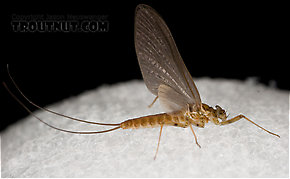 View 7 PicturesThis dun comes from the same location, and is about the same size, so is presumably the same species as this male spinner.
View 7 PicturesThis dun comes from the same location, and is about the same size, so is presumably the same species as this male spinner.Collected May 15, 2007 from Enfield Creek in Treman Park in New York
Added to Troutnut.com by Troutnut on May 18, 2007
Added to Troutnut.com by Troutnut on May 18, 2007
Female Leucrocuta hebe (Little Yellow Quill) Mayfly Dun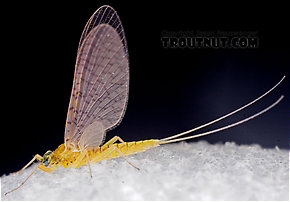 View 9 PicturesI found this dun on the same piece of stream as a similar spinner, probably of the same species.
View 9 PicturesI found this dun on the same piece of stream as a similar spinner, probably of the same species.Collected September 19, 2006 from Mystery Creek #43 in New York
Added to Troutnut.com by Troutnut on October 4, 2006
Added to Troutnut.com by Troutnut on October 4, 2006
Female Epeorus vitreus (Sulphur) Mayfly Spinner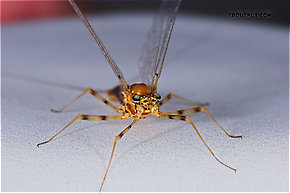 View 7 Pictures
View 7 PicturesCollected June 2, 2005 from the Namekagon River in Wisconsin
Added to Troutnut.com by Troutnut on May 24, 2006
Added to Troutnut.com by Troutnut on May 24, 2006
Female Epeorus vitreus (Sulphur) Mayfly Spinner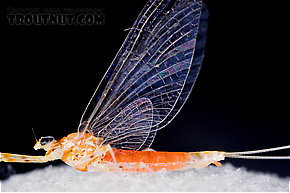 View 9 Pictures
View 9 PicturesCollected September 19, 2006 from Mystery Creek #43 in New York
Added to Troutnut.com by Troutnut on October 4, 2006
Added to Troutnut.com by Troutnut on October 4, 2006
Stenacron interpunctatum (Light Cahill) Mayfly Nymph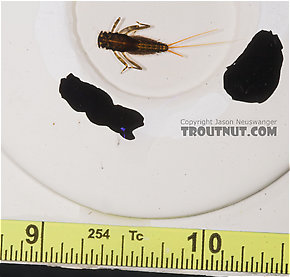 View 7 Pictures
View 7 PicturesCollected June 5, 2005 from the Marengo River in Wisconsin
Added to Troutnut.com by Troutnut on May 25, 2006
Added to Troutnut.com by Troutnut on May 25, 2006
Male Epeorus frisoni Mayfly Dun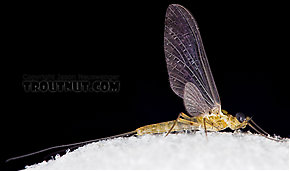 View 9 PicturesI collected this male dun together with a female spinner, a female dun, and another male dun.
View 9 PicturesI collected this male dun together with a female spinner, a female dun, and another male dun.Collected September 6, 2006 from Mystery Creek #23 in New York
Added to Troutnut.com by Troutnut on October 3, 2006
Added to Troutnut.com by Troutnut on October 3, 2006
Stenonema femoratum (Cream Cahill) Mayfly Nymph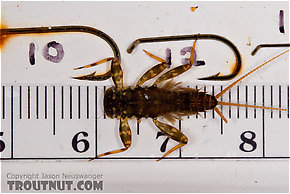 View 6 Pictures
View 6 PicturesCollected May 6, 2007 from Mongaup Creek in New York
Added to Troutnut.com by Troutnut on May 18, 2007
Added to Troutnut.com by Troutnut on May 18, 2007
Rhithrogena impersonata (Dark Red Quill) Mayfly Nymph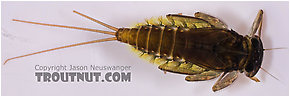 View 6 PicturesThis was the only Rhithrogena specimen in a large sample of nymphs from a small Catskill stream. It looks virtually identical to Rhithrogena impersonata specimens collected in the Midwest, but I didn't get to check the distinguishing features under a microscope.
View 6 PicturesThis was the only Rhithrogena specimen in a large sample of nymphs from a small Catskill stream. It looks virtually identical to Rhithrogena impersonata specimens collected in the Midwest, but I didn't get to check the distinguishing features under a microscope.Collected April 19, 2006 from Mongaup Creek in New York
Added to Troutnut.com by Troutnut on April 21, 2006
Added to Troutnut.com by Troutnut on April 21, 2006
Top 10 Fly Hatches
 Baetis
 Baetidae
 Ephemerellidae
 Hexagenia limbata
 Chironomidae
 Heptageniidae
 Ephemerella subvaria
 Ephemerella
 Isonychia
 Hydropsychidae
Top Gift Shop Designs
 I outfish my daddy!
 Electric blue Hendrickson dun.
 I love buggers. Big, green, wooly ones.
 I outfish my husband!
 Be the trout.
 Eat mayflies.
Top Insect Specimens
 Baetisca obesa Mayfly Nymph
 Corydalus Hellgrammite Larva
 Neophylax Caddisfly Adult
 Rhyacophila fuscula Caddisfly Larva
 Pteronarcys biloba Stonefly Nymph
Miscellaneous Sites
Troutnut.com is copyright © 2004-2024 Jason
Neuswanger (email Jason). See my FAQ for information about use of my images.
 privacy policy
privacy policy