
Blog & Latest Updates
Fly Fishing Articles
Insects by Common Name


Caddisfly Family Hydropsychidae


Taxonomic Navigation -?-
Kingdom
Animalia (Animals)
» Phylum
Arthropoda (Arthropods)
» Class
Insecta (Insects)
» Order
Trichoptera (Caddisflies)
» Family Hydropsychidae


5 genera aren't included.
This is page 2 of specimens of Hydropsychidae. Visit the main Hydropsychidae page for:
- The behavior and habitat of Hydropsychidae.
- 1 underwater picture of Hydropsychidae.
Pictures of 28 Caddisfly Specimens in the Family Hydropsychidae:
Cheumatopsyche (Little Sister Sedges) Caddisfly Adult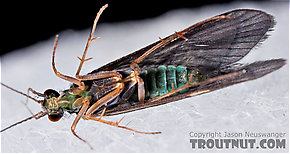 View 9 Pictures
View 9 PicturesCollected September 19, 2006 from Mystery Creek #43 in New York
Added to Troutnut.com by Troutnut on October 4, 2006
Added to Troutnut.com by Troutnut on October 4, 2006
Female Hydropsyche (Spotted Sedges) Caddisfly Adult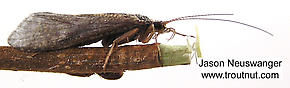 View 4 Pictures
View 4 PicturesCollected May 16, 2004 from unknown in Wisconsin
Added to Troutnut.com by Troutnut on January 25, 2006
Added to Troutnut.com by Troutnut on January 25, 2006
Hydropsyche californica (Spotted Sedge) Caddisfly Larva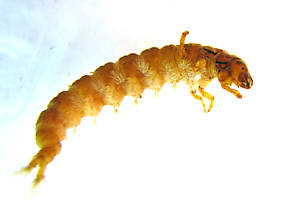 View 5 PicturesSize - 14 mm
Condition - preserved
Habitat - cobble bottom, moderate flow run, at a depth of approx. 1 1/2 feet.
Key Characters - pair of large prosternal sclerites (Sclerite: A hard plate of chitinous material, such as those that form the exoskeletons of arthropods, uninterrupted by cracks or sutures.)
This is a very common taxon at this location. I collected using a kick net. In life, it is bright olive green ventrally, shading to a dull olive at its dorsal (Dorsal: Top.) abdominal surfaces. In the hand, the legs, thoraxic regions, and head appear medium chocolate brown. The stark contrast of the thoraxic plate's dark edges and light legs are effects of preserving. The plumouse anal hooks were duck down gray, not the color of the gills as appears in the preserved specimen.
The Lower Yuba River is a good habitat for this species, being a larger river with an open canopy. The Feather River just to the north of the Yuba system also finds H. californica in abundance. The other common Hydropsyche species in the area, Hydropsyche occidentalis, seems to prefer smaller, shaded streams.
Entoman
View 5 PicturesSize - 14 mmCondition - preserved
Habitat - cobble bottom, moderate flow run, at a depth of approx. 1 1/2 feet.
Key Characters - pair of large prosternal sclerites (Sclerite: A hard plate of chitinous material, such as those that form the exoskeletons of arthropods, uninterrupted by cracks or sutures.)
This is a very common taxon at this location. I collected using a kick net. In life, it is bright olive green ventrally, shading to a dull olive at its dorsal (Dorsal: Top.) abdominal surfaces. In the hand, the legs, thoraxic regions, and head appear medium chocolate brown. The stark contrast of the thoraxic plate's dark edges and light legs are effects of preserving. The plumouse anal hooks were duck down gray, not the color of the gills as appears in the preserved specimen.
The Lower Yuba River is a good habitat for this species, being a larger river with an open canopy. The Feather River just to the north of the Yuba system also finds H. californica in abundance. The other common Hydropsyche species in the area, Hydropsyche occidentalis, seems to prefer smaller, shaded streams.
Entoman
Collected March 9, 2011 from the Lower Yuba River in California
Added to Troutnut.com by Entoman on November 2, 2011
Added to Troutnut.com by Entoman on November 2, 2011
Cheumatopsyche (Little Sister Sedges) Caddisfly Pupa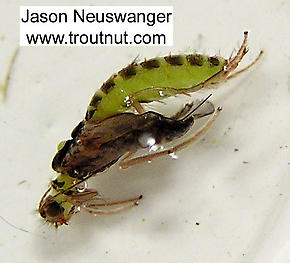 View 3 PicturesI photographed this one recently dead. It's hard to keep caddis pupae alive for very long in a collection container.
View 3 PicturesI photographed this one recently dead. It's hard to keep caddis pupae alive for very long in a collection container.Collected May 18, 2004 from the Namekagon River in Wisconsin
Added to Troutnut.com by Troutnut on January 25, 2006
Added to Troutnut.com by Troutnut on January 25, 2006
Hydropsychidae Caddisfly Larva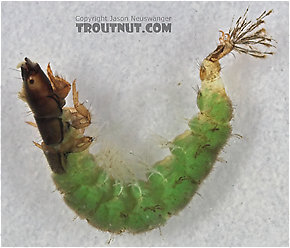 View 2 Pictures
View 2 PicturesCollected March 13, 2005 from Cascadilla Creek in New York
Added to Troutnut.com by Troutnut on April 5, 2006
Added to Troutnut.com by Troutnut on April 5, 2006
Hydropsychidae Caddisfly Larva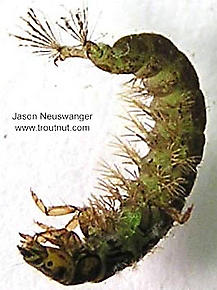 View 4 Pictures
View 4 PicturesCollected January 14, 2004 from unknown in Wisconsin
Added to Troutnut.com by Troutnut on January 25, 2006
Added to Troutnut.com by Troutnut on January 25, 2006
Hydropsyche (Spotted Sedges) Caddisfly Larva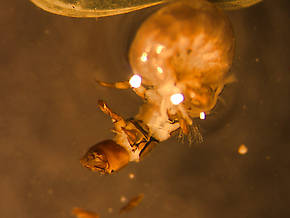 View 1 PicturesThis genus can get incredibly abundant especially below dams.This specimen shows the two sclerotized bars needed to identify it to genus. These usually curl up like this one when preserved.
View 1 PicturesThis genus can get incredibly abundant especially below dams.This specimen shows the two sclerotized bars needed to identify it to genus. These usually curl up like this one when preserved.Collected June 12, 2007 from the Flathead River-lower in Montana
Added to Troutnut.com by Bnewell on June 26, 2011
Added to Troutnut.com by Bnewell on June 26, 2011
Hydropsychidae Caddisfly Larva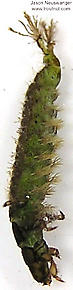 View 2 Pictures
View 2 PicturesCollected February 7, 2004 from unknown in Wisconsin
Added to Troutnut.com by Troutnut on January 25, 2006
Added to Troutnut.com by Troutnut on January 25, 2006
Hydropsyche (Spotted Sedges) Caddisfly Adult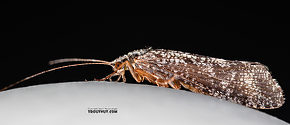 View 11 PicturesI haven't keyed this specimen out, but I am instead placing it in Hydropsyche based on the striking visual similarity to this one, which I did key out.
View 11 PicturesI haven't keyed this specimen out, but I am instead placing it in Hydropsyche based on the striking visual similarity to this one, which I did key out.Collected June 30, 2019 from the Madison River in Montana
Added to Troutnut.com by Troutnut on July 17, 2019
Added to Troutnut.com by Troutnut on July 17, 2019
Male Cheumatopsyche (Little Sister Sedges) Caddisfly Adult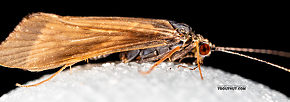 View 12 PicturesI didn't identify this one directly, but I eventually identified one of several I collected from the same swarms that appeared to be of the same species. (I lost track of which specimen was which in storage.) The microscope pictures come from one of these specimen, not necessarily the same specimen as the DSLR pictures. They key to Cheumatopsyche, and the hind wing venation (Venation: The pattern in which the veins on the wings of an insect are arranged. It is usually one of the most useful identifying characteristics.) that separates them from Hydropsyche is pretty clear in the attached picture as well as another specimen I checked under the scope.
This specimen was one of tens of thousands we saw on a July 1st evening on the Madison, beginning with big swarms around every vehicle and tree at the Eight Mile Ford access point and continuing all up and down the river bank. We somehow didn't catch any trout, perhaps because they were stuffed with pupae from when these things emerged. Or maybe we just weren't fishing well. Either way, this one represents a major hatch there.
I somehow forgot to photograph this important specimen against the hooks size chart, but fortunately I preserved a few. The body length is about 6 mm, and total length from head to wingtip is 9 mm.
View 12 PicturesI didn't identify this one directly, but I eventually identified one of several I collected from the same swarms that appeared to be of the same species. (I lost track of which specimen was which in storage.) The microscope pictures come from one of these specimen, not necessarily the same specimen as the DSLR pictures. They key to Cheumatopsyche, and the hind wing venation (Venation: The pattern in which the veins on the wings of an insect are arranged. It is usually one of the most useful identifying characteristics.) that separates them from Hydropsyche is pretty clear in the attached picture as well as another specimen I checked under the scope. This specimen was one of tens of thousands we saw on a July 1st evening on the Madison, beginning with big swarms around every vehicle and tree at the Eight Mile Ford access point and continuing all up and down the river bank. We somehow didn't catch any trout, perhaps because they were stuffed with pupae from when these things emerged. Or maybe we just weren't fishing well. Either way, this one represents a major hatch there.
I somehow forgot to photograph this important specimen against the hooks size chart, but fortunately I preserved a few. The body length is about 6 mm, and total length from head to wingtip is 9 mm.
Collected July 1, 2019 from the Madison River in Montana
Added to Troutnut.com by Troutnut on July 18, 2019
Added to Troutnut.com by Troutnut on July 18, 2019
Top 10 Fly Hatches
 Baetis
 Baetidae
 Ephemerellidae
 Hexagenia limbata
 Chironomidae
 Ephemerella subvaria
 Heptageniidae
 Ephemerella
 Isonychia
 Hydropsychidae
Top Gift Shop Designs
 I outfish my daddy!
 Electric blue Hendrickson dun.
 I love buggers. Big, green, wooly ones.
 I outfish my husband!
 Be the trout.
 Eat mayflies.
Top Insect Specimens
 Baetisca obesa Mayfly Nymph
 Corydalus Hellgrammite Larva
 Neophylax Caddisfly Adult
 Pteronarcys biloba Stonefly Nymph
 Hydropsyche aenigma Caddisfly Adult
Miscellaneous Sites
Troutnut.com is copyright © 2004-2024 Jason
Neuswanger (email Jason). See my FAQ for information about use of my images.
 privacy policy
privacy policy