
Blog & Latest Updates
Fly Fishing Articles
Insects by Common Name

Animal Kingdom Animalia (Animals)


Taxonomic Navigation -?-
Kingdom Animalia (Animals)
| Phylum in Animalia |  |  |
| AnnelidaWorms and Leeches | 0 | 2 |
| ArthropodaArthropods | 0 | 122 |
| ChordataVertebrates | 0 | 4 |
| Mollusca | 0 | 6 |
| PlatyhelminthesFlatworms | 0 | 0 |
Common Name
| Match | Common Name |
 | Animals |
This is page 3 of specimens of Animalia. Visit the main Animalia page for:
- The behavior and habitat of Animalia.
- 131 underwater pictures of Animalia.
Pictures of 1264 Animal Specimens:
Isogenoides hansoni (Appalachian Springfly) Stonefly Nymph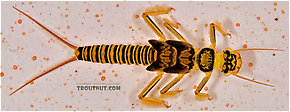 View 11 PicturesThis large Perlodidae stonefly was a strikingly bright yellow color, more so than any other insect I've seen. I didn't enhance it much. See the discussion threads to follow how we identified this specimen, which was listed incorrectly for several years.
View 11 PicturesThis large Perlodidae stonefly was a strikingly bright yellow color, more so than any other insect I've seen. I didn't enhance it much. See the discussion threads to follow how we identified this specimen, which was listed incorrectly for several years.Collected April 19, 2006 from Mongaup Creek in New York
Added to Troutnut.com by Troutnut on April 21, 2006
Added to Troutnut.com by Troutnut on April 21, 2006
Male Ephemerella subvaria (Hendrickson) Mayfly Dun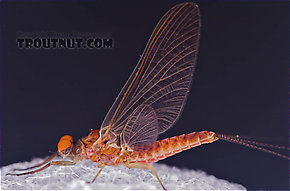 View 9 PicturesI collected this male Hendrickson dun and a female in the pool on the Beaverkill where the popular Hendrickson pattern was first created. He is descended from mayfly royalty.
View 9 PicturesI collected this male Hendrickson dun and a female in the pool on the Beaverkill where the popular Hendrickson pattern was first created. He is descended from mayfly royalty.Collected April 19, 2006 from the Beaverkill River in New York
Added to Troutnut.com by Troutnut on April 22, 2006
Added to Troutnut.com by Troutnut on April 22, 2006
Male Ephemerella aurivillii Mayfly Spinner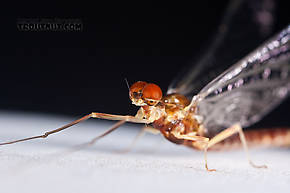 View 15 PicturesThis spinner molted from a dun after being photographed, and the dun form is listed here as a separate specimen. I've rarely found a more cooperative and photogenic mayfly.
View 15 PicturesThis spinner molted from a dun after being photographed, and the dun form is listed here as a separate specimen. I've rarely found a more cooperative and photogenic mayfly.Female Maccaffertium (March Browns and Cahills) Mayfly Adult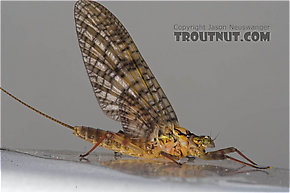 View 13 Pictures
View 13 PicturesCollected May 26, 2005 from the Namekagon River in Wisconsin
Added to Troutnut.com by Troutnut on May 16, 2006
Added to Troutnut.com by Troutnut on May 16, 2006
Belostoma flumineum (Electric Light Bug) Giant Water Bug Adult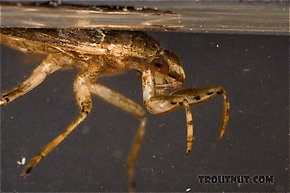 View 13 PicturesI'm glad I finally got one of these Belostoma water bugs under my good camera. I had been hoping to get one in my kick-net samples for a while with no luck, but I ended up finding this one drifting midstream just below the surface while I fished. I have frequently seen water scorpions do that, too, and I'm beginning to suspect that is a common situation travel for these large Hemiptera bugs, and perhaps the way trout are used to seeing them.
View 13 PicturesI'm glad I finally got one of these Belostoma water bugs under my good camera. I had been hoping to get one in my kick-net samples for a while with no luck, but I ended up finding this one drifting midstream just below the surface while I fished. I have frequently seen water scorpions do that, too, and I'm beginning to suspect that is a common situation travel for these large Hemiptera bugs, and perhaps the way trout are used to seeing them.Collected April 24, 2007 from the West Branch of Owego Creek in New York
Added to Troutnut.com by Troutnut on April 24, 2007
Added to Troutnut.com by Troutnut on April 24, 2007
Baetis (Blue-Winged Olives) Mayfly Nymph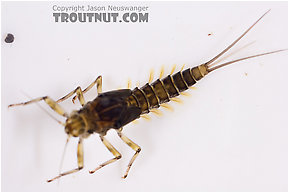 View 10 Pictures
View 10 PicturesCollected May 6, 2007 from Mongaup Creek in New York
Added to Troutnut.com by Troutnut on May 18, 2007
Added to Troutnut.com by Troutnut on May 18, 2007
Male Hexagenia limbata (Hex) Mayfly Spinner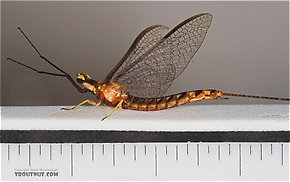 View 13 Pictures
View 13 PicturesCollected June 26, 2005 from Atkins Lake in Wisconsin
Added to Troutnut.com by Troutnut on May 26, 2006
Added to Troutnut.com by Troutnut on May 26, 2006
Nigronia serricornis (Fishfly) Hellgrammite Larva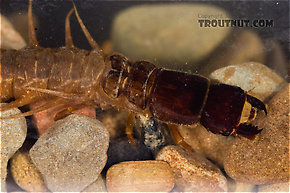 View 13 Pictures
View 13 PicturesCollected April 24, 2007 from Factory Brook in New York
Added to Troutnut.com by Troutnut on April 24, 2007
Added to Troutnut.com by Troutnut on April 24, 2007
Female Drunella tuberculata Mayfly Dun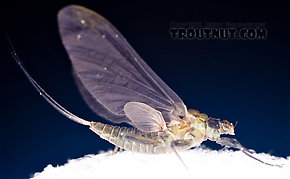 View 14 PicturesI don't know for sure that this is Drunella tuberculata, but that's my best guess for now.
It certainly has a different look and much more robust body shape from Drunella lata duns I photographed a couple weeks earlier, so I doubt it's that species. Using distribution records to eliminate other choices narrows this down to Drunella tuberculata or Drunella walkeri.
Markings described for the abdominal sternites (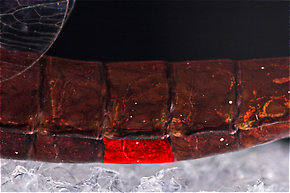 Sternite: The bottom (ventral) part of a single segment on an insect's abdomen.) of the male spinner of Drunella tuberculata are suspiciously similar to those on this female dun. Also, this dun is 9.5mm long (my ruler pic isn't very good, but I'm basing this on measuring the real thing). The size range given in the old Allen & Edmunds keys for walkeri females is 7-8mm, while tuberculata is 9-11mm. For these reasons I'm sticking it in tuberculata for now.
This is the only Drunella mayfly I saw all day. I scooped it off the water as it emerged at around 7pm from a big Catskill tailwater.
View 14 PicturesI don't know for sure that this is Drunella tuberculata, but that's my best guess for now. It certainly has a different look and much more robust body shape from Drunella lata duns I photographed a couple weeks earlier, so I doubt it's that species. Using distribution records to eliminate other choices narrows this down to Drunella tuberculata or Drunella walkeri.
Markings described for the abdominal sternites (
One sternite of this Isonychia bicolor mayfly spinner is highlighted in red.
This is the only Drunella mayfly I saw all day. I scooped it off the water as it emerged at around 7pm from a big Catskill tailwater.
Collected June 1, 2007 from the West Branch of the Delaware River in New York
Added to Troutnut.com by Troutnut on June 8, 2007
Added to Troutnut.com by Troutnut on June 8, 2007
Female Isonychia bicolor (Mahogany Dun) Mayfly Dun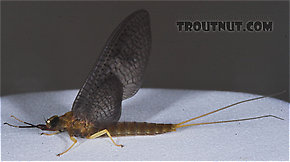 View 13 Pictures
View 13 PicturesCollected June 14, 2005 from the Namekagon River in Wisconsin
Added to Troutnut.com by Troutnut on May 26, 2006
Added to Troutnut.com by Troutnut on May 26, 2006
Jargon Defined:
Dun: Mayflies have two adult stages. They first emerge from the water as duns (scientifically known as the subimago stage). They then molt into the spinner (imago) stage, in which they mate and die. Sometimes the word "dun" is confusingly used to refer to a brownish gray color in fly tying materials.
Spinner: There are two winged stages of adult mayflies. They emerge from the water as duns, molt on land (usually) into their fully mature stage, spinners. As spinners, they mate, lay eggs, and die.
One sternite of this Isonychia bicolor mayfly spinner is highlighted in red.
Top 10 Fly Hatches
 Baetis
 Baetidae
 Ephemerellidae
 Hexagenia limbata
 Chironomidae
 Heptageniidae
 Ephemerella subvaria
 Ephemerella
 Isonychia
 Hydropsychidae
Top Gift Shop Designs
 I outfish my daddy!
 Electric blue Hendrickson dun.
 I love buggers. Big, green, wooly ones.
 I outfish my husband!
 Be the trout.
 Eat mayflies.
Top Insect Specimens
 Baetisca obesa Mayfly Nymph
 Corydalus Hellgrammite Larva
 Neophylax Caddisfly Adult
 Rhyacophila fuscula Caddisfly Larva
 Pteronarcys biloba Stonefly Nymph
Miscellaneous Sites
Troutnut.com is copyright © 2004-2024 Jason
Neuswanger (email Jason). See my FAQ for information about use of my images.
 privacy policy
privacy policy