
Blog & Latest Updates
Fly Fishing Articles
Insects by Common Name


Dark Red Quills


Scientific Names


Like most common names, "Dark Red Quill" can refer to more than one taxon. They're previewed below, along with 12 specimens. For more detail click through to the scientific names.
Mayfly Genus Cinygmula
These are often called Dark Red Quills.
This is primarily a Western genus. Cinygmula ramaleyi is the most important species, producing good hatches in the West. Cinygmula reticulata may also be relevant, and I have seen a great spinner swarm from an unsung species, Cinygmula par, in the Washington Cascades.
There is only one Eastern species, Cinygmula subaequalis, and its importance is minor.
There is only one Eastern species, Cinygmula subaequalis, and its importance is minor.
Cinygmula subaequalis (Small Gordon Quill) Mayfly Nymph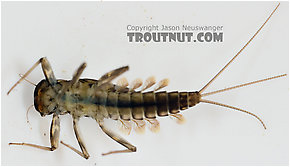 View 10 PicturesThis nymph is missing a few gills, but is otherwise in good shape. It was the only one of its species which turned up in my sample.
View 10 PicturesThis nymph is missing a few gills, but is otherwise in good shape. It was the only one of its species which turned up in my sample.Female Cinygmula ramaleyi (Small Western Gordon Quill) Mayfly Dun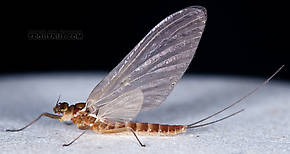 View 7 PicturesThis dun is almost certainly of the same species as this nymph, as it hatched in my cooler from a nearly identical nymph.
View 7 PicturesThis dun is almost certainly of the same species as this nymph, as it hatched in my cooler from a nearly identical nymph.Male Cinygmula (Dark Red Quills) Mayfly Spinner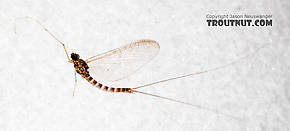 View 11 PicturesI'm unsure of the ID on this one; keys put it closest to Cinygmula reticulata, but I'm very doubtful of the species and not positive on the genus. Epeorus is another possibility, but I don't know which species it would be.
This one was collected in association with a female dun probably of the same species.
View 11 PicturesI'm unsure of the ID on this one; keys put it closest to Cinygmula reticulata, but I'm very doubtful of the species and not positive on the genus. Epeorus is another possibility, but I don't know which species it would be.This one was collected in association with a female dun probably of the same species.
Male Cinygmula ramaleyi (Small Western Gordon Quill) Mayfly Adult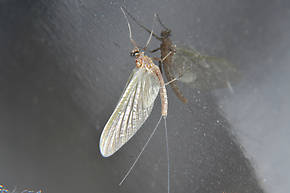 View 4 PicturesAdults were collected from the North Fork of the Touchet River at Touchet Corral, 21 Sept. One photo is the swarm of males over the stream about 3 PM, air temp about 66 degree.
View 4 PicturesAdults were collected from the North Fork of the Touchet River at Touchet Corral, 21 Sept. One photo is the swarm of males over the stream about 3 PM, air temp about 66 degree.See 31 more specimens...
Mayfly Species Rhithrogena impersonata
These are sometimes called Dark Red Quills.
This intriguing species has two distinct colors of nymphs, which were once considered to be different species. Most nymphs are a dark olive gray, but some are a surprisingly bright reddish brown. The red ones were once classified as Rhithrogena sanguinea. There is no apparent difference between the adults of the two varieties.
Rhithrogena impersonata (Dark Red Quill) Mayfly Nymph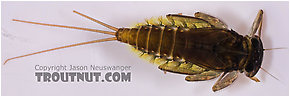 View 6 PicturesThis was the only Rhithrogena specimen in a large sample of nymphs from a small Catskill stream. It looks virtually identical to Rhithrogena impersonata specimens collected in the Midwest, but I didn't get to check the distinguishing features under a microscope.
View 6 PicturesThis was the only Rhithrogena specimen in a large sample of nymphs from a small Catskill stream. It looks virtually identical to Rhithrogena impersonata specimens collected in the Midwest, but I didn't get to check the distinguishing features under a microscope.See 2 more specimens...
Mayfly Species Rhithrogena jejuna
These are sometimes called Dark Red Quills.
Mayfly Species Attenella attenuata
These are very rarely called Dark Red Quills.
This intriguing species has received a lot of attention in past angling books. Recent authors suspect that much of this credit was a case of mistaken identity, with Attenella attenuata receiving praise for the hatches of Drunella lata and Dannella simplex. Much of the credit was legitimate and accurate, but this species is no longer thought to be on par with its most popular cousins in Ephemerella and Drunella.
I have several specimens listed under this species, but I'm not positive the identification is correct.
I have several specimens listed under this species, but I'm not positive the identification is correct.
Female Attenella attenuata (Small Eastern Blue-Winged Olive) Mayfly Dun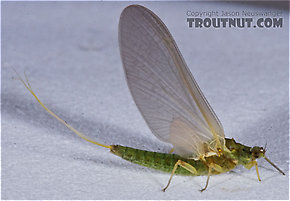 View 4 PicturesThis specimen came from the same hatch as a male.
View 4 PicturesThis specimen came from the same hatch as a male.See 2 more specimens...
Mayfly Species Isonychia bicolor
These are very rarely called Dark Red Quills.
This is by far the most important species of Isonychia. Many angling books once split its credit with the species Isonychia sadleri and Isonychia harperi, but entomologists have since discovered that those are just variations of this abundant species.
See the main Isonychia page for more about these intriguing mayflies.
See the main Isonychia page for more about these intriguing mayflies.
Isonychia bicolor (Mahogany Dun) Mayfly Nymph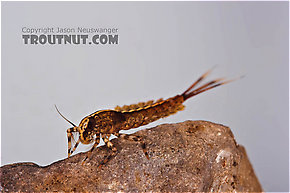 View 7 PicturesThis Isonychia bicolor nymph from the Catskills displays the prominent white stripe sometimes characteristic of its species. This is the first such specimen I've photographed, because members of the same species in the Upper Midwest have a more subdued stripe (and were once thought to be a different species, Isonychia sadleri). The striking coloration on this eastern nymph is more appealing.
View 7 PicturesThis Isonychia bicolor nymph from the Catskills displays the prominent white stripe sometimes characteristic of its species. This is the first such specimen I've photographed, because members of the same species in the Upper Midwest have a more subdued stripe (and were once thought to be a different species, Isonychia sadleri). The striking coloration on this eastern nymph is more appealing.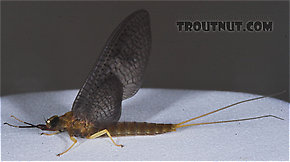
Male Isonychia bicolor (Mahogany Dun) Mayfly Spinner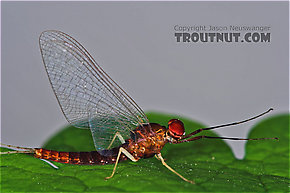 View 15 PicturesI got several really nice pictures of this spinner. I also collected a female on the same trip.
View 15 PicturesI got several really nice pictures of this spinner. I also collected a female on the same trip.See 16 more specimens...
Mayfly Species Cinygmula ramaleyi
These are very rarely called Dark Red Quills.
This can be the first mayfly of the season on high mountain streams in the western states, but emerges later in the season in Alaska. It is the most important species of Cinygmula for anglers.
Cinygmula ramaleyi (Small Western Gordon Quill) Mayfly Nymph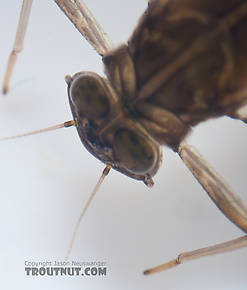 View 9 PicturesThis nymph is almost definitely the same species as this dun, which hatched from a nearly identical nymph from the same collection.
View 9 PicturesThis nymph is almost definitely the same species as this dun, which hatched from a nearly identical nymph from the same collection.Female Cinygmula ramaleyi (Small Western Gordon Quill) Mayfly Dun
View 7 PicturesThis dun is almost certainly of the same species as this nymph, as it hatched in my cooler from a nearly identical nymph.
View 7 PicturesThis dun is almost certainly of the same species as this nymph, as it hatched in my cooler from a nearly identical nymph.Male Cinygmula ramaleyi (Small Western Gordon Quill) Mayfly Spinner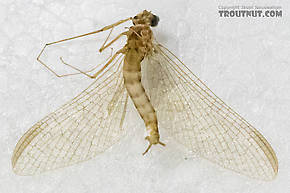 View 4 PicturesThis one was preserved in ethanol and partially dissected, so it doesn't have its natural wild coloration, and it's missing some appendages. I'm posting it for identification purposes.
View 4 PicturesThis one was preserved in ethanol and partially dissected, so it doesn't have its natural wild coloration, and it's missing some appendages. I'm posting it for identification purposes.Male Cinygmula ramaleyi (Small Western Gordon Quill) Mayfly Adult
View 4 PicturesAdults were collected from the North Fork of the Touchet River at Touchet Corral, 21 Sept. One photo is the swarm of males over the stream about 3 PM, air temp about 66 degree.
View 4 PicturesAdults were collected from the North Fork of the Touchet River at Touchet Corral, 21 Sept. One photo is the swarm of males over the stream about 3 PM, air temp about 66 degree.See 5 more specimens...
Mayfly Species Rhithrogena undulata
These are very rarely called Dark Red Quills.
This is one of the two most common species of Rhithrogena.
Male Rhithrogena undulata (Small Western Red Quill) Mayfly Spinner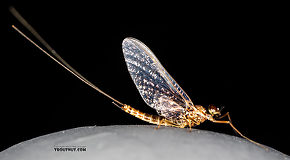 View 13 PicturesThis male was collected at the same time as this female and is likely the same species.
It keys pretty clearly to Rhithrogena undulata using the key in Traver 1935, although the size is larger than expected for that species in that source.
View 13 PicturesThis male was collected at the same time as this female and is likely the same species.It keys pretty clearly to Rhithrogena undulata using the key in Traver 1935, although the size is larger than expected for that species in that source.
See 1 more specimens...
Top 10 Fly Hatches
 Baetis
 Baetidae
 Ephemerellidae
 Hexagenia limbata
 Chironomidae
 Ephemerella subvaria
 Heptageniidae
 Ephemerella
 Isonychia
 Hydropsychidae
Top Gift Shop Designs
 I outfish my daddy!
 Electric blue Hendrickson dun.
 I love buggers. Big, green, wooly ones.
 I outfish my husband!
 Be the trout.
 Eat mayflies.
Top Insect Specimens
 Baetisca obesa Mayfly Nymph
 Corydalus Hellgrammite Larva
 Neophylax Caddisfly Adult
 Pteronarcys biloba Stonefly Nymph
 Hydropsyche aenigma Caddisfly Adult
Miscellaneous Sites
Troutnut.com is copyright © 2004-2024 Jason
Neuswanger (email Jason). See my FAQ for information about use of my images.
 privacy policy
privacy policy