
Blog & Latest Updates
Fly Fishing Articles
Insects by Common Name


Tiny Sulphur Duns


Scientific Names
| Match | Scientific Name |
 | Anafroptilum |
| Cloeon |
| Procloeon |
| Procloeon venosum |
Like most common names, "Tiny Sulphur Dun" can refer to more than one taxon. They're previewed below, along with 4 specimens. For more detail click through to the scientific names.
Mayfly Genus Anafroptilum
These are pretty much always called Tiny Sulphur Duns.
These species were previously in Centroptilum, a genus no longer represented in North America.
They are closely related to the important European "Spur Wings", a name given them due to the hook on the leading edge of their hind wings. These very small mayflies are usually reported in this country as inhabiting water too warm and/or stagnant for trout but this is not always the case. Significant numbers have been reported in many cold water environments throughout the West. These tiny sulphurish mayflies are easy to confuse with small Pale Morning Duns which is perhaps the reason for their under-reporting by anglers. Their having only two tails is the easiest to way to tell the difference.
From an angling perspective, a downside of many taxonomic advances is the loss of what was thought to be the ability to use easily identifiable morphological differences for determining between genera. This is especially problematic in sorting out baetids. The truth is the old rule used by anglers involving the hindwings (i.e., spurwing - prev. Centroptilum, no wing - prev. Pseudocloeon, the rest - Baetis) has been dubious for years. They can no longer be applied as more has been learned about new genera and species properly reassigned. It is now recognized that some species of Anafroptilum and Baetis lack hindwings altogether.
They are closely related to the important European "Spur Wings", a name given them due to the hook on the leading edge of their hind wings. These very small mayflies are usually reported in this country as inhabiting water too warm and/or stagnant for trout but this is not always the case. Significant numbers have been reported in many cold water environments throughout the West. These tiny sulphurish mayflies are easy to confuse with small Pale Morning Duns which is perhaps the reason for their under-reporting by anglers. Their having only two tails is the easiest to way to tell the difference.
From an angling perspective, a downside of many taxonomic advances is the loss of what was thought to be the ability to use easily identifiable morphological differences for determining between genera. This is especially problematic in sorting out baetids. The truth is the old rule used by anglers involving the hindwings (i.e., spurwing - prev. Centroptilum, no wing - prev. Pseudocloeon, the rest - Baetis) has been dubious for years. They can no longer be applied as more has been learned about new genera and species properly reassigned. It is now recognized that some species of Anafroptilum and Baetis lack hindwings altogether.
Anafroptilum conturbatum (Tiny Sulphur Dun) Mayfly Nymph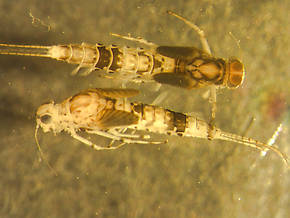 View 2 PicturesA moderately rare mayfly perhaps because the nymphs are fragile that nymphs are usually damaged in collection making identification more difficult.
View 2 PicturesA moderately rare mayfly perhaps because the nymphs are fragile that nymphs are usually damaged in collection making identification more difficult.Female Anafroptilum album (Tiny Sulphur Dun) Mayfly Dun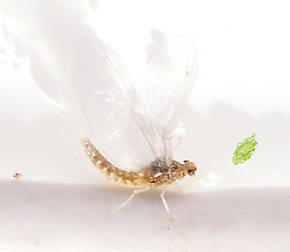 View 3 PicturesApprox. 5 mm. This is a very significant hatch. It is mostly seen at the height of Summer and I was very surprised to see it emerging this late in the season and in such numbers. When this one is emerging, the fish can become quite selective.
View 3 PicturesApprox. 5 mm. This is a very significant hatch. It is mostly seen at the height of Summer and I was very surprised to see it emerging this late in the season and in such numbers. When this one is emerging, the fish can become quite selective.Mayfly Genus Cloeon
These are pretty much always called Tiny Sulphur Duns.
Many relevant (although not outstanding) species were once classified in this genus, but entomologists recently found that they belong in the Procloeon genus instead. Only one insignficant species remains in the genus Cloeon in North America.
Mayfly Genus Procloeon
These are pretty much always called Tiny Sulphur Duns.
This genus is not well-known to fly fishers because most of its species were, until very recently, classified as either Centroptilum or Cloeon.
These mayflies may be abundant enough to cause fishable hatches in spite of their tiny size.
It's difficult to discern from previous angling literature exactly which statements now apply to Procloeon, because its species come from other little-known genera and the accounts for them conflict. They were mentioned in combination with other genera, adding to the confusion. So the information below is highly tentative and, where accounts seem to conflict, both have been given.
These mayflies may be abundant enough to cause fishable hatches in spite of their tiny size.
It's difficult to discern from previous angling literature exactly which statements now apply to Procloeon, because its species come from other little-known genera and the accounts for them conflict. They were mentioned in combination with other genera, adding to the confusion. So the information below is highly tentative and, where accounts seem to conflict, both have been given.
Procloeon pennulatum (Tiny Sulphur Dun) Mayfly Nymph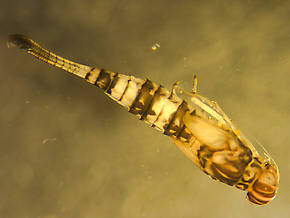 View 1 PicturesThis fragile nymph is easily damaged during sampling making identification more difficult.
View 1 PicturesThis fragile nymph is easily damaged during sampling making identification more difficult.Female Procloeon (Tiny Sulphur Duns) Mayfly Dun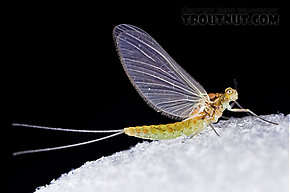 View 8 PicturesThis dun of a fairly large Baetidae species was one of only a couple I saw all evening.
View 8 PicturesThis dun of a fairly large Baetidae species was one of only a couple I saw all evening.Mayfly Species Procloeon venosum
These are pretty much always called Tiny Sulphur Duns.
This taxon can be found in large western rivers.
Top 10 Fly Hatches
 Baetis
 Baetidae
 Ephemerellidae
 Hexagenia limbata
 Chironomidae
 Heptageniidae
 Ephemerella subvaria
 Ephemerella
 Isonychia
 Hydropsychidae
Top Gift Shop Designs
 I outfish my daddy!
 Electric blue Hendrickson dun.
 I love buggers. Big, green, wooly ones.
 I outfish my husband!
 Be the trout.
 Eat mayflies.
Top Insect Specimens
 Baetisca obesa Mayfly Nymph
 Corydalus Hellgrammite Larva
 Neophylax Caddisfly Adult
 Rhyacophila fuscula Caddisfly Larva
 Pteronarcys biloba Stonefly Nymph
Miscellaneous Sites
Troutnut.com is copyright © 2004-2024 Jason
Neuswanger (email Jason). See my FAQ for information about use of my images.
 privacy policy
privacy policy