
Blog & Latest Updates
Fly Fishing Articles
Insects by Common Name


Rusty Spinners


This common name refers to only one genus.
Mayfly Genus Baetis
These are sometimes called Rusty Spinners.
This is one of the most prolific genera of mayflies in North American trout streams. Their small size permits the growth of up to three generations per year, and they are good dry-fly insects because they often hatch in impressive numbers and the duns ride the water for a long time before taking flight.
The genus Baetis and its species are probably the most misidentified mayflies in angling. Many who see mayflies too small to imitate with a size 16 Adams call them Baetis, especially if they're olive in coloration. In reality, Baetis (though the most prominent) is only one of several very similar and abundant genera in the family Baetidae. It seems species in the family are perpetually being reclassified, and identifying any of them, even to genus level is difficult. The angler who wants to describe what is seen streamside usually has only four choices:
1. Call them "Blue-Winged Olives" as most do. the problem is this name has lost all meaning due to being applied to dozens of species across several families (many of which have neither blue wings nor olive bodies). Besides, the name was originally coined for a species of British ephemerellid, the family where this common name should properly reside.
2. Call them "baetids", the Latin name for referring to members of the Baetidae family as a group. While technically accurate scientifically, it doesn't tell the listener or reader much about their appearance.
3. Call them outmoded scientific names - Even calling them by the updated name is usually risky for most species in the field. Adding to the difficulty by using names from outdated nomenclatures? Talk about confusion...
4. Call them "little (whatever color they are) quills." Perhaps this is the best choice as at least it's more accurately descriptive.
The fact is many are so similar that even alot of the specimens in the hatch pages can't be keyed below the family level with absolute certainty; at least from what's observable in the photos alone. They often require observation with a microscope and extensive knowledge of the subtle differences for accurate determinations. So - the next time a fishing buddy identifies a little olive mayfly from a distance using an obsolete name like Baetis vagans, just smile and nod...
For anglers raised on Schwiebert, Swisher, etc., it is often difficult to locate many important species in the newer literature. When working with older taxonomies and/or angling texts, the following hatch page links may prove helpful:
Baetis devinctus = Diphetor hageni (can be an important eastern species)
Baetis hiemalis = Baetis brunneicolor (important Midwest species with a national distribution)
Baetis insignificans = Acentrella insignificans (can be important in some western locales)
Baetis parvus = Diphetor hageni (very important western species)
Baetis propinquus = Labiobaetis propinquus (important in the West with a national distribution)
Baetis pygmaeus = Acerpenna pygmaea (can be important with distribution across all regions)
Baetis vagans = Baetis tricaudatus (most abundant and important species nationwide)
The relatively new genus Fallceon has two species of interest that are made up of several previous Baetis species. They are distributed nationally and may prove significant as more is learned about the angling opportunities they present, especially in the the South and Southwest.
The genus Baetis and its species are probably the most misidentified mayflies in angling. Many who see mayflies too small to imitate with a size 16 Adams call them Baetis, especially if they're olive in coloration. In reality, Baetis (though the most prominent) is only one of several very similar and abundant genera in the family Baetidae. It seems species in the family are perpetually being reclassified, and identifying any of them, even to genus level is difficult. The angler who wants to describe what is seen streamside usually has only four choices:
1. Call them "Blue-Winged Olives" as most do. the problem is this name has lost all meaning due to being applied to dozens of species across several families (many of which have neither blue wings nor olive bodies). Besides, the name was originally coined for a species of British ephemerellid, the family where this common name should properly reside.
2. Call them "baetids", the Latin name for referring to members of the Baetidae family as a group. While technically accurate scientifically, it doesn't tell the listener or reader much about their appearance.
3. Call them outmoded scientific names - Even calling them by the updated name is usually risky for most species in the field. Adding to the difficulty by using names from outdated nomenclatures? Talk about confusion...
4. Call them "little (whatever color they are) quills." Perhaps this is the best choice as at least it's more accurately descriptive.
The fact is many are so similar that even alot of the specimens in the hatch pages can't be keyed below the family level with absolute certainty; at least from what's observable in the photos alone. They often require observation with a microscope and extensive knowledge of the subtle differences for accurate determinations. So - the next time a fishing buddy identifies a little olive mayfly from a distance using an obsolete name like Baetis vagans, just smile and nod...
For anglers raised on Schwiebert, Swisher, etc., it is often difficult to locate many important species in the newer literature. When working with older taxonomies and/or angling texts, the following hatch page links may prove helpful:
Baetis devinctus = Diphetor hageni (can be an important eastern species)
Baetis hiemalis = Baetis brunneicolor (important Midwest species with a national distribution)
Baetis insignificans = Acentrella insignificans (can be important in some western locales)
Baetis parvus = Diphetor hageni (very important western species)
Baetis propinquus = Labiobaetis propinquus (important in the West with a national distribution)
Baetis pygmaeus = Acerpenna pygmaea (can be important with distribution across all regions)
Baetis vagans = Baetis tricaudatus (most abundant and important species nationwide)
The relatively new genus Fallceon has two species of interest that are made up of several previous Baetis species. They are distributed nationally and may prove significant as more is learned about the angling opportunities they present, especially in the the South and Southwest.
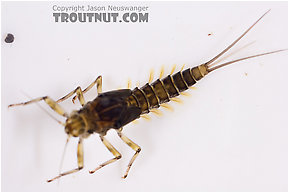
Male Baetis (Blue-Winged Olives) Mayfly Dun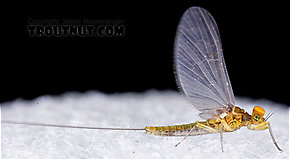 View 14 PicturesThis dun molted most of the way into a spinner (though the wings got stuck) the evening after I photographed it, so I took some more photos of the spinner.
I found a female nearby, probably of the same species.
View 14 PicturesThis dun molted most of the way into a spinner (though the wings got stuck) the evening after I photographed it, so I took some more photos of the spinner.I found a female nearby, probably of the same species.
Female Baetis (Blue-Winged Olives) Mayfly Spinner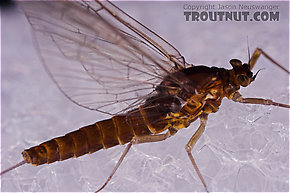 View 4 PicturesI captured and photographed this specimen as a dun before she molted into the spinner photographed here. Her wings got a bit torn up in the process.
View 4 PicturesI captured and photographed this specimen as a dun before she molted into the spinner photographed here. Her wings got a bit torn up in the process.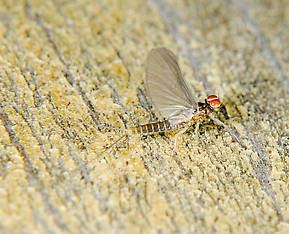
See 28 more specimens...
Top 10 Fly Hatches
 Baetis
 Baetidae
 Ephemerellidae
 Hexagenia limbata
 Chironomidae
 Heptageniidae
 Ephemerella subvaria
 Ephemerella
 Isonychia
 Hydropsychidae
Top Gift Shop Designs
 I outfish my daddy!
 Electric blue Hendrickson dun.
 I love buggers. Big, green, wooly ones.
 I outfish my husband!
 Be the trout.
 Eat mayflies.
Top Insect Specimens
 Baetisca obesa Mayfly Nymph
 Corydalus Hellgrammite Larva
 Neophylax Caddisfly Adult
 Rhyacophila fuscula Caddisfly Larva
 Pteronarcys biloba Stonefly Nymph
Miscellaneous Sites
Troutnut.com is copyright © 2004-2024 Jason
Neuswanger (email Jason). See my FAQ for information about use of my images.
 privacy policy
privacy policy