
Blog & Latest Updates
Fly Fishing Articles
Insects by Common Name


Gray-Winged Brown Quills


Scientific Names
| Match | Scientific Name |
 | Baetis intercalaris |
| Acentrella turbida |
Like most common names, "Gray-Winged Brown Quill" can refer to more than one taxon. They're previewed below, along with 1 specimen. For more detail click through to the scientific names.
Mayfly Species Baetis intercalaris
These are very rarely called Gray-Winged Brown Quills.
Mayfly Species Acentrella turbida
These are very rarely called Gray-Winged Brown Quills.
These tiny mayflies were once known by the names Pseudocloeon carolina in the East and Pseudocloeon turbidum in the West. They are now considered synonymous. With the new species name turbida, these mayflies were also moved to the genus Acentrella. The combining of these two species has made turbida's distribution trans-continental. In places their numbers compensate for their small size and make for excellent hatches.
In the West, turbida is more variable in size and appearance than its eastern iteration, in keeping with the large and varied regions it inhabits. It can run as small as 3.5 mm and as large as 5 mm, the larger sizes tending to be more brownish. It is often confused with the smaller broods of Diphetor hageni, but its conical mesonotal projection (Conical mesonotal projection: small cone shaped spike sticking up from the top and front part of the middle thorax segment.), lack of hind-wings, exaggerated turbinate (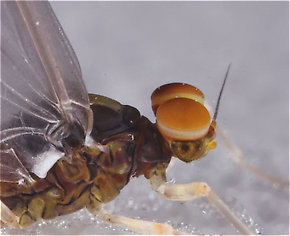 Turbinate: Shaped like a top or elevated on a stalk; usually refers to the eyes of some adult male Baetidae mayflies which are wider near the tip than at the base.) eyes (hence its name) and stockier build help to differentiate it.
They are often found on the water with a mix of other Baetidae mayflies, making for very challenging fishing.
In the West, turbida is more variable in size and appearance than its eastern iteration, in keeping with the large and varied regions it inhabits. It can run as small as 3.5 mm and as large as 5 mm, the larger sizes tending to be more brownish. It is often confused with the smaller broods of Diphetor hageni, but its conical mesonotal projection (Conical mesonotal projection: small cone shaped spike sticking up from the top and front part of the middle thorax segment.), lack of hind-wings, exaggerated turbinate (
This male Baetidae dun has slightly turbinate eyes.
They are often found on the water with a mix of other Baetidae mayflies, making for very challenging fishing.
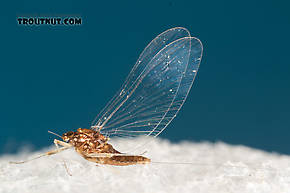
See 3 more specimens...
Jargon Defined:
Broods: When a species produces more than one generation per year, each one is called a brood.
Conical mesonotal projection: small cone shaped spike sticking up from the top and front part of the middle thorax segment.
Top 10 Fly Hatches
 Baetis
 Baetidae
 Ephemerellidae
 Hexagenia limbata
 Chironomidae
 Heptageniidae
 Ephemerella subvaria
 Ephemerella
 Isonychia
 Hydropsychidae
Top Gift Shop Designs
 I outfish my daddy!
 Electric blue Hendrickson dun.
 I love buggers. Big, green, wooly ones.
 I outfish my husband!
 Be the trout.
 Eat mayflies.
Top Insect Specimens
 Baetisca obesa Mayfly Nymph
 Corydalus Hellgrammite Larva
 Neophylax Caddisfly Adult
 Pteronarcys biloba Stonefly Nymph
 Rhyacophila fuscula Caddisfly Larva
Miscellaneous Sites
Troutnut.com is copyright © 2004-2024 Jason
Neuswanger (email Jason). See my FAQ for information about use of my images.
 privacy policy
privacy policy